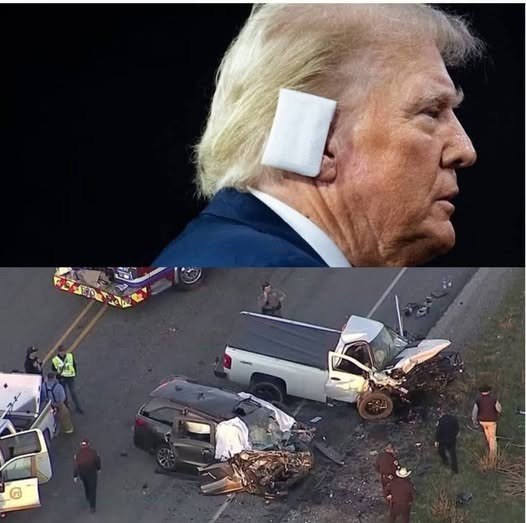
American history carries a persistent, unnerving pattern: whenever violence edges near the presidency, it exposes the fragility of power, the intensity of symbolism, and the precarious balance that sustains national stability. Assassination attempts are rarely isolated incidents. Instead, they emerge as recurring events, reflecting not just the personal danger faced by an individual leader but the broader anxieties of the country itself. That thread resurfaced sharply on September 15, 2024, when former president Donald Trump narrowly survived what authorities described as a second assassination attempt. The incident immediately drew comparisons to a lineage of attacks that have punctuated the nation’s history, underscoring how the office of the presidency exists both as a symbol of authority and as a focal point for social and political tensions.
Trump’s brush with mortal danger placed him among a surprisingly long list of presidential figures who have faced direct threats. Since the founding of the United States, forty-five men have held the office, and nearly forty percent of them have been targeted by assassination attempts. Four presidents—Abraham Lincoln, James A. Garfield, William McKinley, and John F. Kennedy—were killed in office, a grim reminder that the risk is neither theoretical nor historical curiosity. The stark reality is that the threat of violence against the presidency is a structural part of the American story, one that has repeatedly tested both individual leaders and the nation’s institutions.
The presidency is far more than a political position. It is a living symbol, embodying hope, fear, and the unresolved tensions of a nation. Supporters project stability, progress, and protection onto the office, while opponents often see in it the embodiment of frustration, anger, or systemic oppression. In this sense, attacks on presidents are rarely directed solely at an individual; they are acts aimed at the idea of authority itself, a manifestation of collective unease or ideological fervor. This dual nature of the presidency—as both human and symbolic—makes it uniquely vulnerable, amplifying every threat beyond personal harm to touch the very identity of the nation.
Trump’s recent experiences illustrate this reality vividly. In 2024, his Secret Service detail responded to a major security threat at his Florida golf course, exchanging gunfire with an armed suspect. Earlier, a shooting at a Pennsylvania rally targeted him directly, leaving multiple attendees injured and reigniting debates over campaign security. Though he survived both incidents physically unharmed, the symbolism could not be ignored: a former president, still polarizing and deeply present in national discourse, remained a target even outside the White House, even after leaving office. These events remind us that in modern America, the presidency—or its former holders—is both a magnet for devotion and a lightning rod for grievance.
Historical patterns reinforce this perspective. Firearms have consistently been the weapon of choice in assassination attempts, highlighting both the accessibility of violence and the particular cultural context of American political aggression. Nearly all assailants have been men, with only two documented female attempts against Gerald Ford in 1975. Motives range widely, encompassing political extremism, personal delusion, and ideological obsession, yet the methods and underlying symbolism persist, revealing the enduring vulnerability inherent in concentrated authority.
The earliest and most consequential presidential assassination was Abraham Lincoln’s murder in April 1865 by John Wilkes Booth. This act was far from isolated; it was part of a broader conspiracy aimed at destabilizing the federal government in the immediate aftermath of the Civil War. That night, Secretary of State William H. Seward was brutally attacked but survived, and a third conspirator failed to carry out plans against Vice President Andrew Johnson. The intent was explicit: chaos. The broader goal was to fracture a Union already strained by internal conflict, demonstrating how political violence can intersect with moments of national vulnerability.
This pattern recurred in subsequent decades. In 1881, James A. Garfield was shot by Charles Guiteau, a disgruntled office seeker who believed the act would elevate his own importance and influence. Garfield lingered for weeks before succumbing to his injuries, highlighting both the human cost of political fanaticism and the limitations of contemporary medical care. Two decades later, President William McKinley was assassinated by anarchist Leon Czolgosz, who viewed McKinley as a symbol of oppressive authority, reflecting ideological fractures in early twentieth-century America. These attacks reveal how national anxiety often manifests in the targeting of the presidency as a symbolic point of failure or rebellion.
The twentieth century brought both continuity and amplification. John F. Kennedy’s assassination in 1963, in Dallas, embedded a permanent sense of vulnerability into American consciousness. The televised aftermath, the unresolved questions, and the international shock ensured that Kennedy’s death would resonate across generations. Similarly, survival narratives became defining moments in their own right. Gerald Ford survived two separate assassination attempts in 1975, both within a mere seventeen days. The first, by Lynette Fromme, a follower of Charles Manson, was thwarted when the firearm malfunctioned; the second, by Sara Jane Moore, was interrupted by bystander Oliver Sipple. These incidents underscored the razor-thin margin between ordinary public appearances and catastrophe, emphasizing the randomness and intensity of threats faced by leaders.
Ronald Reagan’s near-fatal shooting in 1981 added another layer to the narrative. John Hinckley Jr., motivated by obsession with actress Jodie Foster, targeted the president, with the bullet puncturing Reagan’s lung after striking the presidential limousine. Reagan’s survival, coupled with his composed demeanor and humor in the hospital, reinforced a narrative of resilience, showing the nation that leadership could endure—even in moments of extreme personal danger.
Trump’s experience adds a distinctly modern dimension to this long historical lineage. Both assailants in the 2024 attempts were reportedly former supporters who had grown disillusioned, reflecting the heightened political polarization of contemporary America. In an era defined by digital radicalization, instantaneous misinformation, and performative outrage, the symbolic weight of political figures has intensified. Presidents and ex-presidents are no longer remote figures confined to history books or formal appearances; they are daily presences in private digital spheres, increasing both their accessibility and exposure.
Modern security protocols are more sophisticated than ever but face unprecedented challenges. Open-air events, mass communication, and lone actors driven by fragmented ideological motives complicate prevention. The Secret Service’s response to Trump’s Florida incident likely averted a national disaster, yet it also illuminated how quickly threats can materialize in a society saturated with both technology and political tension.
Each assassination attempt, past and present, is not simply an isolated incident but a reflection of social fractures where political grievance, mental instability, and access to firearms converge. They force the nation to confront uncomfortable truths about its volatility while simultaneously testing institutional resilience. Yet alongside violence runs another theme: endurance. Following every attack, the machinery of government has persisted. Courts, Congress, and civil society have absorbed shocks and continued to function. Heroic acts—by doctors, by bystanders, by security personnel—have repeatedly prevented chaos from morphing into collapse.
Trump’s survival, like Reagan’s and Ford’s before him, reinforces a historical lesson: the presidency operates within a constant tension between vulnerability and resilience. The office evokes both reverence and rage, adoration and opposition. This duality is enduring, a structural aspect of American governance and national identity. Threats may come, violence may manifest, yet the core institutions and symbolism of the presidency continue to endure.