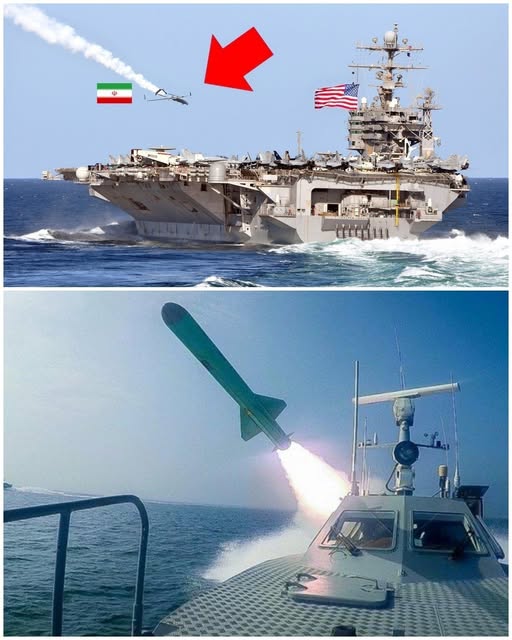
When Iran’s Revolutionary Guard released footage showing a swarm of drones striking a mock target shaped like the USS Abraham Lincoln, the message was clear. Inexpensive, mass-produced drones overwhelming one of the world’s most costly naval assets. Quantity defeating quality. The video was not only aimed at a domestic audience in Tehran, but also at Washington and naval strategists monitoring the Strait of Hormuz.
However, propaganda videos simplify warfare. Real combat is far less dramatic and far more complex.
If Iran attempted to carry out such an attack in reality, it would likely start with surveillance and gradual escalation rather than an immediate mass strike. Launch positions along the coast near Bandar Abbas could activate sequentially. One-way attack drones, similar to the Shahed-136, might take off in staggered waves, following pre-programmed GPS routes toward a carrier strike group operating in or near the Persian Gulf.
These drones are not advanced autonomous systems. They mainly rely on satellite navigation and predetermined target coordinates. Once launched, they cannot easily change course to avoid defenses or adapt to electronic interference. Their main advantage lies in their low cost and the ability to deploy them in large numbers.
Detection would occur long before the drones reached visual range.
An E-2D Hawkeye airborne early-warning aircraft flying high above the fleet could detect incoming targets at significant distances. Its AN/APY-9 radar is designed to track small, low-flying objects even in complicated environments. The information is shared across Cooperative Engagement Capability networks, creating a unified sensor picture for the entire strike group.
In practical terms, this allows a destroyer dozens of miles away to fire using data collected by another platform. The carrier strike group therefore operates less like separate ships and more like a single, integrated combat system.
The first defensive responses would likely involve layered conventional weapons. Naval guns firing proximity-fused ammunition can effectively destroy slow aerial targets. Close-in weapon systems such as the Phalanx are built to eliminate threats within a few kilometers of a ship. Rolling Airframe Missiles and Standard Missiles extend that defensive shield much farther from the fleet.
Critics often highlight the cost imbalance in missile defense: interceptors costing millions of dollars compared with drones that may cost only tens of thousands. This imbalance has influenced Iran’s drone strategy, which focuses on overwhelming defenses through saturation and forcing defenders to expend large numbers of expensive missiles.
Yet missile inventories are no longer the only factor.
In recent years, the U.S. Navy has tested directed-energy technologies, including laser and high-power microwave systems, specifically designed to counter drone swarms. Unlike traditional weapons, these systems do not rely on physical ammunition. Instead, they draw power directly from a ship’s onboard energy systems.
High-power microwave weapons can disable or destroy electronic components by flooding circuits with electromagnetic energy. Rather than blowing up a drone, they can disrupt its guidance or control systems, causing it to lose stability and crash.
If deployed widely, such systems could significantly change the economic balance. Instead of firing a missile at every incoming drone, a destroyer might neutralize multiple targets during a single engagement cycle, limited mainly by power generation and heat management rather than ammunition supply.
That does not mean conventional weapons become unnecessary. Directed-energy systems still rely on accurate targeting data. Low-flying drones moving close to sea clutter can complicate radar detection. Environmental conditions, engagement geometry, and coordination with friendly interceptors also create operational constraints.
For example, a microwave beam does not distinguish between hostile and friendly electronics. If a defensive missile passed through an active microwave sector at the wrong moment, timing would be critical. Modern Aegis combat systems help manage these situations automatically, calculating safe engagement windows in milliseconds.
The most challenging scenario for any naval force is not a single drone wave but a combined attack.
Iranian doctrine emphasizes multi-layered pressure: drones to saturate defenses, anti-ship ballistic missiles to trigger interceptor launches, and fast attack boats armed with cruise missiles to exploit any openings. These coordinated assaults aim to overwhelm commanders and create timing conflicts between defensive systems.
Against ballistic threats such as the Khalij Fars anti-ship missile, traditional interceptors remain essential. Directed energy cannot replace every layer of defense. Standard Missiles would still be required for high-altitude intercepts to protect the carrier and its escort ships.
At the same time, helicopters like the MH-60R Seahawk would handle surface threats, using precision weapons to stop fast attack boats before they could launch cruise missiles.
All of these systems must operate together in carefully timed coordination. Sensors track targets, algorithms assign engagement zones, and defensive actions occur within fractions of a second. Human commanders oversee the battle, but automated systems perform calculations that would be impossible for people to handle in real time.
In this environment, the cost imbalance begins to change.
A drone swarm that once threatened to exhaust missile supplies might instead expose its own launch infrastructure. Every radar activation, every opened shelter door, and every telemetry transmission generates detectable signals. An E-2D Hawkeye flying above electronic interference layers can locate these emissions with high precision.
The immediate tactical outcome—how many drones are destroyed—may matter less than the strategic information gained. If a carrier strike group preserves most of its missiles while mapping the enemy’s coastal network, the balance of deterrence shifts.
This is a frequently overlooked aspect of modern naval warfare: defense and reconnaissance are closely connected. Attempting an attack can reveal critical infrastructure.
Of course, no system guarantees complete protection. Thermal limits, radar blind spots, environmental interference, and sheer numbers remain challenges. A determined adversary can adapt tactics, change flight profiles, introduce electronic warfare, or combine cyber operations with physical attacks.
Still, the assumption that inexpensive drones will automatically overwhelm advanced navies relies on the idea that defenses remain unchanged. Naval warfare continues to evolve.
If directed-energy systems become widely operational, they could mark a major doctrinal shift. Defensive capacity would depend less on missile stockpiles and more on electrical power and energy management. This would weaken the economic logic behind saturation strategies.
For Iran, propaganda footage portrays confidence: swarms of drones converging on a symbolic target. For the U.S. Navy, the response would likely be far less dramatic and far more methodical.
Long-range detection. Layered defense. Automated coordination. Selective use of interceptors. Directed energy against high-volume threats. Aviation assets handling surface targets. And above all, information superiority.
In a real confrontation, the most important outcome might not be how many drones are destroyed, but what infrastructure becomes visible in the process.
Today, naval power is not defined only by the size of an aircraft carrier or the range of a missile. It depends on how effectively sensors, networks, and weapons operate together under pressure.
Drone swarms test that integration.