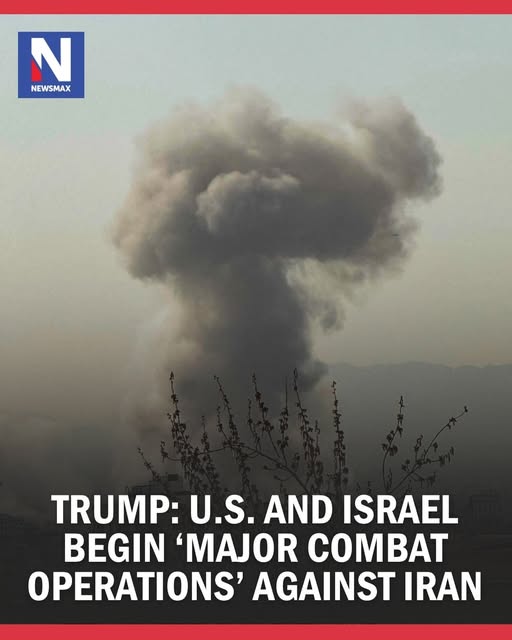
The United States and Israel launched a major military assault on Iran on Saturday, with U.S. President Donald Trump urging Iranians to “seize control of your destiny” and rise up against the Islamic leadership that has governed the country since 1979. The strikes represent a significant escalation in tensions between the long-standing adversaries.
Initial attacks appeared to target areas near the offices of Supreme Leader Ali Khamenei in Tehran. Iranian media reported strikes across multiple cities, with smoke visible over the capital. It was not immediately known whether the 86-year-old leader was present during the initial bombardment. Witnesses described explosions near key government buildings, causing panic and chaos in central Tehran.
In a video addressing the Iranian people, Trump described the operation as “major combat operations” and urged citizens to take control of their government once the military action concluded. “When we are finished, take over your government. It will be yours to take,” he said, adding that this may be the Iranians’ “only chance for generations.” He claimed that the Iranian people had long sought U.S. support but had received none.
Israeli Prime Minister Benjamin Netanyahu echoed Trump’s message, stating that the joint operation would create conditions for the Iranian people to determine their own future. Both leaders emphasized the strategic objective of curbing Iran’s military capabilities and influence in the region.
The assault marked the second major use of force against Iran by the Trump administration within eight months. It followed a separate operation earlier in the year, in which Trump ordered a mission to capture Venezuelan President Nicolás Maduro to face U.S. federal drug conspiracy charges in New York.
Tensions had been rising for weeks as U.S. naval forces deployed to the region and Trump pressed for agreements to limit Iran’s nuclear program. Domestically, Iran had seen widespread unrest due to nationwide protests, creating a volatile environment.
Iran responded rapidly to the strikes. Waves of missiles and drones were launched toward Israel, and U.S. military facilities in Bahrain, Kuwait, and Qatar were targeted. In response, the United Arab Emirates and Iraq closed their airspace as a precautionary measure.
Iran’s Foreign Ministry condemned the attacks as acts of aggression, declaring that it would “not hesitate” to defend its homeland. State media broadcast images of damaged buildings and crowds gathering in protest, while senior officials warned that retaliation could follow swiftly.
According to Iran’s state-run IRNA news agency, five students were killed at a girls’ school in southern Iran during the strikes. In the United Arab Emirates, state media reported that shrapnel from an Iranian missile attack killed one person in the capital.
Israel described the operation as a broad, coordinated campaign against Iran’s ruling regime, planned over several months in close collaboration with the United States. Trump defended the attacks, citing Iran’s nuclear ambitions and missile development, which he claimed could threaten the U.S. He acknowledged that American casualties were possible, saying such losses “often happen in war.”
The rationale contrasted with Trump’s previous “America First” pledges to avoid prolonged foreign conflicts. In his address, he referred to grievances dating back to the 1979 Iranian revolution, which transformed Iran from a close U.S. ally into a long-term adversary.
Trump said the goal was to “annihilate” Iran’s navy and dismantle regional proxy forces backed by Tehran. He called on members of Iran’s Revolutionary Guard to surrender, offering immunity to those who complied and warning of “certain death” for those who resisted.
While Iran has stated that it has not enriched uranium since June, it has barred international inspectors from visiting certain sites affected in a prior 12-day conflict. Satellite imagery analyzed by The Associated Press indicated renewed activity at two of these facilities. Tehran currently limits its ballistic missiles to a 2,000-kilometer range, placing much of the Middle East and parts of Eastern Europe within reach. No public evidence exists that Iran is developing intercontinental ballistic missiles, though Washington has expressed concerns about its space program potentially advancing that capability.
Iran maintains that it wants to avoid a full-scale war but insists on its right to uranium enrichment and refuses to negotiate over its missile program or support for armed groups such as Hamas and Hezbollah. Analysts warn that the conflict could disrupt global markets, particularly if Iran restricts shipping through the Strait of Hormuz, a crucial oil transit route that handled more than 14 million barrels per day — roughly a third of seaborne global oil exports in 2025.
Across Iran, outlets reported strikes in multiple cities. Roads leading to Khamenei’s compound were sealed off, and additional explosions were reported in central Tehran. The supreme leader had not appeared publicly in recent days and was not immediately seen following the attacks. During the previous 12-day conflict in June, he had reportedly been relocated to a secure location away from his compound.
Eyewitnesses in Tehran described a powerful initial blast near Khamenei’s office. State television confirmed the explosion but did not provide details about its cause. Additional explosions were reported as Israel continued strikes against Iranian targets. Authorities have not yet released comprehensive casualty figures.
An official familiar with the operation said that Israeli targets included Iranian military assets, intelligence facilities, and government symbols. Hours after the initial strikes, Iran’s paramilitary Revolutionary Guard announced a “first wave” of drones and missiles targeting Israel. Israeli authorities issued nationwide alerts as defense systems attempted to intercept incoming projectiles. No immediate reports of casualties or damage were confirmed.
In Bahrain, a missile targeted the U.S. Navy’s Fifth Fleet headquarters. Sirens and explosions were also reported in Kuwait, home to U.S. Army Central, and in Qatar. Iraq and the UAE closed their airspace, while warning sirens were activated in Jordan.
Iran-backed Houthi officials in Yemen declared intentions to resume attacks on Red Sea shipping and Israel, although no formal announcement was made by the group’s leadership. U.S. diplomatic missions in Qatar, the UAE, and Israel advised staff to shelter in place and urged American citizens to do the same until further notice.
The situation remains highly volatile, with potential for rapid escalation as both sides continue military operations and issue strong warnings. Global powers are monitoring closely, urging restraint and attempting to prevent the conflict from spiraling into a wider regional war.