The debate between McCormick & Company and Watkins Inc. over pepper packaging may seem like a trivial matter at first, but it has sparked a much larger conversation about transparency, marketing strategies, and consumer trust in the spice industry. What began as a dispute over container size has evolved into a discussion about how brands influence consumer perceptions well before shoppers even read a label.
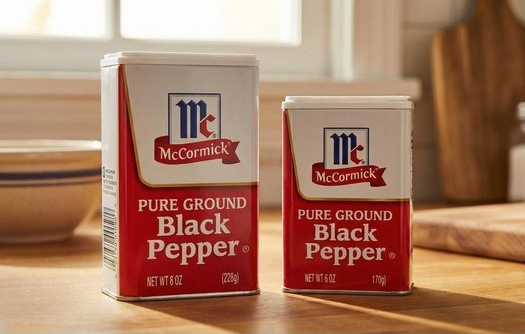
The issue first emerged when reports revealed that McCormick’s classic pepper tins — long a staple in American kitchens — appeared to be holding less product than before. For years, consumers were used to seeing around 8 ounces of pepper inside those recognizable red-and-white tins. Recently, however, that amount had dropped closer to 6 ounces. In an industry where packaging rarely changes visibly, this shift drew attention not only from customers but also from competitors.
Watkins Inc., a well-regarded spice company known for its emphasis on clear packaging and minimalist design, publicly raised concerns. Their issue wasn’t just with the quantity; it was also with how the product was presented. Watkins argued that McCormick’s redesigned tins could create the illusion of unchanged volume, despite the reduced amount. Since McCormick uses opaque tins, shoppers can’t actually see the pepper inside and must rely entirely on the container’s shape and the printed weight on the label.
McCormick responded by standing firm, asserting that all of their containers display the net weight clearly and meet all regulatory requirements. From their perspective, no deception was involved since the necessary information was provided — clearly marked, in accordance with industry standards, and legally compliant. As long as the label shows the correct weight, McCormick believes consumers have everything they need to make an informed choice.
However, Watkins maintained that visual context is just as important as printed information. Their products are packaged in transparent containers, allowing customers to see exactly how much they’re getting. When two competing brands appear side by side — one opaque and larger, the other smaller but visibly full — it’s easy to see how confusion could arise. Watkins argued that packaging design plays a key role in shaping consumer expectations, whether companies like McCormick admit it or not.
This disagreement has led to a broader conversation, particularly among shoppers who are increasingly skeptical about packaging practices throughout the food industry. Many consumers express uncertainty about how much product they’re truly receiving when the container size appears unchanged but the contents have shrunk. The term “shrinkflation” has become a familiar one when discussing food and household items, and spices are no exception. Customers notice when jars feel lighter, when they run out more quickly, or when trusted brands make subtle adjustments to quantities without altering the overall look of the packaging.
At the same time, McCormick emphasizes that their labeling provides full transparency. They argue that it is ultimately the consumer’s responsibility to check the net weight, which is displayed on every package. Without this standard, comparing products would be nearly impossible. From McCormick’s perspective, the debate is more about market positioning than honesty. They suggest that Watkins is using the controversy to draw attention to its own packaging style rather than addressing the broader issues affecting producers, such as ingredient costs, supply chain pressures, and inflation.
But consumers are not only concerned about cost; they are worried about trust. And trust, once broken, is fragile. Once shoppers feel misled — even unintentionally — their confidence in a brand can quickly diminish. Some customers have even raised concerns through legal channels, with cases currently under review in federal courts. While no rulings have been issued yet, the very existence of these cases shows how seriously people take transparency in everyday products.
This conversation is complicated further by the need for companies to balance clarity with marketing. Packaging is not just a container; it’s an identity. McCormick’s iconic tin is an integral part of its brand legacy, and any drastic change risks losing recognition that has been built up over generations. On the other hand, Watkins emphasizes transparency — quite literally — as part of their commitment to consumers. Neither approach is inherently wrong, but they appeal to different consumer expectations.
This debate also exposes an uncomfortable truth: many shoppers rely more on visual cues than on printed details. A container that looks the same as it did the previous year encourages assumptions — even if the label says otherwise. This mismatch between perception and reality is at the heart of the controversy. It’s not about accusing brands of dishonesty; it’s about understanding how packaging shapes psychological expectations.
As the discussion unfolds, one lesson stands clear: honesty isn’t just about providing facts. It’s about anticipating how those facts are interpreted. When people feel misled — even unintentionally — they scrutinize every detail more closely. They compare brands, talk to other shoppers, and question whether the companies they trusted still deserve their loyalty.
On the other hand, when companies consistently demonstrate transparency, they build consumer loyalty. Clear communication fosters trust. Thoughtful design strengthens credibility. These choices matter, especially in a market where many brands compete for the same space on grocery store shelves.
The situation between McCormick and Watkins highlights a bigger issue than just pepper packaging. It underscores how even small details — a few ounces of spice, a tin that looks familiar, a clear container showing exactly what’s inside — can spark important discussions about value, honesty, and corporate responsibility. Ultimately, consumers want to know they’re getting what they paid for. They want packaging that reflects reality, not just branding.
For consumers, this case encourages a closer look at product labels, net weights, and the subtle cues that influence perceptions. For companies, it’s a reminder that trust must be earned continuously, not assumed. In a competitive industry, transparency isn’t just good ethics; it’s good business.
As legal reviews progress and public discussion continues, one truth remains clear: trust is one of the most valuable assets any brand can have. Losing it is easy. Regaining it is not. And preserving it requires ongoing transparency, honesty, and a commitment to meeting consumers where they truly are — not where marketing hopes they’ll be.