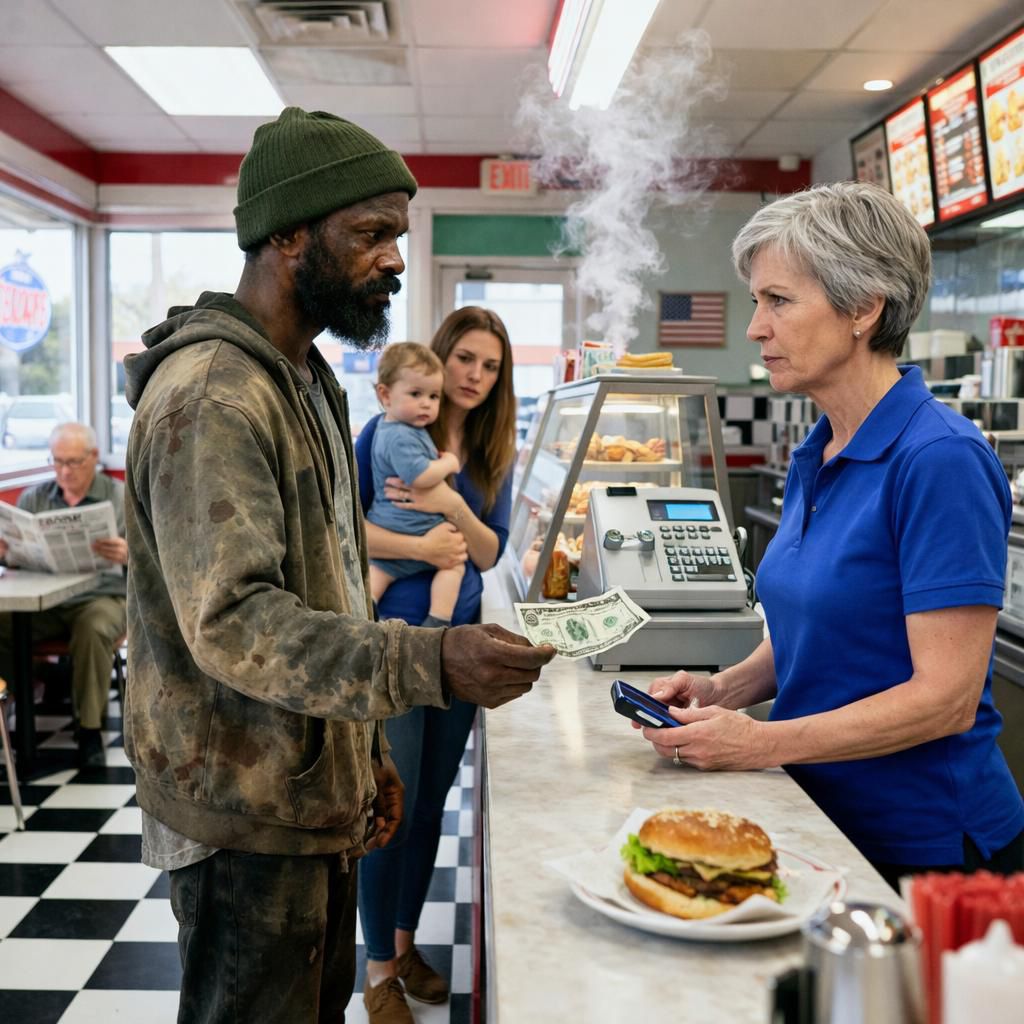
Downtown Springfield always began its day with a measured, predictable rhythm, the kind that made the city feel alive yet reassuringly constant. The hum of morning traffic on Main Street provided a steady bassline to the percussive hiss of city buses and the rapid, rhythmic footfalls of office workers clutching lukewarm lattes. The scent of asphalt warmed by the early sun mingled with the faint aroma of bakery bread wafting from corner shops, creating a sensory symphony that heralded the start of another ordinary day. Amidst this metropolitan awakening stood Carter’s Diner, a local institution whose very walls seemed to breathe comfort and familiarity. Its red vinyl booths were worn to a soft patina, a tactile memory of generations past, and the scent of bacon grease and toasted sourdough had long since permeated every inch of the place. To the casual observer, it was merely a place to eat; to the regulars, it was a sanctuary, a refuge where the world’s jagged edges felt just a little softer, and where the daily grind could be momentarily suspended.
Michael Carter, the man whose name adorned the neon sign flickering outside, had built this empire from a single, struggling roadside stop, laboring at the grill for years, earning every scar on his hands and every dollar in his bank account. Now, overseeing seven flourishing locations from a polished executive suite thirty miles away, he confronted a subtle yet gnawing disconnect. The spreadsheets glowed with favorable reviews, yet the flagship Springfield location was hemorrhaging profit in a way he could not quantify. Worse, the veterans who had formed the diner’s soul—the men and women who had kept its heart beating through decades of economic cycles and culinary trends—were vanishing, replaced by a transient staff that lacked the unmistakable “Carter touch.”
As he stared at the cold data projected across his glass office, Michael felt the distance between himself and his creation like a physical weight pressing against his chest. Restaurants do not live or die on numbers alone; they survive on the pulse, the energy, the care of the people within them. To find the truth, he realized, he could not arrive as the benefactor in a tailored suit. He had to return as a ghost.
The transformation was painstaking. Michael traded his bespoke wardrobe for scuffed boots, faded jeans, and a weathered flannel shirt. He capped the disguise with a construction company hat pulled low over his eyes, practicing a slower, heavier gait until his movements felt convincingly ordinary. When he finally stepped through the chime-adorned doors of his own diner, the brass handle felt foreign in his grip. Visually, the interior had changed little, but the atmosphere felt thin, hollowed of the warmth that once flowed naturally. Efficiency remained, yes, but it had become a practiced, shallow performance, a shadow of the life it once carried.
Sliding onto a squeaky vinyl stool at the far end of the counter, Michael began to observe. His eyes were immediately drawn to the service window, where an older man with silver hair and stooped shoulders moved with measured, deliberate grace. Henry Lawson treated every dish as though it were sacred, every plate deserving his full attention. In a world that seemed to value speed over care, his movements were an act of quiet rebellion, a steadfast assertion of dignity.
Michael struck up a casual conversation with Megan, a young waitress whose attention barely rose above the frenzied pace of the morning rush. When he asked about the man in the back, her response was a sharp jab of ageism, dismissive and cruel. She labeled Henry a relic, someone who “got in the way,” suggesting he should have retired long ago. Michael watched Henry glide across the kitchen floor, anticipating the needs of customers and coworkers alike with a quiet authority that the younger staff seemed incapable of grasping.
The morning’s observation quickly took a darker turn. He saw a young mother fumble at the register, her expression twisting in panic as her card declined. Megan and a cashier named Troy exchanged subtle, mocking glances, savoring her discomfort. But Henry stepped forward, as he had done countless times, pulling a few rumpled bills from his own pocket to cover the woman’s meal without ceremony. The mother fled with a whispered “thank you,” but Troy’s laughter cut through the air. Megan scoffed, revealing that Henry lived out of his car, his life upended by medical bills for his late wife. They mocked his poverty and his generosity in the same breath. Michael felt a cold fury settle deep in his bones. This diner, his diner, a place meant to be a haven, had become a breeding ground for cruelty and entitlement.
Over the next several days, Michael returned in various disguises, chronicling a pattern that transcended mere negligence. He witnessed Troy and Megan skimming cash from the drawer, voiding legitimate transactions, and pocketing the difference. Worse, they systematically framed Henry for their theft, whispering to the manager about his “generosity” as though it were a mark of guilt, planting seeds of suspicion. It was a premeditated effort to scapegoat the kindest man in the building.
The climax arrived on a sweltering morning when Michael orchestrated a controlled “crisis”: a customer whose payment was engineered to fail. He watched from the counter, heart hammering, as the scene unfolded. Henry stepped forward with calm, practiced gallantry, paying the bill himself. Immediately, Troy called for the manager, Patricia, pointing accusingly at Henry.
“Henry,” Patricia said, her voice heavy with reluctant suspicion, “we need to talk.”
The diner fell silent. The air thickened with the weight of impending injustice. And then Michael stood. The scrape of his stool echoed through the room like a shot. He reached up, removed his hat, and met the eyes of the stunned staff.
“Stop,” he commanded, his voice a lance of authority.
Shock rippled across the room. Megan’s mouth hung open; Troy turned pale. Michael placed his phone on the counter, revealing high-definition footage he had quietly recorded, exposing every fraudulent transaction, every lie, every whispered scheme against Henry.
“Henry used his own money,” Michael said, voice reverberating through the chrome and tile. “You used mine.”
Within minutes, law enforcement arrived to escort Troy and Megan out in handcuffs. The diner, once hollow, seemed to exhale a long-held breath. Michael turned to Henry, who stood by the dish pit, his face a mixture of disbelief and quiet relief.
“Henry,” Michael said softly, “this place failed you. I failed you. But it ends today.”
In front of the remaining staff and a room of applauding regulars, Michael unveiled a life-altering plan: Henry’s medical debts were wiped clean, he was given the deed to a nearby house, and he was elevated to Floor Manager, a living embodiment of the diner’s original values. Henry’s authority was not merely managerial; it was moral, teaching respect, care, and attentiveness to a new generation of employees.
Michael continued to visit, no longer in disguise, witnessing the diner regain its warmth. He learned a difficult truth: success can blind an owner to the life within their walls, but observation, empathy, and courage could illuminate the unseen. In the end, the diner thrived not because profits were maximized, but because the man who protected everyone else was finally recognized, honored, and empowered. The diner’s soul, once endangered, had been restored.