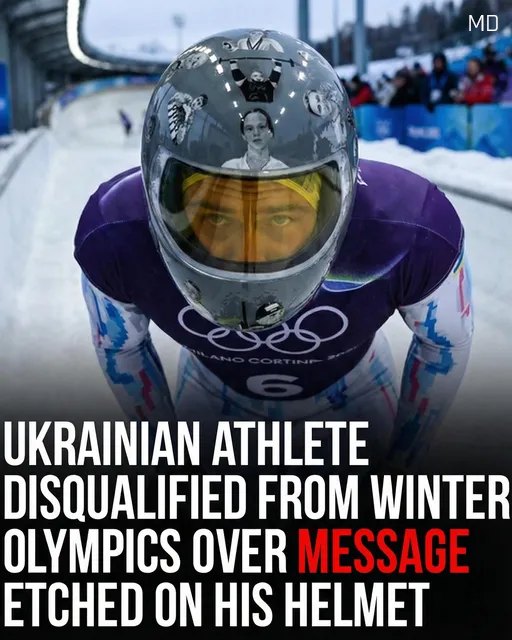
The intersection of geopolitical realities and international sporting regulations came to a head at the Milano Cortina 2026 Winter Olympics when Ukrainian skeleton athlete Vladyslav Heraskevych was disqualified from the men’s competition. The ruling stemmed from a dispute over his custom-designed helmet, which Olympic officials deemed a violation of strict guidelines regarding political neutrality and athlete expression. This decision, made in the tense final moments before the event, sparked a global debate over the limits of personal expression on one of the world’s most visible competitive stages.
The controversy centered around the imagery on Heraskevych’s helmet. He had commissioned a tribute to the victims of the ongoing conflict in Ukraine, featuring evocative images to honor those who have suffered or lost their lives in the war. For Heraskevych, the helmet was more than just protective gear; it was a mobile monument—a way to carry the weight of his national identity and the grief of his people down the icy chutes of the skeleton track. However, for the International Olympic Committee (IOC) and event officials, the helmet breached Rule 50 of the Olympic Charter, which prohibits political, religious, or racial demonstrations in any Olympic venues.
As the scheduled start time approached, urgent negotiations unfolded between Heraskevych, the Ukrainian National Olympic Committee, and event officials. The IOC argued that the Olympic arena must remain a neutral space, free from the entanglements of global conflicts, to preserve the focus on athletic merit and international unity. They asserted that the imagery on the helmet went beyond personal remembrance and ventured into the realm of political statement, which they felt obligated to restrict in order to maintain consistency across all sports and participating nations.
During these discussions, officials reportedly offered several compromises, such as replacing the specific imagery with a more generalized symbol of mourning or peace, or using a plain, unadorned helmet. However, no agreement could be reached. Heraskevych, standing firm on the symbolic importance of his tribute, argued that honoring victims of a humanitarian crisis should transcend political categorization. He insisted that his gesture was an act of empathy, not a partisan message. In the end, with no change made to his equipment, officials issued the ruling of ineligibility as the starting light turned green.
The fallout from this decision was immediate. Heraskevych, known for his poise, expressed deep disappointment after being pulled from the event. In a statement, he clarified that he never intended to spark controversy or disrupt the spirit of the Games. His primary goal, he explained, was to use his brief moment in the global spotlight to ensure the human cost of the conflict in Ukraine was not forgotten amidst the spectacle of the Winter Olympics. For him, the disqualification felt like a silencing of a necessary voice, where the rigidity of the rules took precedence over human compassion.
Olympic leadership, while acknowledging the emotional weight and tragic context of Heraskevych’s tribute, defended the decision as essential for the long-term health of the Olympic movement. They argued that making exceptions for one cause could quickly turn the “field of play” into a chaotic mosaic of competing political and social messages, undermining the diplomatic neutrality that allows the Games to function in the first place. According to the IOC, the uniform and equipment of athletes are sacred spaces of sporting equity, and allowing personal expression there would set an unmanageable precedent.
This incident has reignited a complex conversation among sports fans, human rights advocates, and international observers. In an age where athletes are increasingly seen as social influencers with a moral obligation to use their platforms for good, the “neutrality” of the Olympic Games is being tested like never before. Critics of the ruling argue that the IOC’s definition of “political” is often arbitrary and that human rights issues should not be treated as mere politics. They point to the irony of an event that promotes “peace” and “unity,” yet prohibits athletes from acknowledging the very real obstacles to those ideals.
On the other hand, supporters of the ruling argue that the Olympics provide a rare and valuable reprieve from global divisions. They contend that the power of the Games lies in the fact that, for a brief time every two years, athletes from nations at odds can compete under the same rules and on equal terms. By enforcing strict equipment guidelines, they believe the IOC is protecting athletes from the pressure of becoming political symbols, allowing them to focus solely on their athletic discipline.
For Heraskevych, the Milano Cortina 2026 Games will be remembered not for a podium finish or a personal best, but for a stand taken in the shadows of the starting gate. The empty lane where he was meant to compete became a silent testament to the struggle between individual conscience and institutional regulations. His disqualification serves as a stark reminder that even in elite sports—where every millisecond counts and every movement is scrutinized—the most significant moments often unfold before the race even begins.
As the Winter Olympics continue, the vacancy in the men’s skeleton event remains a topic of discussion. The case of the Ukrainian helmet has become a landmark example of the evolving relationship between athletes and the institutions they represent. It forces a re-examination of what it means to be an “ambassador” in the modern age, and whether the gear an athlete wears—their helmet, their suit, their skis—can ever truly be separated from their identity. While the records will show that Vladyslav Heraskevych did not compete in 2026, the story of his helmet guarantees that his message reached a far wider audience than any single skeleton run ever could.