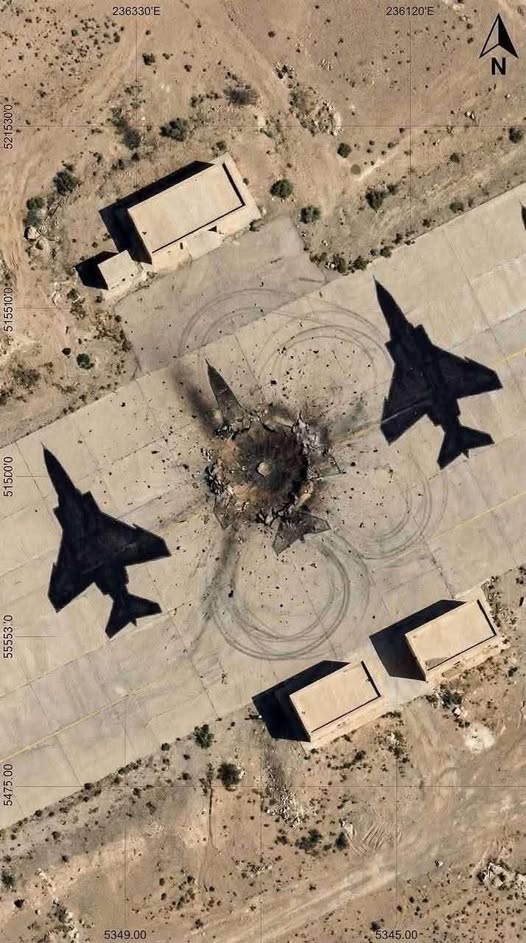
A bizarre and somewhat surreal incident has been making the rounds online, capturing the attention of military enthusiasts, social media users, and conspiracy theorists alike. According to circulating reports, pilots from the United States and Israel allegedly carried out air operations targeting what they believed to be Iranian missile launchers, only to later realize—or at least question—that the “targets” were not functional military installations at all, but rather elaborate drawings on the desert floor. The story, whether fully accurate or exaggerated in retellings, has sparked both amusement and debate over the challenges of modern aerial surveillance and the ingenious ways military deception can be employed.
Sources claim that the so-called “fake missile launchers” were designed to mimic real missile systems when viewed from high altitudes. Painted or etched onto the sand and rocky surfaces of desert regions, these shapes created the illusion of sophisticated launch platforms. From the cockpit of a fighter jet or the screen of a drone operator hundreds or even thousands of feet above the ground, the drawings appeared strikingly realistic. The perspective, combined with natural shadows cast by the low sun and the contrast of the markings against the desert terrain, allegedly made them virtually indistinguishable from actual weaponry, at least in initial reconnaissance images.
Military analysts note that such visual deception techniques are far from new. For decades, militaries around the world have employed decoys, mock installations, and other forms of camouflage to mislead enemy intelligence. From inflatable tanks in World War II to painted plywood airstrips during the Cold War, these strategies are designed to exploit human—and even technological—limitations in target recognition. By directing an adversary’s firepower toward false targets, a country can conserve its genuine resources, waste the enemy’s ammunition, and gain a tactical advantage in both defensive and offensive operations. In this context, the alleged desert drawings are simply the latest evolution of a centuries-old strategy, adapted to modern surveillance and high-altitude strikes.
The timing of this incident also coincides with escalating tensions in the Middle East, particularly between Iran, Israel, and the United States. In recent years, both sides have increasingly relied on satellite imagery, drone surveillance, and precision-guided munitions to track and, if necessary, neutralize perceived threats. Against this backdrop, even small mistakes in interpretation—such as confusing artwork or markings on the ground with actual missile sites—can have potentially significant consequences, from wasted sorties to international diplomatic incidents. Some experts argue that such misidentifications are not necessarily a sign of incompetence, but rather an illustration of how challenging it is to distinguish real threats from cleverly designed visual illusions under conditions of limited time and high pressure.
The incident has inspired widespread discussion across social media platforms. Many users have responded with humor, poking fun at the idea that elite air forces might be misled by simple desert sketches. Memes, jokes, and satirical commentary have flooded forums and timelines, often framing the episode as a modern-day “cartoon war” where sand drawings outsmart sophisticated military technology. Others, however, have used the story to spark serious debate about the reliability of aerial intelligence, the vulnerabilities of high-tech military systems to deception, and the potential for escalation based on misinterpretation of visual data.
Interestingly, this case also highlights the psychological component of warfare. Human operators, whether pilots, analysts, or drone controllers, are influenced by expectations and assumptions. If intelligence reports suggest that a particular region is home to missile installations, there is a cognitive bias to interpret ambiguous shapes as genuine threats. Even the most advanced sensors and imaging systems can fall victim to carefully constructed illusions that exploit angles, perspective, and environmental conditions. In effect, the desert drawings serve as a reminder that technological superiority does not entirely eliminate the element of human error.
Whether or not the incident involved actual airstrikes or merely reconnaissance confusion remains somewhat unclear, but the underlying lesson resonates: deception in warfare is a potent tool, and appearances from above can be deceiving. Analysts suggest that militaries may need to develop even more sophisticated verification protocols, combining multiple intelligence sources, to ensure that high-stakes actions are based on accurate information. Satellite imagery, infrared scanning, and cross-referencing with ground-level data may all help reduce the risk of targeting errors in the future, but the story of the “drawn missile launchers” underscores that even in an age of drones, satellites, and precision-guided munitions, simple human ingenuity can create illusions that fool both men and machines.
In the meantime, the episode has captured the imagination of the public, serving as both a cautionary tale and a source of fascination. It illustrates the complex interplay between perception, technology, and strategy in modern warfare. And whether viewed as a humorous anecdote or a serious study in military deception, it reminds us that in conflict zones, not everything is as it seems—and sometimes, a pencil and a sand-colored canvas can do what a thousand missiles cannot: make an enemy question reality itself.