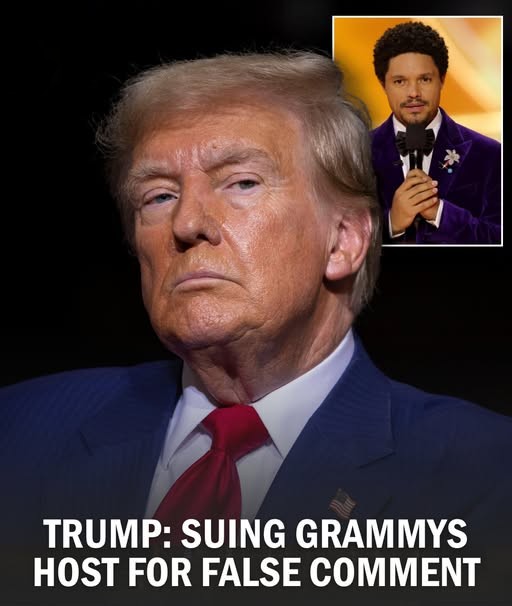
The laughter stopped almost instantly. In the middle of Hollywood’s most glamorous and scrutinized night, a single punchline detonated a political firestorm that no one saw coming. The Grammys, an annual celebration of music, celebrity, and cultural spectacle, suddenly transformed into a battleground for reputation, law, and the delicate balance between humor and harm. Trevor Noah, the host known for his razor-sharp wit and fearless satire, had delivered a quip linking Donald Trump to one of the most infamous and darkly publicized scandals of the modern era: Jeffrey Epstein’s private island. Within hours, the entertainment world buzzed with disbelief, political commentators scrambled for context, and social media erupted as Trump himself vowed legal war, claiming the joke was not merely inappropriate, but a direct attack on his character.
Allies and operatives rushed to their respective corners. Legal teams were immediately mentioned, not as idle threats but as tangible signals that the next moves could shift from red carpets and comedy stages to the courtroom. For many, the line between satire and accusation had suddenly blurred. Careers, public reputations, and the age-old question of what counts as “just a joke” were all suddenly in play, tested under a national microscope. No longer was this a punchline to be consumed and forgotten; it was a moment that threatened to shape perceptions of both the host and the former president in real time.
Trump’s response, delivered with characteristic intensity via Truth Social, escalated the situation from fleeting entertainment to national controversy. In his statement, he insisted, unequivocally, that he had never set foot on Epstein’s island, framing Noah’s joke not just as tasteless humor but as a knowingly false and defamatory claim capable of inflicting serious damage on his reputation. Legal analysts quickly weighed in, noting that, while political satire enjoys broad protections under U.S. law, there remains a fine line when public statements resemble allegations of criminal behavior. Trump’s team appeared poised to test that line, signaling that this confrontation would not merely be waged in the court of public opinion but could potentially unfold in actual courts, where facts, evidence, and testimony would be scrutinized under legal standards rather than entertainment metrics.
Noah’s quip, delivered with his usual biting style, cleverly linked Trump’s announced Greenland ambitions to a sarcastic suggestion that he needed “a new island to hang out with Bill Clinton.” The remark resonated widely because it tapped into a narrative thread already embedded in American cultural consciousness: the mystery, controversy, and public outrage surrounding Epstein’s network and his high-profile associates. The joke, while humorous in intent, collided with the fact that Epstein’s island has become shorthand for some of the darkest scandals involving wealth, influence, and alleged criminal activity, and it carried an undeniable edge precisely because of those associations.
Despite the explosive nature of the joke, no credible evidence has emerged to support the claim that Trump ever visited Epstein’s private Caribbean property. Even some of the most critical media voices, known for their skepticism toward Trump, have been careful not to assert that connection as fact. Yet the tension remains: when humor references serious accusations, how should society weigh intent, context, and the impact on reputation? The White House and Trump’s legal representatives have characterized the joke as “irresponsible political theater,” highlighting the risk of jokes masquerading as factual commentary, and suggesting that what was meant for laughs can quickly morph into a serious ethical and legal dilemma.
At its core, the episode underscores a timeless question in democratic societies: what are the boundaries of free speech, particularly when satire intersects with potential defamation? Comedy, after all, thrives on exaggeration, hyperbole, and the playful inversion of power. Yet, when those inversions brush against highly sensitive allegations involving criminal networks, powerful figures, and historical trauma, even an ostensibly harmless joke can acquire weight far beyond the stage. For Noah, the quip was consistent with decades of socially conscious satire—poking fun at political figures, highlighting contradictions, and drawing attention to hypocrisy—but for Trump, it was an attack with the potential to alter public perception and challenge legal boundaries.
The Grammys, an event that usually celebrates artistry, now finds itself at the intersection of media scrutiny, politics, and legal discourse. Fans, critics, and casual observers alike are forced to confront the uncomfortable reality that in an era of instantaneous global communication, a single line of comedy can ripple across social platforms, news cycles, and legal frameworks in ways the performer could never have fully predicted. The punchline that stopped laughter has become a case study in the power of words, the fragility of reputation, and the complexity of free expression in a society that prizes both humor and accountability.
As the story unfolds, questions will linger. Did Trevor Noah cross a line from comedy into potential defamation? Will Donald Trump’s legal threats result in a courtroom showdown, or will the case resolve in the court of public opinion alone? And more fundamentally, what does this moment tell us about the nature of satire, the responsibilities of public figures, and the thin but vital line between joke and accusation in an era where both travel at the speed of social media?
For now, the cameras have stopped rolling, the Grammy stage is dark, and the punchline has entered the history books—not just as a joke, but as a flashpoint in the ongoing conversation about truth, power, and the consequences of mixing comedy with politics. What began as a fleeting moment of laughter has grown into a multifaceted debate, proving once again that in today’s cultural landscape, words, humor, and fame are never as simple as they seem.