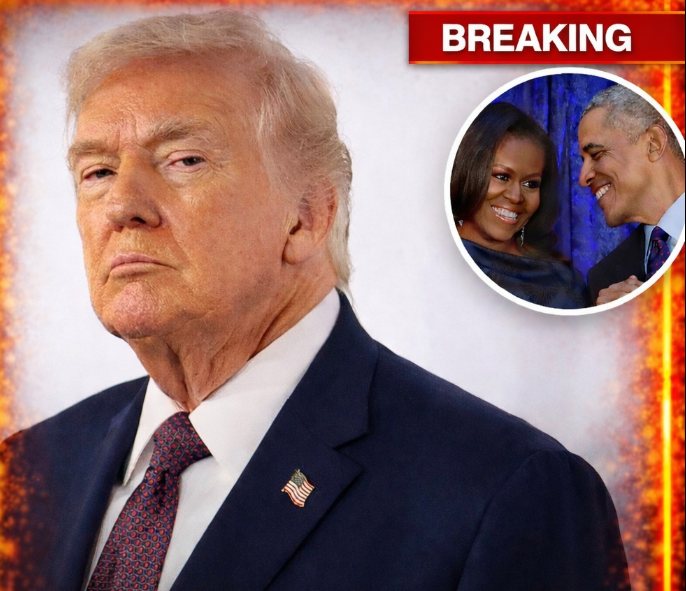
The reaction to Donald Trump’s recent post on Truth Social was immediate, visceral, and revealing of the deep cultural and political fault lines that define modern America. When the former president shared a crude video meme targeting Barack and Michelle Obama, the response from civil rights leaders, historians, and the public underscored that this was not simply another instance of incendiary political rhetoric. Many saw it as a deliberate step into a painful form of historical dehumanization. By invoking “jungle” imagery and archaic tropes, the post attacked America’s first Black First Family with a mockery rooted not in contemporary politics, but in some of the nation’s darkest, most regressive eras.
For scholars of racial discourse, the video was far from isolated. It echoed the “ape” and “simian” caricatures of the 19th and early 20th centuries—stereotypes historically used to suggest that Black individuals were biologically inferior, less than human, and unworthy of full citizenship. Pew Research Center data indicates that roughly 65% of Americans believe the expression of racist or insensitive views has grown since 2016. This latest incident reinforces concerns that social media platforms are normalizing imagery that once belonged to the fringes of society.
The public response revealed a three-way fracture in national conscience. The first group consisted of longtime supporters of the former president who expressed genuine disillusionment. For these individuals, the post crossed a moral boundary that surpassed partisan loyalty. They spoke of embarrassment and shame, recognizing that while they might support certain policies, they could no longer excuse a tone that demeaned the dignity of the presidency and of America’s former leaders. Surveys show that nearly 40% of Americans report feeling “exhausted” by the relentless hostility of public discourse, and this reaction mirrored that broader fatigue.
The second group dismissed the outrage as politically motivated exaggeration. These defenders framed the video as “edgy humor” or a critique of the “liberal establishment,” arguing that outrage was merely a product of “cancel culture.” From this perspective, historical context mattered little; the post was simply a tool to mock political opponents. The divide underscores a fundamental difference in how Americans perceive harm: what one sees as a dangerous erosion of civil rights progress, another sees as an exercise of free expression.
The third—and perhaps largest—group comprised ordinary citizens overwhelmed by growing cynicism. For them, the episode was yet another sign that standards for public behavior had plummeted. The American Psychological Association reports that nearly 60% of Americans cite political climate as a significant stressor. When leaders exploit resentment instead of elevating dialogue, the ripple effects extend far beyond immediate targets, signaling to the public—and especially younger generations—that mockery is an acceptable substitute for debate, and dehumanization is a valid tool for attention.
At the heart of the controversy lies a fundamental question: the boundaries of leadership. Public figures wield “amplification power,” the ability to shape cultural norms simply through visibility. When that power revives harmful racial tropes, it quietly instructs society on how to treat one another. Rewarding mockery with engagement incentivizes cruelty, eroding standards of civil discourse. America is confronted with a moral reckoning: how much harm will citizens tolerate in exchange for political loyalty?
History shows that the strength of a society is measured not only by its laws but by its tone. Normalizing the degradation of former leaders based on race corrodes the shared humanity essential to democracy. Dehumanizing rhetoric is rarely “just a joke”; historically, it has been a precursor to civil liberty erosion and heightened physical risk for marginalized communities. FBI Uniform Crime Reporting data demonstrates that fluctuations in hate crimes often coincide with spikes in inflammatory public rhetoric. In recent years, hate crimes targeting Black Americans have consistently comprised over half of all race-based incidents.
Even silence in the wake of the Truth Social post carries weight. Indifference to the use of racial tropes by a prominent political figure signals passive acceptance, forcing the electorate to confront a crucial question: what kind of public life is tolerable? If spectacle and the exploitation of historical pain become norms, the damage to civic cohesion may take generations to repair. Dignity is fragile; once eroded, it cannot be restored by a single election or policy shift.
Ultimately, the video targeting Barack and Michelle Obama serves as a stark warning: repeated cruelty, when rewarded, becomes cultural feature rather than flaw. It undermines trust, replacing it with a race to the bottom. For a nation already divided along ideological lines, the revival of vile historical tropes is not merely a social media incident—it is a challenge to the enduring values of the American experiment.
As the fallout continues, it is felt not only in the comment sections of social media but in the private reflections of citizens asking whether decency can be restored. The question remains: will the public refuse the normalization of such rhetoric, or will the erosion of shared humanity continue until the damage is irreversible? As America moves toward 2026 and beyond, the tone set by its leaders will determine whether the country becomes a society guided by wisdom—or a culture dominated by mockery.