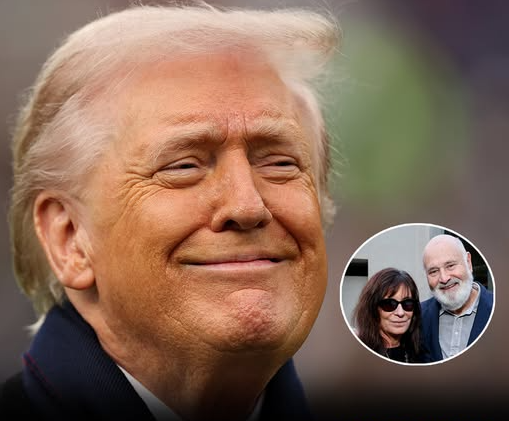
The shocking discovery of the apparent double homicide of acclaimed, Academy Award–nominated filmmaker and actor Rob Reiner and his wife, Michele Reiner, inside their luxury Brentwood, Los Angeles residence on a Sunday afternoon sent immediate and profound shockwaves through Hollywood and beyond. What initially stood as a devastating personal tragedy soon escalated into a national political controversy following an extraordinary and incendiary intervention by former President Donald Trump. As detectives from the Los Angeles Police Department continue their high-profile investigation—during which Reiner’s son, Nick Reiner, was reportedly taken into custody on a staggering $4 million bond—Trump released a public statement that mocked the deceased director, asserting that Reiner’s death was somehow connected to what he derisively labeled “Trump Derangement Syndrome” (TDS).
Publicly ridiculing a person in the immediate aftermath of their death is widely viewed as a fundamental violation of social decency. When such remarks originate from a former U.S. president, the reaction is magnified exponentially. Trump’s comments, shared via his Truth Social platform, spread rapidly across social media and mainstream news outlets, quickly overshadowing both the gravity of the criminal investigation and the profound grief of the Reiner family. The focus of the story shifted almost instantly from mourning and justice to outrage and political warfare.
Rob Reiner was widely respected not only for his legendary contributions to cinema—films such as A Few Good Men and When Harry Met Sally…—but also for his deep and sustained involvement in Democratic politics. The Los Angeles Times frequently described him as both a “political force” and an active Democratic Party advocate. Unlike many celebrities who limit their engagement to fundraising events, Reiner immersed himself directly in policy debates and political advocacy. He was particularly passionate about issues including marriage equality and early childhood education reform in California. Democratic strategist Ace Smith once noted that Reiner possessed a rare ability to bridge entertainment and politics, emphasizing that he invested real effort into understanding policy at a substantive level rather than engaging symbolically.
By the age of 78, Reiner had also become one of Donald Trump’s most outspoken and relentless critics. He offered unwavering support for Joe Biden during the 2020 presidential election and regularly used public platforms to question Trump’s character, competence, and fitness for office. As early as 2017, while speaking at the Dubai International Film Festival, Reiner openly declared that he believed Trump was mentally unfit to serve as president. He went further, describing Trump as the most unqualified individual ever to hold the office, arguing that he lacked both the knowledge of governance and the desire to learn it.
In the years that followed, Reiner continued his political engagement through filmmaking. In 2024, he produced the documentary God and Country, which explored the growing influence of Christian nationalism in American politics. During promotional interviews, including one with The Guardian, Reiner sharply criticized Trump’s self-portrayal as a champion of Christian values, suggesting that while Trump might be able to spell the word “Bible,” he likely had little understanding of its contents. Reiner also pointed out how supporters often excused Trump’s behavior by claiming divine justification, a notion he openly rejected.
As the nation approached the highly anticipated 2024 presidential rematch, Reiner publicly supported the Democratic candidate despite widespread concerns about age. He bluntly argued that having an older president who might stumble was far preferable to electing someone he described as a habitual liar and criminal, referencing Trump’s numerous indictments. The remark underscored the depth of Reiner’s disdain and left little doubt about where he stood politically.
Those years of sharp criticism were evidently not forgotten. Following Reiner’s death, Trump issued a statement that went far beyond political disagreement. In his post, Trump referred to Reiner as “once very talented” but “tortured and struggling,” asserting—without evidence—that the director’s death was linked to the anger he provoked through an “incurable” obsession with Trump, which he labeled a “mind-crippling disease.” Trump concluded by claiming that Reiner had driven people “crazy” through his relentless criticism of him.
The backlash was immediate and fierce. Political commentators, journalists, and social media users condemned the statement as grotesque, heartless, and unprecedented. Many labeled it one of the most disturbing responses to a death by a political figure in modern history. Democratic strategist Max Burns described the message as a “monstrosity,” drawing comparisons to past instances of politicized grief and condemning what he viewed as blatant hypocrisy. Critics argued that Trump’s decision to weaponize a violent personal tragedy for political revenge ensured that the story would remain deeply divisive, cementing the Reiner homicides not only as a criminal case but as another flashpoint in America’s ongoing political polarization.