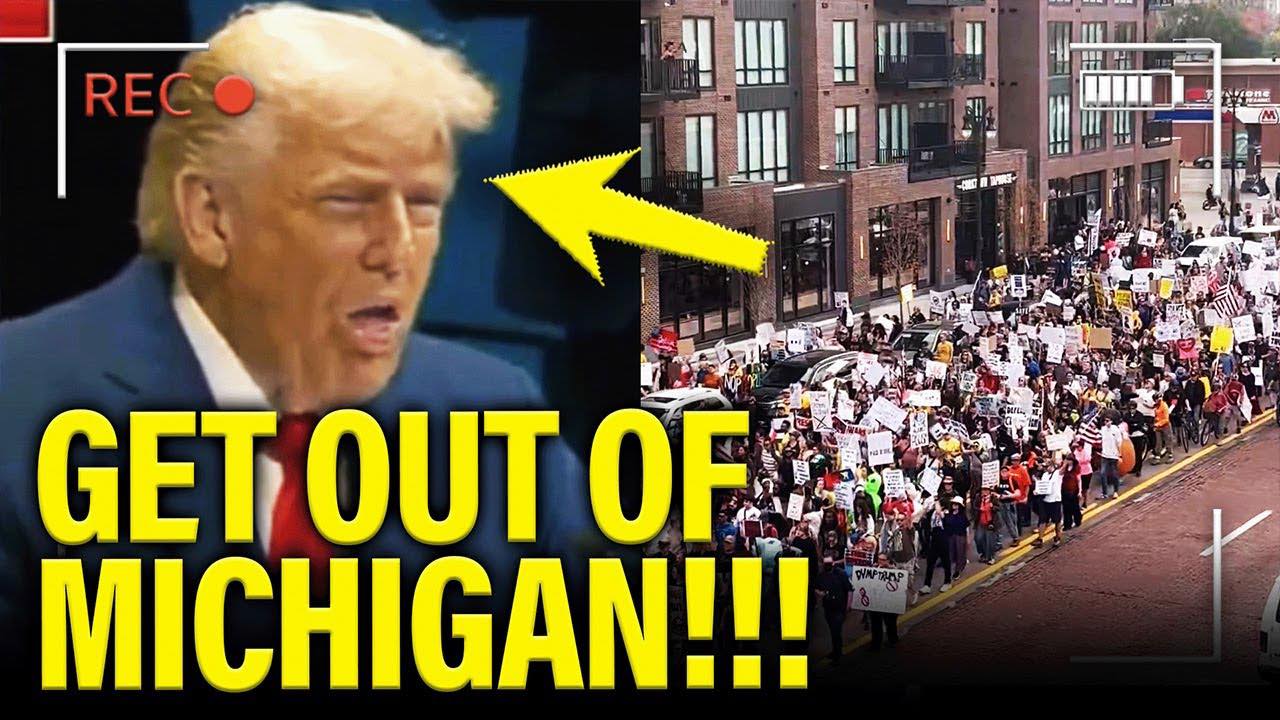
The Great Lakes State’s political scene has changed from a victorious battlefield to a terrifying warning to the Trump administration. Michigan was supposed to be the last demonstration that Donald Trump’s hard-edged economic nationalism had a permanent home in the American heartland, and it was hailed as the crown jewel of his 2024 comeback. His second-term mandate was meant to be validated by this “blue-collar fortress.” Rather, the state is starting to resemble a damning critique of his policy program as 2025 comes to an end.
The President’s approval ratings are declining not only in progressive urban areas like Ann Arbor or Detroit but also in the very manufacturing centers and union households that were once his most ardent supporters, according to a number of recent high-profile surveys. For a White House that thought its hold on the Rust Belt was unshakeable, this decline in support marks a fundamental “rude awakening.” In the divisive atmosphere of a second term, the honeymoon phase, if it ever existed at all, has not only expired but imploded due to economic friction.
The actual, daily costs of “Trumpism” in action are the main cause of this dissatisfaction. Michigan’s most important industry is currently suffering from a number of unforeseen repercussions brought on by the strong tariff arrangements intended to save American car jobs. Even if protectionism rhetoric is still often used at rallies, the situation on the ground is much more dire. The administration has unintentionally increased the cost of new cars and replacement parts by increasing the price of imported steel, aluminum, and vital electrical components. The math no longer adds up for the families in Michigan whose lives revolve on their pickups and lengthy trips to the factory floor.
Every significant touchpoint in the working-class experience is impacted by the financial strain. Every extra dollar spent at the grocery shop, the car dealership, and the gas pump is hurting families. The “car tax” brought about by trade volatility is seen as a violation of the pledges made during the campaign trail in a state where the automobile sector is not only a company but also a cultural identity. The blue-collar voters feel a great feeling of “buyer’s remorse” as they navigate a world of stagnating salaries and growing costs instead of the economic resurgence they had anticipated.
The public demonstrations of confidence and bravado inside the White House are increasingly perceived as a thin cover for underlying unease. According to those close to the administration, the president is regularly incensed by Michigan’s declining statistics and routinely calls them “rigged” or “fake” in private outbursts. But the evidence is becoming too reliable to ignore. The political ascent of Governor Gretchen Whitmer, who has utilized her position to present a competing narrative of stability and regional economic expansion, coincides with the declining popularity ratings. Whitmer’s ongoing popularity in the state provides a consistent, obvious contrast to the administration’s difficulties, encouraging rumors of a shift in momentum across the country.
As Michigan Republicans prepare for the 2026 midterm elections, this change is making them feel apprehensive. Previously “safe” or “deep red” manufacturing districts are starting to falter. In private, local GOP leaders are cautioning that the party may suffer a historic defeat if the economic trend lines don’t turn around. The worry is that Michigan is sending a loud warning to the rest of the nation, not just straying from the president. The administration’s second-term mandate may be far more precarious than the Washington establishment is prepared to admit if the Trump brand is unable to retain the very state that characterized its blue-collar appeal.
The inherent dangers of a “protectionist-first” economic strategy are clearly highlighted by Michigan’s volatility. The typical customer is bearing the short-term pain even while the goal of repatriating supply chains is a long-term strategic objective. The abrupt cutoff of trade links has resulted in a number of “economic tremors” in the Rust Belt’s specialized economy, where the local and global are intrinsically intertwined. The core of Michigan’s manufacturing sector, small-to-medium-sized tool and die manufacturers, are finding it difficult to control the volatile pricing of raw materials, which is causing layoffs and fewer shifts—exactly what the tariffs were meant to stop.
Additionally, the administration’s emphasis on conventional manufacturing has caused conflict with the nascent electric vehicle (EV) industry. Michigan’s traditional automakers are torn between the market reality of a green energy transition and the president’s rhetoric in favor of fossil fuels as global markets shift. Many workers are left wondering whether they are being used as pawns in a wider geopolitical game or if their jobs are being protected for a future that does not exist as a result of this policy disarray.
The demise of the Michigan honeymoon poses a fundamental threat to the survival of the Republican party and is not merely a local problem. The notion that the GOP could develop into a working-class, multiracial party served as the foundation for the “MAGA” alliance. That experiment was conducted in Michigan. The entire electoral landscape for the ensuing ten years could be altered if the experiment fails there—if union households rejoin the Democratic Party because their bank accounts are empty. The Great Lakes serve as a stark reminder that populism is only effective when it results in prosperity. The political repercussions are swift and dire when the “America First” strategy starts to feel like “Michigan Last.”
The state is in a condition of cautious waiting as the winter of 2025 descends. The harm to the President’s brand of “economic wizardry” may already be done, even if the government tries a number of “reset” measures, such as providing the auto industry with temporary tariff exemptions or targeted subsidies. Michigan’s blue-collar voters are practical; they pay attention to the rhetoric yet cast their ballots. Those checkbooks now depict a tale of suffering and unfulfilled promises.
If the White House is unable to stabilize the Michigan numbers, Donald Trump’s second term will be characterized by a four-year defensive fight to hold onto the exact people who put him in office rather than a significant national revolution. The government is perceiving an increasingly chilly, unpredictable, and politically dangerous future as the crown gem has lost its shine. Michigan’s song has become a continuous, melancholy alarm; it is no longer a trophy on the shelf, but rather the canary in the coal mine.