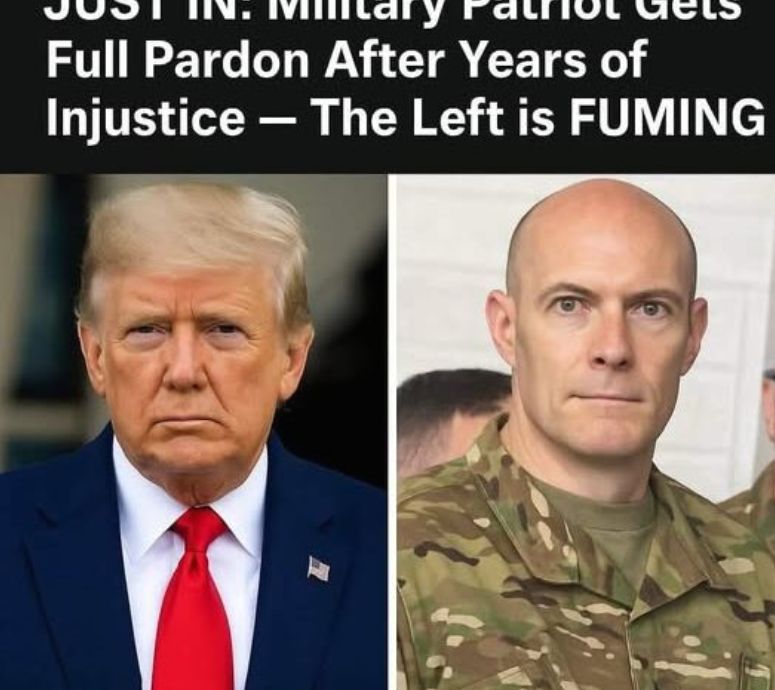
In a decision that has reverberated far beyond the Pentagon walls and into every corner of the nation’s political discourse, former President Donald Trump issued a full presidential pardon to former Army 1st Lt. Mark Bashaw in February 2026. The move has reignited debates over civil liberties, military discipline, and the boundaries of executive power during a public health crisis, becoming a lightning rod for both national reflection and political controversy. By using his constitutional authority to erase Bashaw’s record—the first service member ever court-martialed for refusing COVID-19 protocols—Trump has not merely changed the course of one man’s life; he has compelled the nation to revisit fundamental questions about conscience, duty, and the limits of governmental authority during unprecedented circumstances.
Mark Bashaw’s story begins in the meticulously controlled environment of the Army Public Health Center at Aberdeen Proving Ground, Maryland. In 2022, Bashaw, an entomologist and former Air Force noncommissioned officer, found himself in the eye of a military-legal storm that would define his career and personal life. He faced three specifications of failing to obey lawful orders after declining to comply with COVID-19 safety measures mandated on the installation. Specifically, Bashaw refused to telework, rejected mandatory negative COVID-19 tests before entering his workplace, and consistently resisted wearing masks indoors, actions the military construed as clear violations of the chain of command.
To prosecutors, Bashaw’s actions represented an unambiguous case of insubordination. Within the rigid hierarchy of the Army, lawful orders are not suggestions—they are the linchpin of operational readiness and national security. The special court-martial that followed confirmed his guilt, yet the presiding judge chose not to impose any punitive measures such as imprisonment, reduction in rank, or fines. Despite the absence of a formal sentence, the conviction remained a permanent mark on Bashaw’s record, ultimately leading to his administrative separation from the Army in 2023. For a man who had dedicated years to service and science, the legal judgment was a shadow that threatened to define his professional identity indefinitely.
Nearly three years later, Trump’s intervention transformed what had been a quiet blemish into a highly public, politically charged emblem. In his announcement, Trump framed the pardon not as a benevolent act toward an offender, but as a correction of a systemic “injustice.” To many Americans aligned with this perspective, Bashaw’s resistance to pandemic-era mandates was not mere defiance; it was an assertion of individual conscience against perceived government overreach. For these supporters, Bashaw became a symbol of personal liberty, a figure standing at the intersection of ethical conviction and state authority. The pardon, therefore, was not just legal—it was emblematic, a declaration that executive power can validate moral opposition to controversial policies.
The implications extended beyond Bashaw alone. The pardon coincided with broader Pentagon and Department of Defense efforts, spearheaded by Secretary of War Pete Hegseth, to reinstate service members who had been discharged for refusing COVID-19 vaccinations. Following the pardon, Bashaw’s military record was fully corrected, and he was ceremoniously reinstated to active duty, simultaneously promoted to the rank of Captain in the Pentagon’s Hall of Heroes. This act carried immense symbolic resonance: a man once criminalized under military law was now elevated within the same institution, tasked with reintegrating other “warriors of conscience” into the Army. The ceremony was broadcast widely, signaling both a personal restoration and a broader ideological shift in how the military could reconcile discipline with individual belief.
Despite the fanfare, critics raised urgent concerns. Legal analysts, retired military officials, and leadership scholars warned that the pardon could undermine core principles of military discipline. In a structure where obedience to lawful orders ensures cohesion and survival, the message that future service members could count on political intervention if they disobey raises serious questions about authority and precedent. The critics’ argument is stark: if disobedience can be absolved post hoc by executive fiat, the chain of command itself may be compromised, potentially eroding the very framework of accountability that allows the armed forces to function effectively under extreme conditions. From this vantage point, the pardon is not merely a political statement—it is a seismic test of institutional norms.
For Mark Bashaw personally, the journey from court-martialed officer to reinstated Captain represents both vindication and a profound affirmation of his worldview. In his speech at the Pentagon, he framed his return not as a triumph over the Army, but as a continuation of his service under the banner of truth, ethics, and constitutional fidelity. He emphasized that his resistance was never born of rebellion for its own sake, but out of a moral duty to maintain bodily autonomy and personal integrity in the face of unprecedented mandates. For supporters, Bashaw embodies courage and conscience; for detractors, he exemplifies the dangers of politicizing military obedience.
The broader national implications are equally significant. The pardon shines a light on unresolved cultural and legal tensions left over from the pandemic era, reminding the public that questions of individual freedom, institutional authority, and governmental overreach remain contested terrain. Bashaw’s reinstatement is a touchstone for debates over civil liberties in the 21st-century military: to what extent can personal conscience be honored without destabilizing hierarchical structures? The “fault line” revealed by the original court-martial has widened, leaving the country to grapple with how to balance loyalty, law, and liberty in a hyper-polarized society.
As America moves further into 2026, the Mark Bashaw pardon stands as a defining emblem of the Trump-era approach to governance: bold, polarizing, and unapologetically performative. Whether viewed as a courageous defense of individual rights or a disruptive blow to military cohesion, the case has undeniably reshaped public discourse around what it means to serve in the modern U.S. military. It compels policymakers, service members, and civilians alike to reconsider the delicate balance between obedience and conscience, between collective duty and personal autonomy, and between law as written and justice as perceived. In the end, the Bashaw case is more than a legal footnote; it is a cultural moment, a symbol of enduring tension in a nation still wrestling with the aftershocks of a global crisis and the enduring question of how to govern both responsibly and morally in turbulent times.