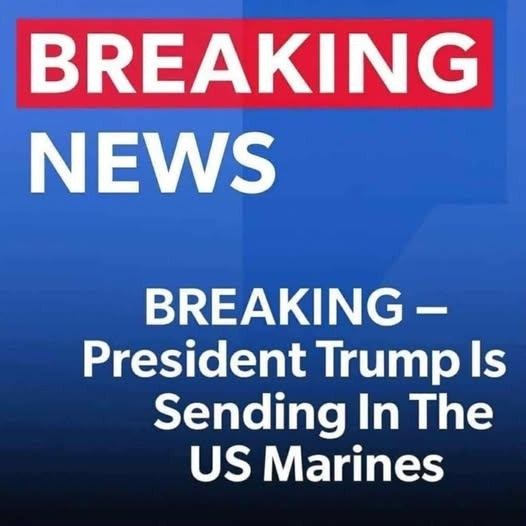
The Trump administration’s decision to deploy United States Marines to the southern border and interior processing facilities marks a significant moment in American civil-military relations. While officials describe the move as a logistical and clerical support measure, its implications have reverberated through Congress, the Pentagon, and households across the country. This is not merely a shift of personnel—it is a military action that has sparked intense debate over the boundaries of domestic law enforcement, national security, and the long-term effects on democratic institutions. As Marines take on roles traditionally handled by civilian contractors and federal agents, the nation faces a crossroads, weighing efficiency against the risks of militarization.
The administration frames the deployment as a response to crisis and necessity. President Trump and his supporters argue that the immigration system—particularly the infrastructure managed by ICE and CBP—is overburdened by backlogs, logistical bottlenecks, and staff shortages. By assigning Marines to administrative and support duties, ICE agents can be freed to return to field operations, carrying out the high-stakes enforcement tasks central to the president’s campaign promises. Supporters see this as a practical solution to systemic failures, maximizing government resources to secure the border and enforce the law.
Critics and constitutional experts, however, view the presence of Marines in immigration centers as a troubling blurring of lines. Even if their roles are “non-combat” and clerical, the visual of camouflaged troops in civilian processing facilities carries a heavy symbolic weight. Opponents stress that the military is designed to confront external threats, not to manage domestic administrative tasks. They cite the Posse Comitatus Act, the 1878 law limiting military involvement in domestic affairs, as a crucial safeguard potentially undermined by this deployment. Beyond the legal concerns, the psychological effect on mixed-status communities and asylum seekers cannot be ignored. The mere presence of armed, uniformed personnel transforms the immigration process into a scene of militarization, raising fears of normalized military oversight in civilian life.
Strategists are also evaluating the impact on the Marine Corps itself. Trained for rapid global deployment, Marines are now tasked with data entry, filing, and facility maintenance—duties that some view as a misuse of elite resources and a potential reduction in combat readiness. There is also concern about precedent: once the military is woven into domestic immigration operations, the distinction between temporary support and permanent deployment becomes blurred, raising broader questions about civilian-military authority.
Internationally, the move has prompted reactions from allies and adversaries alike. Latin American partners may interpret the deployment as escalatory, complicating diplomatic efforts to address migration’s root causes. Adversaries might exploit the imagery of Marines in immigration centers to question the U.S.’s commitment to human rights. In effect, America must now defend domestic policy on a global stage, linking border security to international perception.
For those directly affected—migrants, asylum seekers, and legal residents—the impact is immediate. Seeing uniformed Marines in spaces meant for legal processing shifts perception from civil administration to security enforcement. Advocacy groups warn this may traumatize vulnerable populations, particularly children who fled violence, only to encounter a military presence on arrival in the U.S.
Politically, the deployment has become a focal point in broader debates over governance and civil liberty. Both parties are scrutinizing for signs of “mission creep.” Should support roles transition into enforcement authority, legal challenges may escalate to the Supreme Court. The move also raises internal military concerns: service members are sworn to defend the Constitution, and participation in politically sensitive domestic roles could create internal friction and affect public perception of the military’s neutrality.
Public opinion is divided. Some see decisive action to address a “broken” border using disciplined forces. Others view it as a cautionary sign that militarization of civilian spaces threatens civil liberties. The situation raises a fundamental democratic question: when the military intervenes in civilian matters, can it ever fully withdraw without permanently altering the nation?
While investigations into legality and effectiveness will take time, the immediate effects are already apparent. These deployments involve thousands of Marines, their families, and countless civilians, underscoring the need for transparency and adherence to democratic principles. The world is watching—not just to see how the border is managed, but how America balances its security with its democratic ideals.