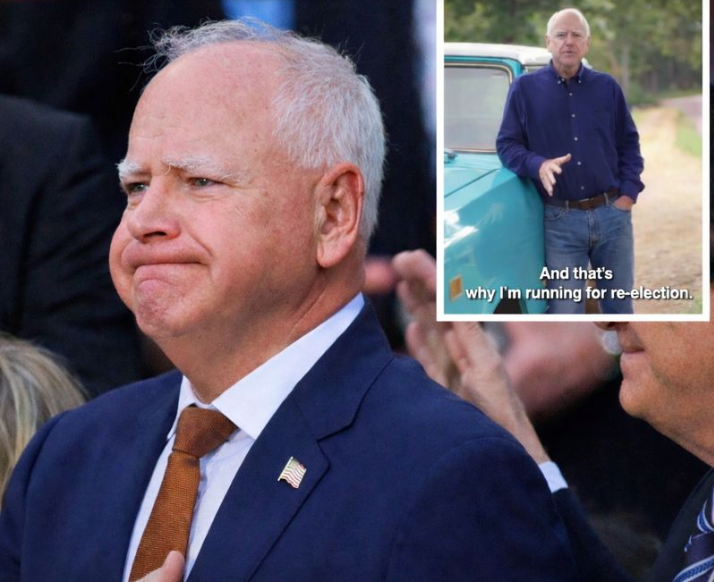
The announcement hit Minnesota like a thunderclap, echoing through the halls of the state capitol and across living rooms from Duluth to Rochester. One moment, Tim Walz was a figure of continuity and promise, a sitting governor with national recognition, a former vice-presidential nominee whose career seemed firmly anchored in both ambition and public service. The next, he was stepping away, abruptly withdrawing from the political arena at a moment when stability seemed most crucial. The news spread with staggering speed: a multibillion-dollar fraud scandal had erupted under his administration, casting shadows over programs, budgets, and agencies, and Walz, in a move that stunned allies and delighted adversaries, announced he would not seek a third term.
The implications were immediate and profound. For decades, Walz had cultivated a reputation as a steady hand — a pragmatic, approachable leader capable of navigating crises with calm authority. But this decision reframed his entire tenure. Was he retreating in the face of political pressure? Was he protecting his personal legacy from further tarnish? Or was this a genuine act of prioritizing governance over self-interest, of recognizing that mounting scandal demanded full attention? The public, pundits, and party officials alike were left grappling with these questions. Supporters framed his decision as a form of ethical leadership, a refusal to let electoral ambition distract from the responsibilities of office. Critics, meanwhile, described a governor cornered, a man whose oversight had failed to prevent alleged mismanagement, now stepping aside at the first whiff of controversy.
Behind the headlines, the human drama was as intense as the political theater. Staffers and advisors scrambled to reassess strategy, brace for media scrutiny, and anticipate the cascade of consequences. Political operatives who had spent years plotting campaigns now faced an entirely new reality. With Walz’s departure, the Minnesota Democratic-Farmer-Labor Party confronted an urgent, destabilizing vacuum: the race for governor was suddenly wide open, with no clear heir apparent, no seamless succession plan. Every statement, every policy choice Walz had made during his administration was now reframed under the lens of scandal, leaving long-standing allies vulnerable to attacks and opponents emboldened.
The nature of the scandal itself only intensified the urgency. Billions in taxpayer dollars were allegedly siphoned from state programs, creating an erosion of trust that will take years to repair. Departments once regarded as efficient and accountable were suddenly under intense scrutiny. Investigations, audits, and congressional inquiries were being discussed in hushed tones, and Minnesotans, watching from the sidelines, wondered how such vast mismanagement had gone unnoticed. Questions arose: Had warning signs been ignored? Had auditors failed to act? Were the allegations the result of systemic oversight failures, or individual malfeasance? The uncertainty left a bitter aftertaste, one that would shadow both the outgoing governor and those who stepped into the resulting political storm.
The race to succeed Walz is already shaping up as a brutal, high-stakes contest. On the Democratic side, Senator Amy Klobuchar’s name has begun circulating with increased frequency, whispered in conversations from party meetings to media panels. Her track record, visibility, and national profile make her a formidable contender, but questions remain about whether she can unify a party reeling from scandal. For Republicans, the opportunity is unprecedented. Minnesota, typically a blue-leaning state, has rarely seen an election this volatile, and the chance to capitalize on a weakened Democratic brand is palpable. Campaign strategists are already poring over polling data, crafting messaging to appeal to independents, and seizing on the frustration of voters who feel betrayed by what they perceive as political negligence.
Meanwhile, Walz’s legacy — a combination of measured governance, crisis management, and a focus on social programs — will now be evaluated not just by accomplishments but by omissions. Decisions that once appeared prudent or minor are now viewed under a harsher microscope: what did he know about the fraud, and when did he know it? Could stronger oversight have prevented the alleged losses? Could swifter action have mitigated the fallout? And perhaps most significantly, will history remember him as a leader who chose principle over politics, or as a governor whose inattention allowed catastrophe to unfold?
For the public, the emotional and psychological impact of this announcement is profound. Minnesotans who had placed trust in Walz’s leadership now face a swirl of doubt, frustration, and anger. Citizens are asking how such a breach of fiscal responsibility could occur in a state long admired for transparency and effective governance. Community leaders, nonprofit directors, and local officials are bracing for the ripple effects: programs under investigation, grants delayed, and initiatives put on hold. The trust between government and people, once a steady, foundational element of Minnesota’s civic life, has been tested in ways few could have predicted.
As the dust settles, political commentators are already framing the next chapter: a campaign season defined not by routine policy debates but by accountability, crisis management, and the question of who can restore confidence to a shaken electorate. Fundraising, endorsements, and media narratives are being recalibrated at lightning speed. Every candidate, ally, and strategist is conscious that the lessons of Walz’s resignation — of scandal, responsibility, and the optics of withdrawal — will define not just this election but Minnesota’s political landscape for years to come.
In the end, Tim Walz’s withdrawal from the gubernatorial race is more than a personal decision. It is a tectonic shift, one that reshapes alliances, recalibrates power, and forces a statewide reckoning with leadership, trust, and accountability. Minnesota, a state accustomed to steady governance and incremental political change, now faces a volatile, unpredictable chapter in its history — one whose consequences will reverberate in the halls of the capitol, in voters’ homes, and in the very fabric of public trust for years to come.