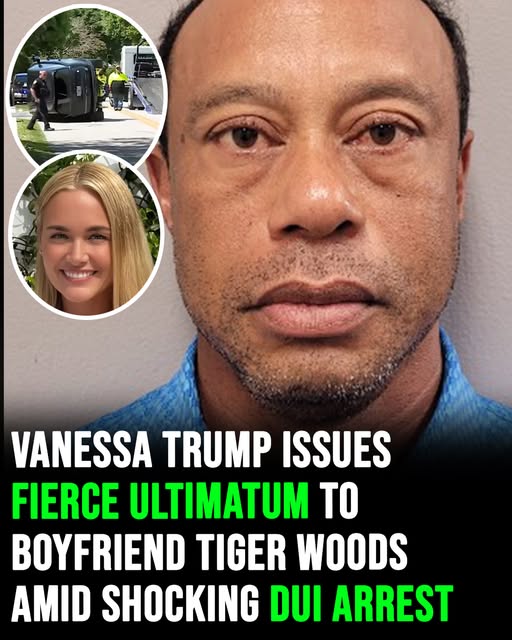
What should have been a routine warm-up before one of golf’s most celebrated tournaments has instead become a storm of controversy, concern, and personal repercussions for Tiger Woods. A recent car accident in Florida has raised serious questions—not only about his health and future in golf but also about his relationship with Vanessa Trump, with insiders suggesting the fallout could be significant.
The crash occurred on Jupiter Island, Florida, when Woods’ vehicle reportedly collided with a trailer and rolled over. The scene immediately drew attention, both for the severity of the accident and because of Woods’ high-profile status.
Initial reports brought some relief: Woods was conscious and suffered no life-threatening injuries, and no one else was harmed. Yet the story quickly took a more complicated turn.
Authorities confirmed a breathalyzer test at the scene was negative, ruling out alcohol. However, officers noted signs of impairment, raising questions about Woods’ condition during the crash. Matters intensified when Woods allegedly refused a urinalysis test, leading to his arrest on charges of driving under the influence with property damage, as well as refusal to comply with a lawful test request. He was released later the same day, but the incident immediately cast doubt over his upcoming plans.
Woods had been expected to compete at the Masters Tournament at Augusta National, one of the sport’s most prestigious events. Now, his participation is uncertain, as both his physical readiness and legal situation hang in the balance.
Beyond professional concerns, the personal implications may be even more immediate. Woods’ relationship with Vanessa Trump—a public figure in her own right—has reportedly been strained by the incident. Sources indicate that the accident introduced a serious tension, with Vanessa described as deeply unsettled, concerned, and disappointed. While she has not spoken publicly, those close to her suggest the situation is being taken very seriously.
According to insiders, her message to Woods was firm: he needs to address whatever contributed to the accident—and quickly. The implication is clear: if he does not make changes, the relationship could be at risk. It’s not framed as punishment, but as a boundary that cannot be crossed again.
For Woods, the moment carries added weight. He has faced public scrutiny before, and each incident draws inevitable comparisons to past controversies. Those close to him describe him as apologetic and shaken, using words like “embarrassed” and “mortified” to capture his reaction. The stakes are no longer only about performance on the course—they’re about accountability, trust, and personal responsibility.
Vanessa Trump’s response reflects concern more than frustration. To her, this accident is not merely a one-time mistake but a warning sign that demands action, highlighting patterns and decisions that may need attention.
Public scrutiny amplifies the pressure. Every action is magnified, every misstep becomes news, and every response is analyzed. For Woods, navigating this moment will require more than legal resolution or recovery—it will require rebuilding trust both personally and publicly.
The timeline is tight, expectations are high, and the consequences—both professional and personal—are already unfolding. The key questions remain: Can Woods address the issues raised by this incident and return to stability on and off the golf course? And can his relationship with Vanessa Trump withstand the pressure?
For now, answers are uncertain. What is clear is that sometimes it’s not the accident itself that changes everything—it’s what follows.