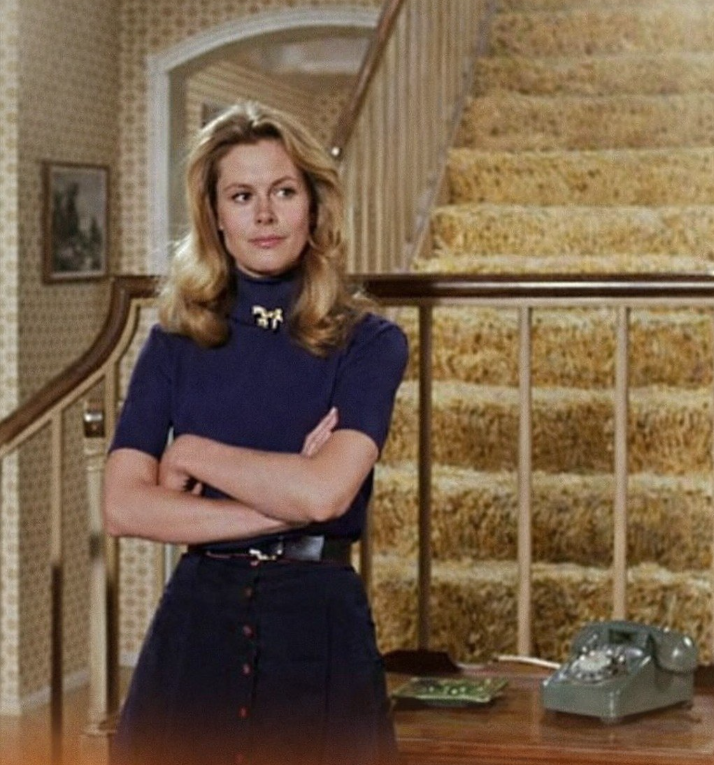
For many generations of television audiences, Elizabeth Montgomery remains forever linked to the image of Samantha Stephens—the thoughtful, compassionate, and quietly independent witch at the center of Bewitched. Though the series premiered in 1964, Montgomery’s portrayal continues to feel relevant decades later, securing its place as one of the most lasting performances in television history. Her impact was never driven by spectacle or novelty. Instead, it stemmed from emotional intelligence, natural elegance, and a subtle strength that defined both her characters and her life.
Elizabeth Victoria Montgomery was born on April 15, 1933, in Los Angeles, into a family deeply rooted in the entertainment world. Her father, Robert Montgomery, was a highly respected actor, director, and producer whose influence extended across film, theater, and television. He was especially known for Robert Montgomery Presents, an acclaimed anthology series that helped elevate early television drama.
Growing up in such an environment exposed Elizabeth early to the rigor of the profession, but it also meant living under constant comparison. From an early age, she understood that access alone would never justify success. Teachers and peers described her as reflective, observant, and quietly driven. Acting was not a privilege she coasted on—it was a discipline she deliberately chose and worked to master.
She pursued formal training at the American Academy of Dramatic Arts in New York City, where she developed a classical foundation in performance. The emphasis on control, nuance, movement, and psychological realism became central to her style. Unlike many contemporaries who relied heavily on charm, Montgomery approached acting as a serious craft. This discipline later distinguished her work on television, where understatement often proved more powerful than exaggeration.
Her early career in the 1950s unfolded largely through television anthology dramas, which were then regarded as the proving ground for serious actors. She appeared in programs such as Studio One, Kraft Television Theatre, Playhouse 90, and The Twilight Zone, earning recognition for her precision and emotional depth. She was frequently cast as women navigating internal conflict or moral complexity—roles that required restraint rather than theatrics.
In 1953, she made her Broadway debut in Late Love, reinforcing her reputation as a serious performer. Although she appeared in feature films like The Court-Martial of Billy Mitchell and Johnny Cool, she increasingly gravitated toward television. At the time, television offered more layered roles for women, while Hollywood often limited actresses to narrow archetypes. Montgomery recognized this disparity early and consistently chose substance over traditional stardom.
Her personal life during these years was marked by change. She married four times, though none of those early marriages brought lasting stability. Later, she found enduring partnership with actor Robert Foxworth. Though they never married, their relationship provided emotional grounding and mutual support, especially in the later years of her life.
The defining moment of her public career came in 1964, when she was cast as Samantha Stephens in Bewitched. Created by Sol Saks, the series followed a witch who marries a mortal man and chooses suburban domestic life, suppressing her powers to conform to social expectations. While the concept was lighthearted, Montgomery brought sincerity and emotional depth to the role.
Under her interpretation, Samantha was never a gimmick. She was intelligent, empathetic, and quietly self-assured—often more perceptive and grounded than those around her, including her husband, Darrin. Without overt rebellion, Montgomery infused the character with quiet authority. Samantha’s restraint, rather than her magic, became the emotional anchor of the series.
Bewitched ran for eight seasons, from 1964 to 1972, becoming one of the era’s most successful sitcoms. Montgomery received multiple Emmy nominations, but the show’s significance went beyond accolades. Over time, Samantha Stephens emerged as a cultural symbol—a woman negotiating power, identity, and autonomy during a decade of rapid social change. Montgomery later acknowledged that the role carried far greater meaning than anyone initially anticipated.
Despite the show’s popularity, she was careful not to be defined by it. Even while filming Bewitched, she continued to take dramatic roles in series such as Alfred Hitchcock Presents, demonstrating her range and resisting typecasting. When the show ended, she faced a familiar crossroads for actors closely tied to iconic roles.
She chose reinvention.
The rise of made-for-television films in the 1970s offered her a new creative direction, which she embraced wholeheartedly. Her post-Bewitched work focused on serious, socially relevant material that demanded emotional courage. In 1974, she delivered a powerful performance in A Case of Rape, portraying a woman confronting both personal trauma and a deeply flawed legal system. At a time when such topics were rarely addressed openly, her restrained and honest portrayal earned critical acclaim and an Emmy nomination.
The following year, she took on one of her most challenging roles in The Legend of Lizzie Borden. Rather than offering clear answers, Montgomery leaned into ambiguity, using silence and psychological tension to chilling effect. The performance was bold, unsettling, and widely regarded as one of the finest of her career.
Through the late 1970s and 1980s, she continued choosing projects centered on moral complexity and social issues, including The Awakening Land, Amos, and Face to Face. These choices reflected her commitment to meaningful storytelling rather than safe or predictable success.
Off-screen, Montgomery became increasingly involved in social causes. She supported civil rights, women’s rights, and LGBTQ+ equality, and was especially outspoken about HIV/AIDS awareness during a period of widespread fear and misinformation. Her activism was sincere and consistent, guided by empathy rather than publicity.
In the early 1990s, she gradually stepped back from public life while continuing to work selectively. Privately, she was battling colon cancer, a diagnosis she largely kept out of the public eye. She passed away on May 18, 1995, at the age of 62, in her Beverly Hills home, surrounded by loved ones.
Her passing stunned fans, but her legacy has only grown stronger. While Samantha Stephens remains a beloved cultural figure, Montgomery’s wider body of work reveals a career shaped by intelligence, courage, and reinvention. She consistently challenged herself and her audience, refusing to be confined by expectation.
Elizabeth Montgomery bridged eras—bringing warmth and wonder to early television comedy, then helping redefine the possibilities of television drama. Decades later, her performances continue to be admired for their emotional honesty and quiet strength.
In an industry often driven by surface and repetition, her career stands as lasting evidence that integrity, depth, and conviction endure longest.