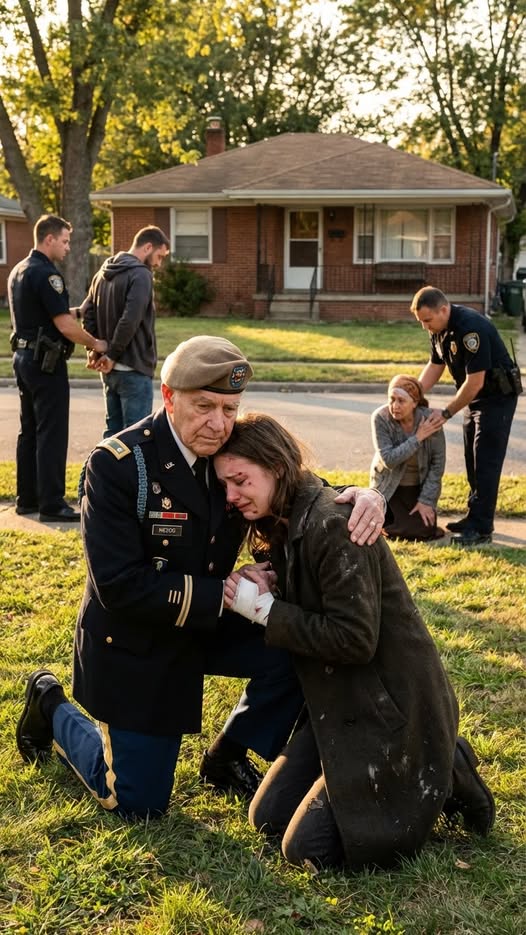
To the neighborhood, I was just Frank—the quiet retiree with a limp and a perfectly kept garden. They saw an aging man in faded flannel and denim, someone whose biggest concern seemed to be roses and aphids. They noticed the gray hair and weathered hands, but they didn’t see the shrapnel buried in my leg from Grenada, or the decades I spent as a Marine Scout Sniper and Chief Instructor of Close Quarters Battle. To them, I was harmless. In truth, I was a weapon that had simply been placed on standby.
Retirement doesn’t erase what a man is—it only redirects it. The hands that once calibrated rifles now pruned stems with the same precision. I lived in quiet agreement with the world: I would remain at peace as long as peace was respected. That agreement ended on a cold Saturday morning in January when my phone rang. It was my daughter, Sarah. Her voice wasn’t screaming—it was worse. A broken whisper, heavy with pain, followed by silence as the call dropped.
Where panic might have overtaken another man, something older and deeper activated in me. My pulse slowed. The garden sounds dulled. Colors sharpened. Frank the gardener stepped aside. Master Gunnery Sergeant Frank Miller was back.
I didn’t rush. Speed without control is useless. I moved deliberately, bypassed my gun safe—firearms are for distance, and this was personal—and drove my old Ford toward Sterling Estates, a place where wealth masqueraded as power. Sarah lived there with her husband Jason and his mother, Eleanor. Their iron gates were meant to intimidate, but to someone who had breached real fortifications, they were decorative. I drove straight through the barrier, across their manicured lawn, and parked on their flower beds.
Jason stood on the porch holding a baseball bat like an actor reciting lines. He talked about discipline and private matters, threatening violence with the confidence of someone who had never earned it. When he swung, it was slow and obvious. I stepped inside the arc and drove a single punch into his solar plexus. The air left his body violently. He collapsed, gasping, helpless.
I stepped over him and followed the sound of my daughter crying. Upstairs, I found cruelty without disguise. Sarah was on the floor, her hair hacked unevenly. Eleanor loomed over her with fabric shears, punishing her for being too sick to perform social duties. I crossed the room and threw Eleanor aside with controlled force—enough to stop her, not enough to kill her.
Sarah was burning with fever, barely conscious. I lifted her—she felt far too light—and carried her to my truck, securing her inside with the air conditioning running.
Then I returned.
Jason had dragged himself upright and began threatening me with lawyers and prison. I pinned him against a brick pillar and spoke quietly—using the voice designed to bypass reason and trigger fear. I told him who I was. I told him what I had done in my life. I told him how little restraint I was choosing to use.
Eleanor was calling the sheriff, screaming about an intruder. I made my own call—on an old flip phone—to a man I once served beside. I reported a Code Black and requested immediate response. The answer came fast.
Sirens arrived within minutes. Captain Rodriguez stepped out first—a man I had once pulled from a burning vehicle overseas. He didn’t look at Jason. He looked at me, stood straight, and saluted. In that moment, everything Jason and Eleanor believed about power collapsed.
Security footage told the rest of the story. They were taken away in zip-ties, stripped of status and protection. As the noise faded, the neighborhood felt quieter—cleaner.
Two weeks later, I was back in my garden. Sarah sat nearby, her hair now short, sunlight on her face. She apologized for not telling me sooner, saying she thought they were untouchable. I told her wealth isn’t power, and noise isn’t strength. Real power is the ability to destroy—and the discipline not to. I reminded her that while the Marine Corps retires its soldiers, a father never stands down.
So I return to my roses. The world sees an old man in flannel, and that suits me fine. Being underestimated is an advantage. I have chosen peace—but my hands remain steady, my tools sharp, and I am always ready.