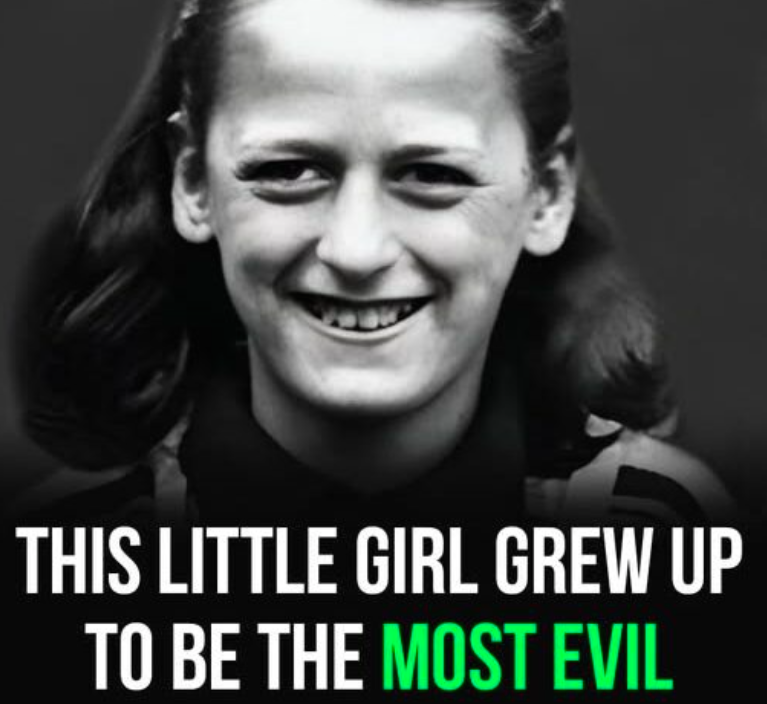
The chilling black-and-white photographs of a young Myra Hindley often strike a discordant note when held against the dark legacy she left behind. In these images, she appears as an ordinary child of her era, with a curious gaze and a slight smile, seemingly unaware of the horror that her name would one day evoke. Born on July 23, 1942, in the industrial city of Manchester, Hindley’s early years were shaped by a world already in turmoil, with the shadows of World War II looming large over everyday life. What is most striking in retrospect is the stark contrast between the innocence captured in these early photographs and the calculated cruelty she would later embrace. The journey from an ordinary, working-class girl to one of the most infamous criminals in the United Kingdom underscores the complex interplay of environment, circumstance, and personal choices that shaped her trajectory.
Her childhood unfolded in a home marked by instability and fear. Her father, struggling with bouts of depression and alcoholism, often created a volatile atmosphere in which domestic violence was an ever-present reality. Her mother, tasked with keeping the family together, lived under constant stress, shielding Myra and her siblings from the worst of the chaos. Psychological studies often point to early exposure to violence as one factor that can predispose individuals to later deviant behavior, though experts stress that such conditions alone do not determine destiny. Hindley’s father, paradoxically, also taught her self-defense techniques, lessons that would later emerge as part of her complex psychological toolkit—a blend of physical resilience and emotional detachment. While she demonstrated intelligence and adaptability in school, the moral guidance that might have helped shape her choices was largely absent, leaving gaps that would later be exploited by external influences.
Teenage years brought further turbulence and pivotal emotional moments. In 1957, the drowning of a local boy with whom she had formed a close emotional bond left her deeply shaken, forcing her to confront mortality and loss at an early age. In the aftermath, she turned to Roman Catholicism with fervent devotion, seeking structure, solace, and meaning in a life that often felt chaotic. Religious rituals and the promise of spiritual salvation briefly offered her a framework through which to navigate her pain. However, this spiritual awakening was fleeting; the fervor that initially guided her moral compass soon waned, leaving a vacuum that would be filled by far darker influences. This period highlights a recurring theme in Hindley’s early life: the oscillation between vulnerability, seeking moral anchorage, and a growing susceptibility to external manipulation.
The decisive turn in her life occurred with her employment at a local chemical company, where she met Ian Brady, a man whose presence would dominate the rest of her life. Their connection was immediate, intense, and transformative. Under Brady’s influence, Hindley was introduced to nihilistic philosophies and the transgressive writings of the Marquis de Sade, which normalized violence and moral disregard. This partnership was both emotional and intellectual, creating a toxic feedback loop where mutual obsession and radicalized ideology replaced conventional ethical boundaries. The pair became inseparable, and within months, their combined influence set the stage for the horrifying crimes that would define their legacy.
Beginning in 1963, Hindley and Brady embarked on a calculated and methodical spree of violence that became known as the Moors Murders. Their victims—children and teenagers—were targeted with chilling precision, and the crimes were characterized by both physical brutality and psychological manipulation. The desolate expanses of Saddleworth Moor were chosen as their burial ground, a location whose isolation mirrored the darkness of their deeds. In total, five young lives were extinguished by their hands, each death leaving a trail of grief and unanswered questions. The disappearance of Keith Bennett, whose remains were never recovered, has remained one of the most haunting aspects of the case, symbolizing the enduring void left by their crimes.
The arrest and trial of Hindley and Brady gripped the United Kingdom, dominating headlines and igniting widespread public horror. Both were sentenced to life imprisonment, yet Hindley’s subsequent behavior behind bars continued to provoke intense scrutiny. Her repeated applications for parole were consistently denied, reflecting a societal judgment that her crimes placed her beyond rehabilitation in the eyes of the public. Until her death in 2002 at age 60, Hindley remained incarcerated, a living symbol of one of Britain’s darkest criminal chapters. Her life story serves as a sobering illustration of the complexity of human morality, trauma, and the capacity for evil, demonstrating how an “ordinary child” can evolve into a figure whose actions reverberate through generations.
Yet, the narrative of Hindley is only one thread in the broader tapestry of events shaping public consciousness in 2026. In consumer culture, debates about symbolic meanings and cultural sensitivity have intensified. For example, retailers such as Target have faced public scrutiny after a shopper flagged a particular sweater as offensive, prompting discussions about corporate responsibility and the evolving role of consumer feedback in shaping retail practices. These disputes underscore the modern interplay between commerce, social awareness, and the collective moral conscience of society.
In health and wellness, a renewed interest in traditional remedies has sparked conversations about alternative approaches to everyday ailments. Reports on garlic oil as a natural antibiotic for earaches, alongside practices such as chewing cloves to aid digestion or freshen breath, illustrate a broader trend of seeking holistic solutions in parallel with conventional medicine. Experts emphasize that while these remedies have historical and anecdotal support, professional medical evaluation remains critical to address potential underlying conditions such as infections or other serious health risks.
Adding a layer of historical intrigue, Oak Island—long the subject of myths and treasure hunting lore—has yielded new developments. Reports indicate a significant find at Smith’s Cove, potentially solving centuries-old mysteries and reigniting global fascination with the elusive treasure. This discovery, blending archaeology, speculation, and folklore, highlights humanity’s enduring obsession with uncovering hidden knowledge and the persistent hope of uncovering the extraordinary within the ordinary.
Meanwhile, the release of documents linked to the Jeffrey Epstein case has continued to create reverberations across the political and social landscape. Figures such as Bill Gates have been drawn into renewed public discussion, compelled to address allegations and clarify past actions. These events demonstrate the ongoing influence of high-profile legal cases on the perception of accountability, transparency, and ethical conduct within the global community.
Finally, the entertainment world continues to revisit its cultural icons. The legacy of actors who brought characters like Columbo to life is undergoing fresh interpretation, revealing the complexity and depth of performers beyond their screen personas. These reflections provide insight into the meticulous craft of storytelling and the nuanced human qualities that shaped beloved figures in film and television.
From the grim reality of Myra Hindley to the evolving narratives of 2026, these stories collectively illustrate the tension between history, morality, and contemporary culture. They remind us that human experience is continuously negotiated across time, from the depths of criminal atrocity to the intricate symbolism of modern consumer life, the pursuit of health, the allure of treasure, and the reinterpretation of iconic cultural figures. Each narrative reflects a society wrestling with its past while simultaneously navigating the demands, curiosities, and responsibilities of the present, underscoring the enduring search for truth, accountability, and meaning.