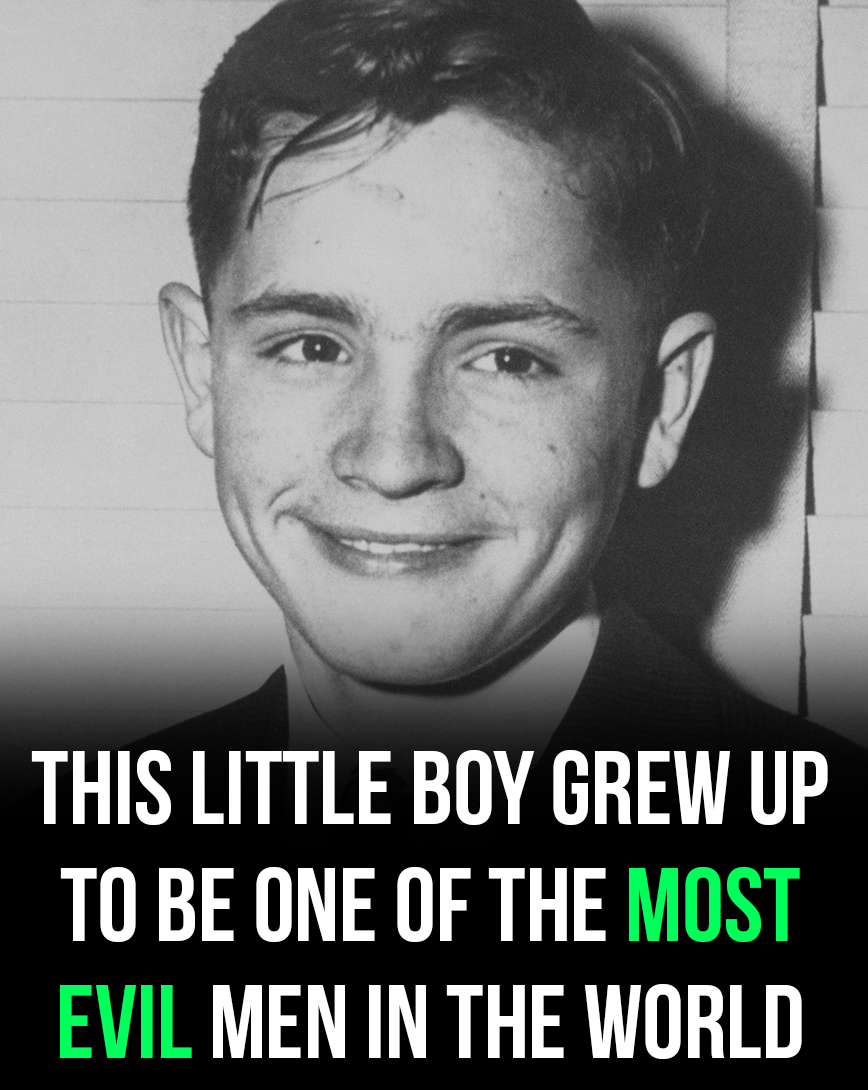
The image of a young boy with wide, curious eyes and a shy, unassuming smile rarely suggests a future defined by blood and madness. Yet, Charles Manson’s life stands as a harrowing reminder that the most destructive forces in society often begin in the quietest, most neglected corners of a child’s existence. To view the childhood photos of the boy who would become the architect of the Helter Skelter murders is to witness a slow-motion disaster, a psychological tragedy shaped by rejection, systemic abuse, and profound emotional neglect.
Charles Manson wasn’t born a monster; he was carefully molded by a society that had no place for him. His early years were a chaotic journey through the underbelly of middle America, starting with a mother who was a teenager trapped in poverty and vice. He grew up learning the most toxic lessons a child can acquire: love is conditional, adults disappear, and survival is a zero-sum game. In the absence of a stable home, state-run institutions filled the void.
Reform schools and juvenile detention centers are meant to rehabilitate, but for Manson, they were more like a dark university. These institutions didn’t heal his psyche—they refined its fractures. Behind bars, he learned the art of the “con.” He saw the world divided into predators and prey, vowing never to be the latter. He learned how to read others’ weaknesses, charm the powerful, and threaten the vulnerable. He became an expert at wearing whatever mask the moment demanded, adapting to mirror the desires and fears of those around him. By the time he was released into the counterculture of the 1960s, Manson had spent more of his life behind bars than free—and he was ready to weaponize the chaos of the streets of San Francisco.
The late 1960s were the perfect breeding ground for Manson’s particular brand of sociopathy. It was an era defined by collective searching—a generation rejecting the rigid structures of their parents’ lives, but not yet finding a new foundation. Into this vacuum stepped Manson, a man who spoke the language of revolution but held the heart of a tyrant. To the lost, the lonely, and the searching, he offered more than just a philosophy; he offered a sense of belonging. He understood that the greatest human hunger is to be seen and accepted, and he used that hunger to create a “Family” of followers who reflected his darkest fantasies back at him with religious fervor.
Manson’s genius lay in his ability to wrap extreme violence in the soft language of peace and communal love. He twisted the ideals of the Haight-Ashbury scene—freedom, shared living, and spiritual enlightenment—into a psychological prison. He didn’t just lead his followers; he consumed their identities. Through isolation, sleep deprivation, and the strategic use of hallucinogens, he broke them down until their will was entirely subsumed by his own. The murders that eventually shocked the world—the brutal slaughter at the Tate and LaBianca residences—weren’t erratic eruptions of evil; they were the inevitable end of a life warped from its beginning. They were the final act of a man who, unable to be part of the world, chose to burn it down so he could reign over the ashes.
Charles Manson’s legacy is often treated as a tabloid curiosity, a relic of a strange time. But the deeper truth of his story is far more uncomfortable. It forces us to confront the structural failures of our own era. Manson was a product of a broken foster care system, an inadequate juvenile justice system, and a society that looked away from the “disposable” children of the poor. His life is a series of missed opportunities for intervention—moments when a single act of compassion or effective mental health support might have changed history.
When we look at the harmless-looking boy in the old black-and-white photos, we are forced to ask a question that haunts our modern social fabric: how many future monsters are we quietly creating, right now, in plain sight? We live in a world where children still fall through the cracks of overburdened systems, where neglect is still an invisible epidemic, and where the internet has created new, digital “alleys” for the lost to find the wrong kind of belonging. The radicalization of the vulnerable by charismatic, predatory figures is not a phenomenon of the past; it has merely moved into new arenas.
The story of Charles Manson is a cautionary tale about the high cost of indifference. It reminds us that when we fail to provide a stable, loving foundation for a child, we create a void that will inevitably be filled by something else—and that something is rarely benign. It teaches us that the masks of charm and spiritualism can hide a bottomless well of resentment. Most importantly, it reminds us that evil is rarely a bolt from the blue. It is a slow-growing vine, nurtured by the very institutions meant to prune it, until it chokes the life out of everything it touches.
As we reflect on the carnage associated with the Manson name, we must look beyond the spectacle and into the source. The boy in the photograph was once just a child who needed a home, a name, and a reason to believe in the goodness of others. Because he found none of those things, the world eventually had to reckon with the man he became. The tragedy of Charles Manson isn’t just what he did to his victims, but what a broken world did to the boy he used to be—and the terrifying reality that the same machinery of neglect is still in operation today.