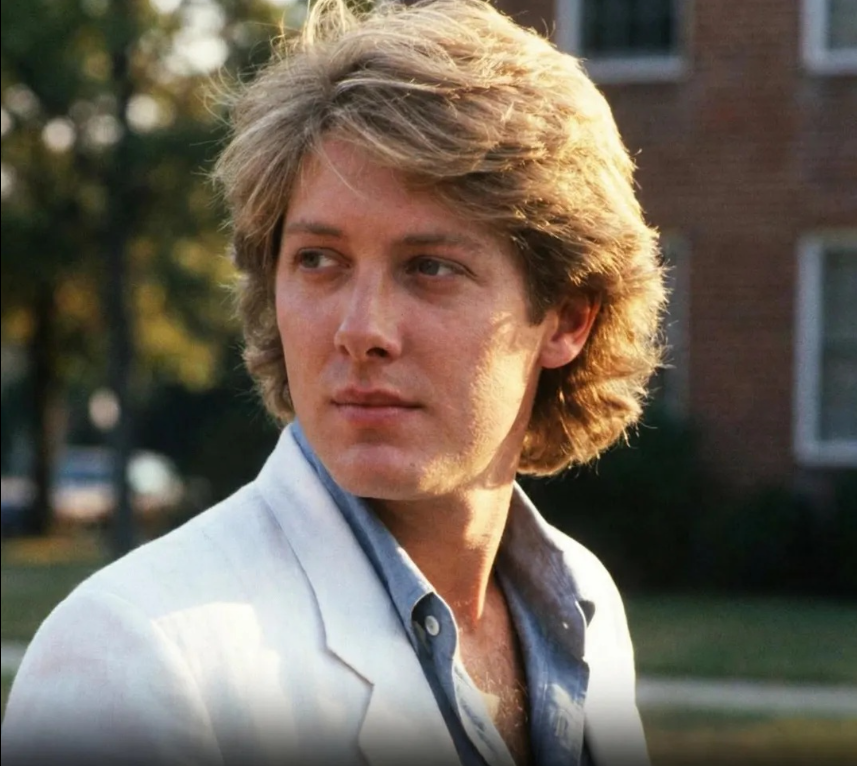
James Spader has always existed as a paradox—an actor who can dominate a scene with a single glance, yet retreats instantly into near-invisibility the moment the cameras stop. At 65, he still carries that unmistakable gravitational pull that made him an icon of 1980s cool, but he moves through life with the careful quiet of someone who has never been seduced by the noise surrounding fame. His performances are known everywhere; the man himself remains elusive, almost spectral, as if he’s made of equal parts presence and absence. It’s not shyness. It’s intention. Spader has always chosen stillness in a world that demands spectacle.
He was born in Boston to parents who lived their lives in the structure and precision of private-school education. His childhood was filled with the rhythms of academic life—books, order, expectations. His siblings stayed on that track. Spader didn’t. Even as a teenager, he felt the call of something undefined but insistent, something that wouldn’t fit within the boundaries of classrooms and carefully drawn futures. At seventeen, he walked away from Phillips Academy, not out of rebellion, but conviction. He took a bus to New York City on the quiet but unshakable belief that acting was his life’s path.
New York didn’t welcome him with open arms. It rarely does. Spader supported himself however survival allowed—moving freight in warehouses, teaching yoga at cramped studios, tending bar during late-night shifts, even driving trucks when the rent was due and auditions were scarce. These were the years that carved his edges: messy, raw, unglamorous. The kind of years that young actors either break under or are sharpened by. For Spader, they were the furnace that forged discipline, intuition, and the uncanny emotional precision that would later define his performances.
Yoga wasn’t just income—it was connection. It was where he met Victoria Kheel, a decorator whose creativity mirrored his own. They built their early life together in tiny apartments full of mismatched furniture, half-finished art projects, and dreams that required more faith than practical sense. She would become his wife and the mother of his two oldest sons. Their world was improvised and financially chaotic, but it was also deeply formative, a period Spader never romanticizes yet never diminishes.
Then came the 1980s—the decade that cracked open Hollywood for him.
His breakthrough role as Steff in Pretty in Pink was a masterclass in cold charisma. He portrayed entitlement with such chilling elegance that audiences walked away remembering the villain as much as the heroes. It could have caged him in typecasting, but Spader refused the easy route. He was drawn to complexity, to depth, to characters who hid more than they revealed.
Everything changed with Sex, Lies, and Videotape. His performance wasn’t just impressive—it was revelatory. He captured quiet emotional disarray with such subtlety that critics and audiences alike reconsidered what young male leads were capable of. Winning Best Actor at Cannes propelled him into a different echelon, proving he wasn’t simply a nostalgia artifact of the ’80s but a serious, layered performer.
The 1990s and early 2000s became Spader’s artistic proving ground. He took roles that required fearlessness: morally ambiguous men, fragile men, calculating men. But none would define him quite like Alan Shore, the brilliant, abrasive, morally slippery lawyer he played in The Practice and Boston Legal. Shore was a walking contradiction—a crusader with questionable ethics, a cynic with a bleeding heart. Viewers adored him for it. Spader won three Emmys for a character no one expected to become beloved. It was the perfect Spader role: intellectually sharp, emotionally intricate, and performed with microscopic precision.
Through all of this, he built and defended a private life that has remained almost mythic in its quietness. Privacy isn’t an aesthetic choice for Spader—it’s a survival strategy. He has long been open about struggling with obsessive-compulsive tendencies and his need for strict boundaries between work and personal life. He rejects the digital world almost entirely, using an old flip phone and avoiding computers. He doesn’t engage with social media. He keeps his home life separate, structured, and intentionally uneventful. These habits aren’t limitations—they’re the architecture of a life lived deliberately.
Spader’s marriage to Victoria ended in 2004, but life carried him forward to a new chapter with actress and sculptor Leslie Stefanson. With her, he welcomed another son in 2008. Becoming a father again at a later age softened him, redirected him, slowed him in the most meaningful way. During the pandemic, while Hollywood paused and scrambled, Spader simply disappeared into the daily rituals of fatherhood, long walks, quiet mornings, and routines that grounded him.
Public sightings of him are rare by design. After The Blacklist, where he embodied Raymond Reddington with delicious menace and gentlemanly charm, Spader once again slipped into near-invisibility. Then, out of nowhere, came the 2025 photographs from Tara Summers’ wedding in Morocco—images of an older, weathered, more settled Spader. Social media exploded. Some lamented the signs of age; others admired the authenticity. But most understood: here was a man who had lived exactly the way he wanted to, untouched by Hollywood’s fear of aging.
And that’s the essence of James Spader’s legacy. While many actors spend their careers reinventing themselves to stay relevant, Spader has remained unwaveringly himself. He selects roles with surgical care, prioritizes meaning over exposure, and refuses to perform off-camera for a world that constantly demands more access. His power lies not in ubiquity, but in scarcity. His mystery isn’t a gimmick; it’s a discipline.
He is no longer the ’80s heartthrob whose sly smirk melted audiences. He has become something far more enduring—a craftsman of rare precision, a man who values presence over attention, and an actor whose depth grows richer with every disappearing act. His legacy is carved not from public spectacle, but from an unwavering commitment to authenticity, intellect, and emotional truth.
James Spader’s life is not one of reinvention but refinement. And in an industry built on noise, his silence has become his loudest, most compelling signature.