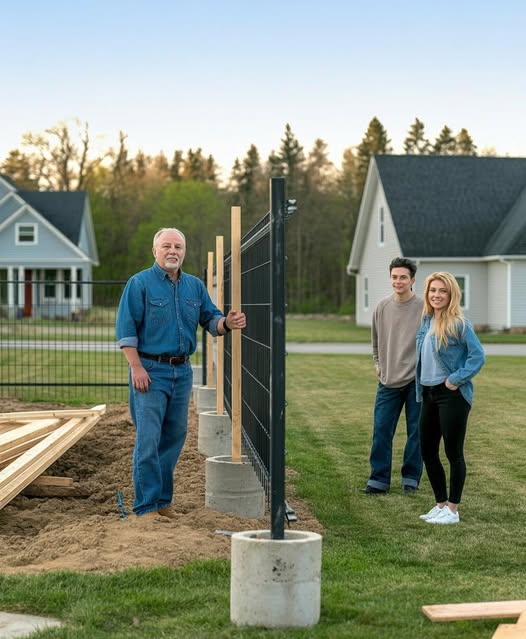
I noticed it before anything else—the house, the trees at the edges of my property turning orange and red, even Daisy barking from inside the truck where I’d left the window cracked. It was the light. Too much of it. My headlights swept across the yard as I turned onto the gravel drive, and where there should have been wood and shadow along the north boundary, there was only open air. Through that gap, I could see straight into my neighbor’s patio, warm yellow light spilling from a string of bulbs stretched between two posts, and the silhouette of a volleyball net where there had been, just a week ago, the enclosed privacy of my land.
I stopped the truck halfway up the drive, engine running. Daisy pressed her nose to the glass, trying to understand what I already did. I cut the headlights. In the dark, the absence of the fence was even sharper. Jagged silhouettes of broken posts jutted from cracked concrete footings, boards piled carelessly on my side like debris cleared without thought.
Their boys played under the net, laughing, diving in the grass. Ethan Carter stood on the back patio with grilling tongs, flipping something over the flame, the picture of a man having a perfectly ordinary Tuesday evening.
I stepped out of the truck slowly.
To understand what I felt moving across that yard toward him, you need to know what that fence meant. Not just legally or structurally—though both mattered—but personally. I spent my thirties in Charlotte in construction management, grinding through long hours, city noise, and a life dictated by other people’s schedules. At forty, I promised myself a quiet place of my own, somewhere I could control.
I bought three wooded acres on a gravel road in 2014. Nothing spectacular, just hardwood forest, good soil, and night so silent you could hear your heartbeat. I built the fence in 2016—six feet of pressure-treated pine in concrete footings, every eight feet, along the full north boundary. I dug every post hole with a rented auger that nearly dislocated my wrists on the rocky ground. My friend Caleb helped on weekends, and when we finished, we sat on overturned buckets with cheap beer, smelling fresh-cut pine, and I remember thinking: this is it. This is what I’ve been working for.
That fence kept Daisy in, deer out, and the world at a manageable distance. Closing the gate at night brought a simple sense of completion city life never had. The previous owners, an older couple downsizing to be closer to family, never complained. We waved from our driveways, sometimes spoke of the weather. For years, it was the arrangement I wanted.
The Carters arrived in spring—Ethan and Mara, mid-forties, two boys, an SUV from Illinois, and the energy of newcomers assuming smaller places will bend to them. Ethan visited the day the moving truck arrived—firm handshake, good smile, scanning my property while talking. He mentioned remote work for a Chicago tech firm, wanting a slower pace for the boys. Mara talked about community and “opening things up.” I didn’t think much of it then.
About a month later, I found Ethan at the north boundary, fingers hooked over the top rail, inspecting the fence with the look one gives a used appliance left at the curb. He turned when he heard me coming with Daisy.
“You ever think about taking this down?”
I scratched Daisy behind the ears. “Taking what down?”
“This.” He patted the rail. “It’s a little much, don’t you think? We could open the yards, make a shared space. The boys would have room to run. Feels more like a neighborhood.”
“I built that fence,” I said. “It’s my property line. I like privacy.”
He smiled, slightly delayed, as if covering something. “Property lines are just lines on paper,” he said. “We’re in this together now, right? Community.”
“Not that kind of community,” I replied, keeping my tone even. “Fence stays.”
He held my gaze longer than necessary, then nodded with the careful neutrality of a man filing something away for later. I walked back to the house and didn’t think much of it. Maybe I should have.
The next few weeks felt orchestrated. Their boys developed a habit of kicking soccer balls against the fence panels in long, repetitive sequences—not playing, just testing resonance. Mara mentioned at the mailbox how closed-off the neighborhood felt compared to their old place in Lake Forest. One Saturday, Ethan had a contractor over, measuring the boundary. When I asked, he said just exploring options, the easy vagueness of someone who knows they don’t have to explain themselves.
The week I left for the Gulf Coast, Ethan saw me loading the truck. “Heading out?” he said. “Just a few days,” I replied. “Beach break.” He smiled. “Enjoy the openness.” I thought it was casual, meaningless. Seven days later, I turned onto my gravel driveway at dusk and understood exactly what he had meant.
I walked across the exposed dirt line toward his patio, suspended in that unreal state where something so clearly wrong has already happened but your brain hasn’t caught up yet. Ethan turned from the grill as I approached. He didn’t flinch—not in his face, not in his posture. “Welcome back,” he said, casual, as if nothing required accounting.
“What happened to my fence?” I said.
“We took it down. It was an eyesore.”
I said his name once, low, and he kept talking. Their landscape architect had said flow between properties would be better without a barrier. The boys needed room. Healthier, more open, better for everyone. Most of the wood was already at the dump. Disposal had cost twelve hundred dollars; we could split it over Venmo if I wanted.
There’s a kind of anger that doesn’t run hot. Cold, deliberate, precise—body and mind aligned in measured outrage. I stood in the cooling evening, Daisy pacing behind me, yard exposed, and looked at Ethan’s untroubled face. This wasn’t thoughtlessness. Thoughtlessness carries awkwardness, acknowledgment of a line crossed. This was something else. He had decided my preferences about my land were a problem to manage, not a reality to respect—and acted while I was gone because timing was convenient.
I told him the fence had been mine, on my property, legally installed. He said, “You’ll adjust. Once you get used to the openness, you’ll thank us.” I walked back to my house without another word, pulled out my phone, and photographed everything—the broken posts, cracked concrete sleeves, piled boards, volleyball net planted directly over my boundary.
Then I went inside, sat at the kitchen table with Daisy’s head on my knee, and called Laura Bennett.
Laura had been two years behind me in high school, one of those people you loosely keep in touch with across decades. Law school, a real estate practice, a reputation for precision and unflappability. I hadn’t talked to her properly in years. When she answered, I said I had a situation. “Tell me,” she said.
I recounted everything. She was quiet as I spoke. When I finished, she asked me to send the photographs. I did. A few seconds later, I heard her open them. Silence followed.
“They did what,” she said. Not a question—just the articulation of someone seeing a thing clearly and naming it.
“I’m not sure what my options are,” I said.
“This is textbook trespass and destruction of property,” she said. “They entered your land and removed a legally installed structure. This isn’t a neighborhood disagreement. It’s deliberate.” She paused. “Hear me: deliberate. Whatever story they’re telling themselves, they waited until you were gone.”
I hadn’t realized how much I needed someone to say that aloud. Since getting home, a quiet, corrosive voice had asked if I was overreacting, whether this was a cultural difference, whether reasonable people could see it as a misunderstanding. Laura’s voice cut through it with surgical clarity.
“What do we do?” I asked.
“We start with a demand letter. Immediate restoration at their expense. If ignored, escalate.”
“Do it,” I said.
She drafted the letter that afternoon. I read it the next morning and it was everything I couldn’t have written myself: precise, legal, referencing the county property records, my original survey, and the building codes allowing six-foot privacy fencing on residential lots of my classification. It cited specific statutes. Nothing soft to push against. She sent it certified mail and emailed a copy directly to Ethan. Then we waited.
Two days later, the response came—not from Ethan, but a firm in downtown Chicago: three attorneys on letterhead, polished yet condescending. They claimed the fence had been structurally compromised, a potential safety hazard, removed in good faith to address shared aesthetic concerns. Somewhere in the second paragraph, they used the phrase “shared property,” which was not accurate by any definition. Their “resolution”: a three-foot decorative hedge along the “approximate boundary,” suggesting the legal line was open to interpretation.
Laura read the letter aloud in her office. She paused, blinked once, the expression of someone whose assessment is confirmed rather than challenged. “They’re trying to reframe this as a landscaping preference dispute,” she said. “If it becomes about taste or aesthetics, they think they have wiggle room. We keep it on the legal facts.”
She filed an emergency injunction with the county court. Photographs, survey plat, building permits, property records summary, demand letter, Chicago firm response—all attached. Within a week, we had a hearing date.
Word travels fast in small towns. By the court date, half the people on our road knew something was happening. Caleb drove over to sit in the back row, a simple act of support. Mrs. Delaney from down the road squeezed my arm on the courthouse steps. “Don’t let them bully you,” she said, matter-of-fact, having seen plenty of bullying dressed in suits.
The Carters arrived looking like they were attending a corporate presentation—Ethan in a jacket, Mara with a leather portfolio—the performance of people signaling they belong in formal settings. They didn’t look at me.
Judge Whitaker, silver-haired with the patience of someone long familiar with human games, reviewed the photographs at a measured pace, then looked at Ethan with a quiet, penetrating calm.
“You removed a fence that was not on your property,” he said. A question framed as such, but not really a question.
Ethan began explaining deterioration, open space, shared benefit. Whitaker raised a hand. “Was it on your property?” Ethan hesitated for the briefest, most revealing fraction of a second. “Technically, the boundary may—” Whitaker interrupted: “Was it on your property?” Ethan said, “No, your honor.”
The courtroom went quiet—the kind of quiet that follows a central fact spoken aloud.
Whitaker looked at the survey plat, then back at Ethan. “You do not get to redefine property lines because they’re inconvenient. The plaintiff’s fence was lawfully permitted and established. You will restore it to original specifications within fourteen days, at your expense. Failure to comply will result in penalties and sanctions.” He tapped the documents. “That’s all.”
Outside, Ethan approached, voice low, cutting yet plausible: “This is ridiculous. You’re turning a neighborhood misunderstanding into something adversarial.”
I looked at him. “You tore down my fence. That was the adversarial act. Everything else is response.”
He shook his head, the small performative shake of a man who believes reality is unreasonable, and walked to his car, Mara a step behind.
The next fourteen days became a lesson. No contractors. No materials delivered. Volleyball net stayed in place. On day eight, a small fire pit appeared on their side, near the old boundary, positioned with precision suggesting intent. On day thirteen, Laura called Ethan directly with me on speaker.
“Tomorrow is your deadline,” she said. “When does reconstruction begin?”
Ethan’s voice smooth, structural in its ease: “We’re evaluating our options.”
“One option,” Laura said. “Rebuild the fence.”
“We may pursue an appeal.”
“You can appeal from behind a restored fence,” she said, and ended the call.
That night, I lay in bed with the ceiling fan turning, distant crickets, intermittent laughter drifting from the open yard that shouldn’t have been open. I thought about the full shape of what had happened: not just the fence, not just the law. I thought about Ethan’s face when he said “enjoy the openness” that morning, the completeness with which he planned this, the calm with which he stood at the grill flipping burgers when I returned, as if demolishing my property boundary were a favor. I traced every small pressure—the soccer balls, the measuring tape, casual “shared space” comments—tests to see whether I’d give ground before he acted.
There is an anger that doesn’t explode. It accumulates, quiet and precise. By day fifteen, when Laura called at five-thirty to say they hadn’t filed an appeal and hadn’t rebuilt anything, that anger had become something less like emotion and more like building material.
“You want the original fence back?” Laura asked. Careful and knowing, she already understood the question wasn’t simple.
“I want something they can’t mistake,” I said.
She exhaled. “I thought you might say that.”