The humid Virginia afternoon pressed down on Richmond, a typical Saturday filled with the mixed scents of floor wax and bakery sweets. It could have been any ordinary day, one destined to fade into the blur of life, yet for my wife Danielle and me, it became a moment that drew a firm line in the sand. Danielle was inspecting peaches, softly humming a jazz tune only she knew. After thirty years of marriage, simply watching her was still my greatest privilege. She carries herself with quiet dignity, her dark hair neatly braided, a calming anchor in a world that often feels chaotic.
I leaned against the grocery cart, an unremarkable fifty-eight-year-old man named Mark in a faded polo shirt, content to blend into the background. Yet twenty years in the Marine Corps left me with instincts that never sleep. I felt the change before I heard it: the prickle at the back of the neck, the unmistakable sense of a predator nearby. Four college-aged men had appeared by the apple display. Backwards baseball caps, university logos, arrogance untested by consequence.
The tallest smirked and tilted his chin toward Danielle. “Damn,” he said, loud enough to pierce the calm. “Didn’t know they allowed that kind of mix in here.”
Time seemed to slow. Nearby shoppers avoided eye contact, clutching plastic produce bags as if they could make themselves invisible. Danielle’s shoulders tensed, a subtle sigh escaping her lips—the sound of someone long accustomed to such small, sharp intrusions.
I turned slowly. No scowl, no puffed chest, just a smile—the one I’d perfected on Parris Island. In the Corps, you learn that shouting is for the untrained. True power is stillness. I held his gaze, watching the smirk falter as he realized he had misjudged me.
Danielle placed a gentle hand on my arm. “Mark, not here. Don’t,” she whispered. She was right, of course. We paid for our groceries and stepped into the bright, oppressive heat of the parking lot, silence heavy with unspoken words. But the hostility didn’t leave.
“Hey, old man!” a high-pitched voice called from behind. “You protecting your charity case?”
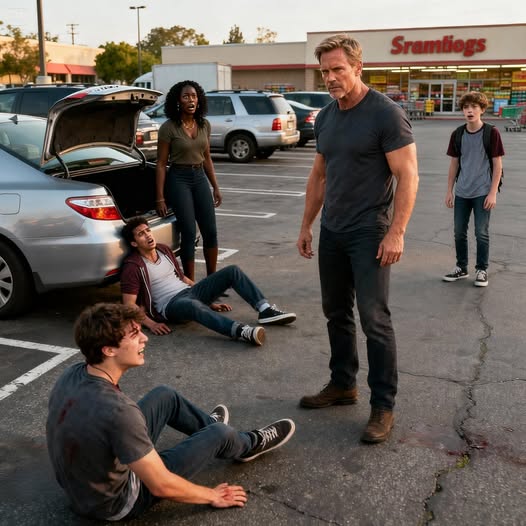
Danielle’s hand trembled in mine—not from fear, but from tightly contained rage. I had spent my life learning when to release that force. As we reached the car, I placed the bags in the trunk, eyes scanning the four who now fanned out before us. The instigator held a fountain soda, flicking it in contempt—spattering Danielle’s yellow sundress.
Time slowed further. Danielle’s sharp intake of breath marked the escalation. Neutralization became the only objective. I stepped forward with precision, every move deliberate.
The first boy, the one with the drink, misread my approach. He flailed; I grabbed his wrist and used his momentum to pivot him to the asphalt. No harm done, but submission became inevitable. The spilled soda ran across his sneakers.
The tall leader lunged next, swinging a wild punch. I sidestepped, delivering a calculated nudge to his shoulder that sent him crashing into a parked car, triggering the alarm.
The bulky third froze, intimidated by the scene. I commanded him to leave. He scrambled, abandoning the chaos.
The fourth, a silent observer, paused. Security approached. With hesitation, he admitted the truth: the others had attacked, I had only intervened.
The guard took in Danielle’s stained dress, the fallen boys, and my calm demeanor, then nodded. All was fine. We drove home, the car smelling faintly of peaches and soda. That night, I reflected on the lessons of restraint versus violence. My years defending ideals overseas mattered little if I couldn’t protect my own in a parking lot.
Two days later, the fourth boy came alone, guilt evident in his posture. He apologized for his friends and himself, handing me an essay he’d written for his school. Danielle read it over my shoulder, resting her head against my back. “Your patience taught more than your fists ever could,” she whispered.
She was right. Violence addressed the immediate threat, but the discipline behind it reached the only soul worth saving. Those other boys would carry the story of the “crazy old man,” but one of them had learned that true strength is calm, measured, and purposeful. My smile had never been a threat alone; it was the quiet declaration that what is sacred will always be protected.