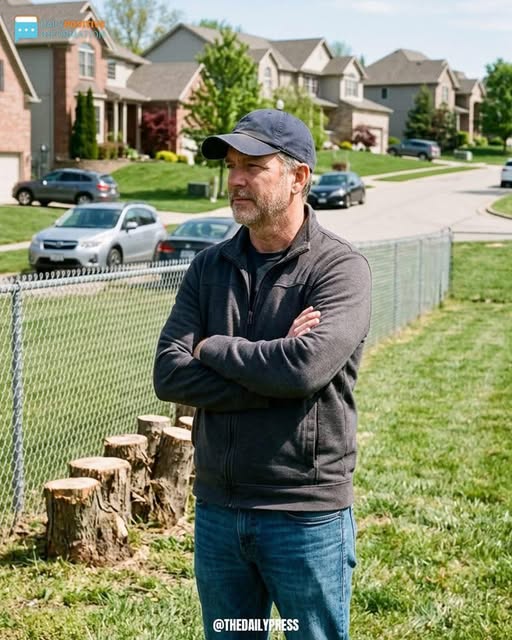
They cut down my trees just so they could have a better view. That’s the short version—the one you tell someone casually over a drink when they look at you like you’re crazy and say, “You didn’t really do that.”
But yes. I did.
My name is Eli Morrison. I’m forty-three, and I’ve lived on my property in the foothills above Boulder, Colorado, my whole life. What happened that Tuesday afternoon set off a chain of events that taught the whole neighborhood a lesson about respect, boundaries, and what can happen when people assume they have the right to reshape the world around them without asking first.
The full story starts on a day that seemed perfectly ordinary. A day so normal it almost hurts to remember, because it reminds you how quickly everything can change when someone decides your land is just an obstacle to their ideal view.
When a Phone Call Changed Everything
I was halfway through a turkey sandwich at my desk when my sister Mara called. She never calls during work unless something serious is happening—bleeding, fire, or a legal nightmare. I answered with my mouth full, skipping the usual small talk.
“Hey, what’s up?”
All I could hear for a moment was wind and her breathing, like she’d been running or pacing outside, trying to process something her brain hadn’t yet caught up with.
“You need to come home. Right now.”
There’s a certain tone people use when they’re trying not to panic. I’ve heard it in emergency rooms and police stations. That afternoon, it was in my sister’s voice: tight, controlled, barely holding together.
“What happened?” I asked.
“Just come home, Eli. Please.”
I didn’t even properly shut down my computer. I grabbed my keys, muttered something about a family emergency to my manager, and rushed out. My office was in Boulder, so the drive home wound through the city and then up into the foothills—a route that should have taken thirty-five minutes but I managed in twenty-eight, pushing the speed limit and running a yellow light that was probably red by the time I crossed.
Pine Hollow Road is a narrow, two-lane path through the foothills. I always get uneasy there in bad weather, when the curves tighten and visibility drops. That afternoon, the sky was perfectly clear—bright blue, birds likely chirping, a day Colorado does best. Still, my stomach felt twisted.
The moment I turned onto my property road, I knew something was wrong before I even saw it.
Landscapes feel different when something familiar disappears. It’s like when you take a picture off the wall—you can still see the empty space, a ghost of what was, a void that instantly draws your attention.
The six sycamore trees along the eastern edge of my land were gone.
What I Found at Home
They weren’t damaged by wind. They weren’t pruned, trimmed, or partially cut. They were simply… gone.
These trees had been there for decades—thick trunks, tall branches, leaning slightly toward the sun, growing steadily. My father planted three of them when I was eight; the other three came later. Together, they formed a solid green wall that shielded my house from the ridge above, from the view of the homes built five years ago, perched as if they owned the valley below.
Now six fresh stumps lined the dirt.
The cuts were perfectly flat. Clean. Professional. The branches had already been hauled away, and even the sawdust had mostly been swept aside, as if someone had tried to tidy up the scene before leaving—like they knew, on some level, that what they’d done demanded a cleanup.
Mara stood near the fence, arms crossed tightly over her chest. She was in her work clothes—yoga instructor attire—which meant she had left her studio to be here, to witness whatever I was about to see, to try and make sense of it before I arrived.
She didn’t apologize. She didn’t say it was awful or unbelievable.
She just shook her head. “I tried to stop them.”
“What do you mean, you tried to stop them?”
She explained that two trucks had shown up late that morning. Company logos on the doors, workers in orange safety shirts and hard hats, equipment buzzing with professional efficiency. She had asked what they were doing. One man told her they were “just following the work order.”
“Whose work order?” she asked.
“Cedar Ridge Estates HOA,” he said.
I blinked. Tried to make sense of the words.
Cedar Ridge Estates—the gated development on the ridge above my land. A place that had sprung up five years ago, with its stone entrance sign, decorative fountain running even during droughts, massive houses, and massive opinions about what the landscape should look like and which views they were entitled to from their multimillion-dollar lots.
“We’re not part of Cedar Ridge,” I said. “We’ve never been part of Cedar Ridge.”
“Exactly,” Mara replied.
She pulled a business card from her pocket, the one left under my windshield wiper that morning: Summit Tree & Land Management. A phone number. A website promising professional landscaping and land management services.
I called the number, my hands feeling steadier than the rage inside me—the controlled fury of someone who sees something precious destroyed by people who never asked permission.
A man answered after two rings.
“Summit Tree, this is Brad.”
“Brad,” I said evenly, “why did your crew cut down six sycamore trees on my property this morning?”
A pause. Papers rustled. I could imagine him rifling through work orders, trying to justify what his crew had done, trying to understand why the homeowner was calling.
“Well, sir, we received a work order from the Cedar Ridge Estates HOA for lot boundary clearing along the south overlook.”
“That overlook isn’t their land,” I said. “It’s mine. Always has been.”
Another pause. Longer this time. The kind that happens when someone realizes they might have made a huge mistake.
“Sir… the HOA president signed the authorization. They said the trees were encroaching on community property and blocking the neighborhood’s view corridor.”
View corridor.
I almost laughed. Almost. But anger kept me silent.
As if forty-year-old trees were nothing more than an administrative inconvenience, a line item on a spreadsheet: obstacles to view optimization.
“Well, Brad,” I said, “those trees were planted decades before Cedar Ridge existed. This property has never belonged to your HOA. You cut down trees on land you don’t own, based on authorization from people with no authority to give it.”
Silence. The kind that fills a phone line when someone knows they’re wrong but doesn’t yet grasp the cost of that wrongness.
Then he said something that made my jaw clench.
“Sir… if there’s been a mistake, you’ll need to take that up with the HOA.”
The Moment I Realized My Options
I stared at the six stumps again. The hillside where my father’s trees had stood, the shade that would never return, the privacy stripped away, the living memory of my childhood erased—all sacrificed for someone else’s view.
And then I understood something with absolute clarity.
The people up on that ridge had treated my land as nothing more than an obstacle to their scenery. A problem to be solved, a line item to manage, a landscape “issue” that could be fixed by removing what was inconvenient.
What they didn’t know—couldn’t have known—was that the only road into Cedar Ridge Estates ran across the lower corner of my property.
And I owned every inch of it.
My father had made that explicitly clear when he drew up the easement agreement forty years ago.
The History of the Property and the Agreement
My father bought twenty acres in these foothills in 1978. He built our house with his own hands and planted those sycamores when I was eight. I remember digging the holes, handing him the saplings, feeling the soil in my palms as we planted something meant to outlast us both.
When he died five years ago—suddenly, from a heart attack—he left me everything: the land, the trees, the easement rights, every property boundary.
Including the private road cutting across the southwest corner—the quarter-mile stretch connecting Cedar Ridge Estates to Pine Hollow Road—the only practical road for the entire development.
Here’s why this matters. My property sits in a valley, lower elevation, accessible to public roads. Cedar Ridge Estates sits above, with better views, higher-value lots, and its own ideas about entitlement.
When the developers built Cedar Ridge, they needed road access. A public road would have required county approval, land acquisition, and heavy construction costs. The only viable path was across my father’s property.
They approached him with offers. Money for a permanent easement. Rejected. More money. Rejected again.
Finally, they proposed a compromise: they would fund the road’s construction and maintenance in exchange for a permanent easement, while my father would retain ownership.
He agreed—but insisted on one clause, the kind of clause I would fully appreciate the day my trees were cut.
The easement could be revoked if Cedar Ridge violated the terms—if they damaged my property, interfered with my use, or failed to maintain the road properly.
A protective measure he never thought he’d need. But one that held immense power.
Discovering the Clause
After hanging up with Brad from Summit Tree, I retrieved the easement agreement from the manila folder in my father’s “Property Documents” box. I read carefully, anger mounting with every paragraph, until I found it—the clause granting us leverage.
“The grantor reserves the right to revoke this easement upon thirty days’ written notice if the grantee or its members cause material damage to the grantor’s property or interfere with the grantor’s quiet enjoyment of the land.”
Six mature sycamores—cut down without permission, without notice, without a single courtesy.
Material damage. Interference with quiet enjoyment.
I called my lawyer, Patricia Chen. She’d handled my father’s estate and understood the history better than anyone.
“Patricia, Cedar Ridge Estates cut down six trees on my property this morning.”
“They what?”
“Without permission. They claim a surveying error, but I have the easement agreement—and the revocation clause.”
She paused. “Do you have it handy?”
“Right here.”
“Read me the revocation clause.”
I did.
She whistled. “Eli… that’s a nuclear option. If you revoke the easement, Cedar Ridge has no road access. They’d be landlocked.”
“I know.”
“And you’re sure? The HOA will likely sue. It could drag on for years.”
I looked at the stumps, the bare hillside, the vanished shade, the message: Your land is ours to manage.
“I’m sure,” I said. “They made a decision about my property without asking me. Now I’m making a decision about theirs.”
The Letter That Started Everything
Patricia drafted the notice. Formal. Legal. Citing the damage, the violation, and the clause giving me the right to enforce consequences.
“This letter serves as formal notice of revocation of the easement granted to Cedar Ridge Estates HOA on March 15, 2019. Per Section 7(b) of the agreement, this revocation takes effect thirty days from the date of this notice due to material damage caused to the grantor’s property by actions authorized by the grantee.”
I hand-delivered it to the HOA president’s mailbox that evening—Gordon Hale, mid-fifties, real estate developer, the kind of man who wears polo shirts with his company logo and thinks loudness equals authority.
Then I waited.
Two days later, certified mail arrived from the HOA’s attorney:
“Dear Mr. Morrison, We are in receipt of your notice of easement revocation dated [date]. While we acknowledge an unfortunate miscommunication regarding tree removal, we do not believe this constitutes grounds for revocation under the agreement. The trees in question were believed to be located on HOA property based on survey records. We request an immediate meeting to resolve this matter amicably.”
I called Patricia. “They’re calling it a miscommunication.”
“Of course. Did they offer to pay for the trees?”
“No. They want a meeting to ‘resolve it amicably.’”
“Do you want to meet?”
I thought about my father planting those trees when I was eight. About Gordon Hale signing an authorization to remove them because they blocked his members’ view. About the assumption that my land existed only to serve them.
“No. The notice stands. Thirty days.”
The Escalation
Calls started on day ten.
Gordon Hale himself, trying to sound calm, panicked underneath.
“Eli, we need to talk. Let’s be reasonable. Neighbors work things out.”
“I gave you notice. It’s legal. It’s final.”
“You can’t just cut off road access to an entire neighborhood. There are kids, elderly people, emergency services—”
“You cut down six trees on my property. Without asking. Without permission. Without notice.”
“That was a surveying error—”
“No. That was arrogance. You decided my trees were in your way. Now my road is in yours.”
He tried to argue. I hung up.
On day fifteen, the HOA called an emergency meeting. I wasn’t invited, but Mara went. She called me afterward.
Gordon called me unreasonable, accusing me of holding the neighborhood hostage over a “minor landscaping dispute.”
A resident asked what would happen if the easement got revoked. Gordon admitted:
“We’d have no legal road access. We’d be landlocked. Property values would tank. We’d have to sue for access, which could take years.”
The room went quiet.
Someone asked why they had cut down trees that weren’t on HOA land.
“A good faith error based on outdated surveys,” Gordon claimed.
Half the room didn’t buy it. The newer residents—three-million-dollar homes, now landlocked—looked betrayed.
By day twenty, Gordon came to my door. No lawyer. No entourage. Just him, exhausted, defeated.
“Eli. Please. Let’s figure this out.”
“There’s nothing to figure out. You damaged my property. I’m revoking the easement.”
“I’ll pay for new trees. Replant. Apologize publicly.”
“My father planted those trees when I was eight. You can’t replant forty years. You can’t replant memory.”
“What do you want? Money? Compensation?”
“I want you to understand my land isn’t yours to manage. That you don’t get to make decisions about my property just because it affects your view.”
“I understand now—”
“You understand because you’re about to lose your road. Not because you actually respect boundaries.”
He offered escalating money, new HOA rules, mediation, arbitration. I refused everything.
The Final Decision
This wasn’t about money. It was principle. My land is not a scenic backdrop. My father’s trees were not a landscaping problem.
Day thirty arrived. The easement was officially revoked.
I put up a gate, locked it, posted a sign: “Private Property. No Trespassing.”
Within hours, my phone rang. Angry residents couldn’t get home.
“You can’t do this! How do we reach our houses?”
“That’s between you and your HOA. They violated the easement.”
Gordon tried sending residents through anyway. I called the sheriff; they were cited for trespassing.
The HOA filed an emergency injunction. Patricia argued back: access was lost because they violated the agreement. The judge denied it. The revocation was legal. Cedar Ridge Estates was landlocked.
The Fallout
The impact was immediate. Property values dropped twenty percent in a month. Residents couldn’t sell, refinance, or get deliveries. Some abandoned homes. Some sued their agents. Some sued me.
The HOA sued me; I countersued for tree value, emotional distress, and legal fees.
Eight months later, we settled.
The HOA paid $150,000.
Issued a formal apology.
Agreed to strict restrictions near property boundaries.
Agreed to notify me of any future landscaping affecting my property.
I granted a new easement—with stricter terms, higher penalties, and a clause that if they ever touched my property without written permission, revocation would be permanent, no appeal.