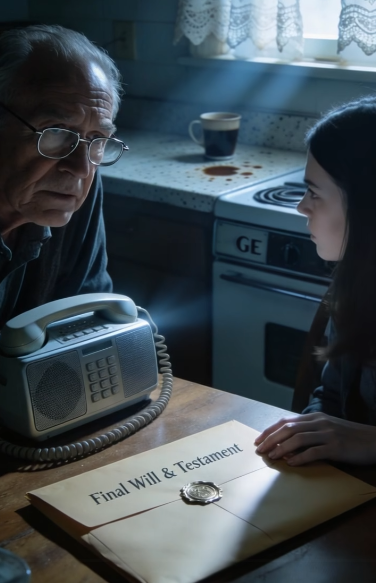
The phone vibrated against the pinewood surface of my kitchen table at exactly 7:12 a.m.—an hour that exists in a strange in-between. Too late for casual chatter. Too early for normal business. Precisely the time bad news chooses to arrive. The caller ID displayed one word, heavy with authority: Dad. My father doesn’t call to talk. He calls to command, to announce decisions already made, to rearrange lives without consent. I answered, already bracing for impact.
His voice was flat, carefully controlled, rehearsed to sound final.
“Grandpa died last night,” he said. The lie landed cleanly, almost clinically. “Funeral’s Friday. He left everything to us. You’re out.”
For a split second, the room felt airless—not because I believed him, but because of what I heard behind his voice. In the background, my mother laughed. Not softly. Not awkwardly. It was sharp, satisfied. The sound of someone enjoying the moment they’d been waiting for. Then she spoke clearly, deliberately:
“Finally. You’re done.”
I could have reacted the way they expected—shock, grief, panic. Instead, I looked up from the phone.
Across the table sat my grandfather, Arthur. Alive. Solid. Holding his favorite chipped ceramic mug, steam rising in slow curls around a face set in stone. His hands were steady. His eyes were clear, piercing, alert in a way that made my stomach tighten.
Between us lay a thick cream-colored envelope stamped with a law firm’s letterhead. Proof. Not emotion—evidence.
I didn’t interrupt the call. I didn’t argue. I calmly switched to speaker and slid the phone across the table, placing it between us like a recording device in an interrogation room.
Emboldened by my silence, my father continued. He spoke about the house, the investment accounts, the northern land. About “handling the paperwork”—a phrase that, in his vocabulary, usually involved forgery and chaos. He was celebrating too early.
Arthur’s jaw tightened by a fraction. He leaned forward slowly, deliberately, like a blade being raised. His eyes met mine. Ready?
I nodded.
Then he spoke one word into the phone.
“Hello.”
The silence on the other end was immediate and complete.
When my father finally spoke again, his voice was stripped bare.
“Dad?”
“I heard everything,” Arthur replied calmly.
Panic followed. My father scrambled for excuses—miscommunications, mysterious phone calls, misunderstandings. Arthur shut it down instantly.
“You didn’t say you got a call,” he said. “You said you got everything.”
Then came the facts.
At 6:48 a.m., a death notification request had been submitted to First National Bank. At 6:52, Arthur received a fraud alert tied to a newly created estate email address. Banking systems don’t care about family—they care about timestamps.
“This is what’s going to happen,” Arthur said coldly. “At nine o’clock, we’re meeting my attorney. Elena will be there. And this call will be played.”
My mother attempted a last-minute pivot into false concern. Arthur ended it with a single sentence.
“I’m well enough to sign—and well enough to revoke.”
At Vance & Associates, Ms. Vance didn’t waste time. She confirmed that my father had already requested death certificates, attempted beneficiary changes, and tried to update property deeds. It wasn’t grief—it was a coordinated takeover.
Worse still, an emergency guardianship petition had been filed, claiming Arthur was mentally incompetent and being manipulated by me. They were laying the groundwork to erase him legally while he was still breathing.
Then my phone buzzed.
A motion alert from Arthur’s cabin camera.
On the screen, we watched my father’s cousin Eddie standing on the porch with a locksmith, fake court documents in hand, attempting to access the lockbox.
Arthur didn’t hesitate. He called the sheriff.
“This is fraud,” he said. “Not confusion. Fraud.”
By the 2:00 p.m. hearing, the narrative had collapsed. The judge listened to the recording. Reviewed the bank logs. Saw the timestamps.
The guardianship petition was dismissed with prejudice in under four minutes.
That evening, Arthur stood outside his cabin, studying the scratches on the doorframe. He handed me a notarized amendment—prepared days earlier—formally disinheriting his children and naming me sole executor.
“They didn’t want me gone because they cared,” he said quietly. “They wanted me gone because I was in the way.”
My father thought one phone call could end my world. Instead, he documented his own downfall.
This wasn’t a family dispute. It was a case file.
The District Attorney is now reviewing charges for elder abuse and attempted fraud. Arthur is alive. The cabin is secure. And the silence in the driveway is no longer a warning—it’s peace, finally earned.