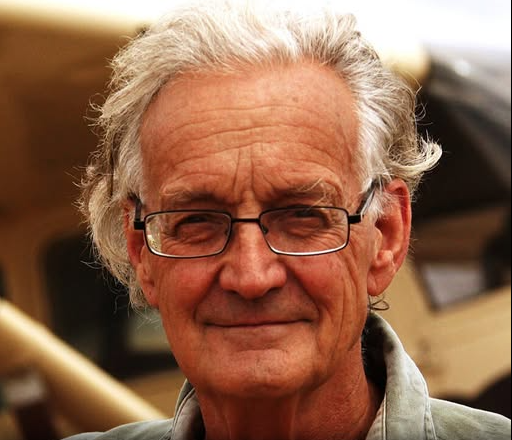
Actors, musicians, and political figures are regularly remembered by the world, while those who subtly alter humanity’s relationship with nature are much less usually honored. That stillness was heavier than normal this week. The world’s conservation community is grieving the passing of Iain Douglas-Hamilton, a man whose life’s work changed how people perceive, safeguard, and live with elephants without aiming for celebrity.
At the age of 83, Douglas-Hamilton passed away at his Nairobi home, leaving behind a bereaved family as well as an indispensable gap in environmental research, global biodiversity advocacy, and wildlife conservation. It would be an understatement to describe him as a zoologist. He was a field scientist, a trailblazer, a whistleblower, and most importantly, a human-elephant translator.
Elephants were frequently viewed as spectacles or symbols prior to Douglas-Hamilton. They were acknowledged after him as sentient beings with memory, intelligence, sophisticated social structures, and the ability to think, feel, and grieve. Governments, environmentalists, and the general public were compelled by his findings to face the unsettling reality that we were misinterpreting elephants rather than only posing a threat.
Tributes came in from all around the world. He was “a man who dedicated his life to conservation and whose work leaves a lasting impact on our understanding of elephants,” according to Prince William, who also said that he would always remember his time spent in Africa with Douglas-Hamilton. Charles Mayhew described him as “a true conservation legend whose legacy will endure long after his passing,” echoing the view expressed by conservation leaders.
Douglas-Hamilton was born in Dorset, England, in 1942 into an aristocratic family. His early years could have been uneventful and comfortable. Rather, he opted for one that was characterized by dust, peril, and intense exposure to nature. He attended Oxford and Scotland to study biology and zoology before relocating to Tanzania in his early twenties and settled close to Lake Manyara National Park. What started off as scholarly inquiry quickly evolved into a lifelong endeavor.
Douglas-Hamilton regarded elephants as unique individuals at Lake Manyara, which was revolutionary at the time. He discovered that he could identify them by the minute variations in their personalities, scars, tusks, and ears. He monitored long-term decision-making, mourning customs, leadership structures, and family ties. He once remarked, “Nobody had yet lived with wildlife in Africa and looked at them as individuals.” The foundation of contemporary elephant behavioral science was established by that realization.
However, this close comprehension was accompanied with a terrifying insight. Douglas-Hamilton recorded elephant deaths in addition to their lives. Poaching was an industrial-scale slaughter, not a singular crime. He exposed the full extent of the destruction caused by the ivory trade through risky airborne surveys. Whole herds were disappearing. Once-vibrant landscapes were becoming quiet.
There were risks associated with his work. During his investigation, armed poachers even shot at him, swarms of bees almost killed him, and elephants assaulted him. But he continued, gathering indisputable information that startled international organizations and governments into taking action. An important milestone in the history of wildlife preservation was reached in 1989 when the international ivory trade was outlawed thanks in large part to his research. Later, he boldly called the problem “an elephant holocaust.”
Douglas-Hamilton helped the world realize that elephants “are capable of feeling just like humans,” according to renowned primatologist Jane Goodall, who co-starred with him in the 2024 documentary A Life Among Elephants. One of his most significant achievements is the change from considering elephants as resources to acknowledging them as sentient beings.
Douglas-Hamilton started Save the Elephants in 1993, and it is currently one of the most significant wildlife conservation groups worldwide. He invented the use of GPS tracking on elephants long before it was commonplace, exposing hundreds of kilometers of migratory routes and showing how elephants employ memory, environmental signals, and human pressure to make strategic decisions.
Iain impacted the future “not just for elephants, but for huge numbers of people across the globe,” according to Douglas-Hamilton’s son-in-law and CEO of Save the Elephants Frank Pope, who emphasized Iain’s bravery, moral clarity, and intellectual rigor. Conservation under Douglas-Hamilton’s direction shifted from being reactive to being data-driven, deliberate, and internationally coordinated.
His influence extended to the highest echelons of authority. Partnerships with world leaders such as Xi Jinping and Barack Obama paved the way for the 2015 U.S.-China agreements that severely curtailed ivory markets, delivering a devastating blow to illicit wildlife trading networks.
Douglas-Hamilton won numerous international awards during his more than 60-year career, including the Indianapolis Prize, the Order of the British Empire, and the title of Commander of the British Empire. But according to others who knew him, praise never inspired him. Coexistence was his real obsession.
He previously stated, “I think my greatest hope for the future is that an ethic of human-elephant coexistence will be developed.” It was a real requirement rather than a romantic ideal. He realized that conservation would not succeed if it did not take into consideration the requirements of both the local population and the wildlife.
Douglas-Hamilton’s six grandkids, daughters Saba and Dudu, and wife Oria survive him. However, his influence goes well beyond his family. It spreads throughout Africa in the form of safe migration routes, less poaching, well-informed policy choices, and thousands of elephants whose existence is directly attributable to his efforts.
He stated that “for human beings to come into balance with their environment, to stop destroying nature” was his ultimate goal. That dream feels both urgent and unfulfilled in a society increasingly characterized by environmental breakdown and climate fear.
Humanity is getting closer to comprehending what that balance looks like because of Iain Douglas-Hamilton. And the elephants are still able to walk because of him.