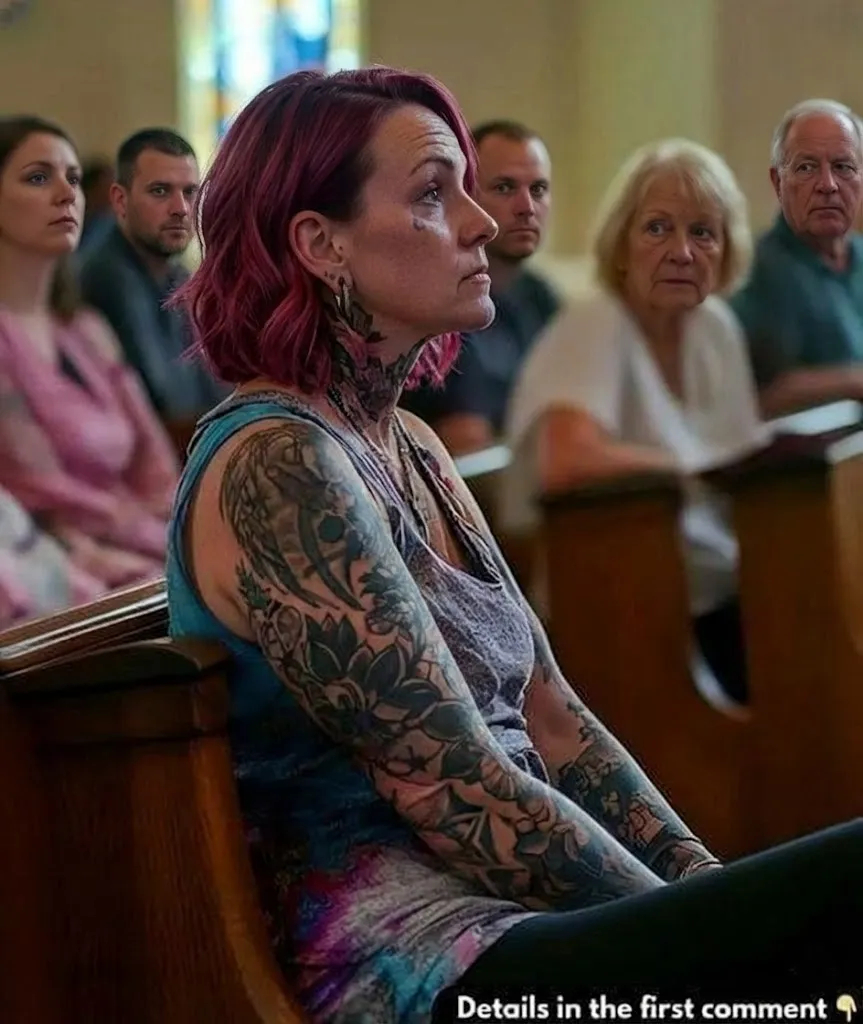
The first thing she noticed were the tattoos. They snaked up the stranger’s arms, curling in intricate patterns, vivid and unapologetic. They were unlike anything she had seen in her usual pew, the kind of visible, permanent declaration of individuality that seemed, at first, almost sacrilegious in the quiet solemnity of the church. Then came the piercings—small silver hoops catching the morning light, glinting with defiance. Every detail made her stomach tighten, a knot of unease and indignation rising in her chest. She had grown up in this congregation believing that appearances mattered: neat hair, modest clothing, quiet demeanor. She had been taught that respect was visible, that reverence could be measured in the way one presented oneself, and that God’s house demanded compliance with those unspoken rules.
As the organ hummed the final chords and the congregation began to file out, she felt a surge of righteous responsibility. Someone had to guard this sacred space. Someone had to ensure that holiness was not marred by what she had been taught were distractions, signs of disrespect, or moral laxity. Her steps quickened, her heart pounding in her chest as if it were echoing the rhythm of judgment itself. She rehearsed her words under her breath, each syllable sharpened with moral certainty. She was prepared to correct this stranger, to teach her—gently, firmly—about the boundaries of a sacred place.
But when she reached the woman, her voice ready to lecture, the stranger looked at her without defensiveness, without shame, without even surprise. Instead, she spoke with quiet authority, a calmness that seemed almost like a counterpoint to the rising storm within her: “How I look has nothing to do with you.” The words were simple, almost deceptively so, but they hit with the weight of truth. They didn’t shame her with anger; they didn’t provoke a debate. They simply placed responsibility back where it belonged—on herself, not the other. In that moment, all the certainty she had carried for years, all the rules she had memorized about what was “proper,” felt suddenly small, brittle, insufficient. The scripture she had clung to, the hymns she had sung, the prayers she had whispered with such devotion—they did not come with instructions about tattoos or piercings.
She walked home that Sunday feeling more exposed than the woman she had intended to correct. The sensation was strange, disorienting, and almost humiliating. She replayed the scene in her mind again and again: the tightening of her jaw, the tension in her shoulders, the judicious care she had taken to maintain her composure, and the stranger’s steady gaze, calm and unwavering, holding a mirror to her own assumptions. That single sentence, simple yet profound, had pried open a door she hadn’t known existed. For decades, she had equated “reverence” with a narrow image of what a faithful person should look like—pressed clothes, muted tones, familiar faces, and the quiet discipline of conformity. And yet, the question now loomed larger than any lesson she had ever been taught: Had she been defending holiness, or simply guarding the boundaries of her own comfort?
The weeks that followed were filled with subtle awakenings. She began to notice those she had previously overlooked, the people who had slipped in quietly, often unnoticed. There was the single mother who came straight from work, clothes smudged with ink and paint, carrying a toddler on one hip and a thermos in her hand. There was the teenager with shocking blue hair, who belted every hymn with abandon, eyes closed in something more profound than performance. There was the man who never missed a prayer, his jeans worn and patched, shoes scuffed from years of walking a thousand invisible miles. Their appearances, once distractions in her mind, now became irrelevant; it was their devotion, their presence, their stories that touched her. She realized, slowly and reluctantly, that a sacred space is desecrated far less by tattoos than by cold hearts at the door.
Her definition of “appropriate” began to shift, almost imperceptibly at first. It was no longer a question of style or dress code, no longer an evaluation of conformity to unspoken societal rules. It became a question of authenticity. Of humility. Of a willingness to show up fully, even if imperfectly, even if unconventionally. She learned to recognize grace in the cracks, to find holiness in ordinary, messy human lives. In surrendering her narrow judgments, she found the sanctuary finally felt spacious, open, and alive. It was wide enough for the woman she had judged, wide enough for every child, every parent, every soul who sought refuge there. And, perhaps most surprisingly, it was wide enough for her, too.
Over time, she began to understand that faith was not about control, nor about policing appearances, nor about rigidly defining what is right and wrong in a way that others could see. Faith was about presence, about love, about acceptance, about offering a space where people could arrive as they were and still belong. She started to carry that lesson beyond the walls of the church, into her interactions with neighbors, coworkers, and even strangers on the street. The same patience, the same willingness to see people in full complexity, became her measure of reverence in life itself.
She never forgot the woman with the tattoos and piercings, nor the calm, unwavering words that had shifted something deep within her. That brief encounter became a lens through which she learned to look at the world: a reminder that appearances are often misleading, that judgment can be unearned, and that grace is not bound by expectation. Her understanding of holiness had expanded to include imperfection, diversity, and courage. And in that expansion, she found freedom—freedom from fear, from judgment, from the need to control the lives of others.
The sanctuary, once a place defined by rules and appearances, became, at last, a place of living, breathing grace. And she realized that in allowing that woman to exist without scrutiny, she herself had been granted a gift: a lesson in humility, a glimpse of the divine in unexpected places, and a reminder that every human being carries their own story, their own scars, and their own quiet sanctity.