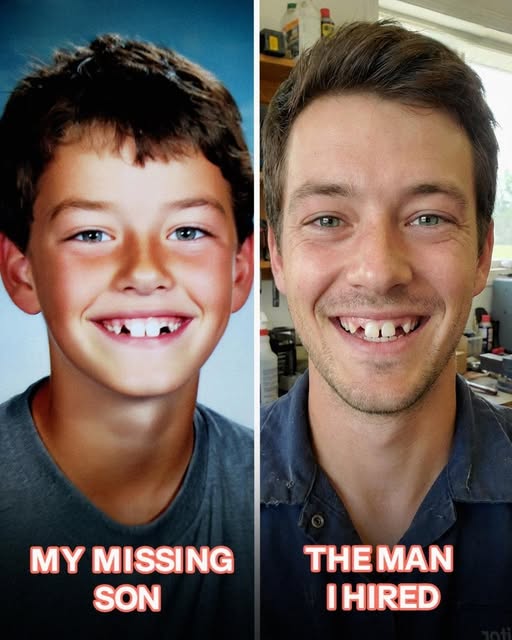
Losing a child leaves behind a kind of emptiness that nothing—not time, not distraction—can ever truly fill. For fifteen years, I lived in that silence after my eleven-year-old son, Barry, disappeared. We searched everywhere—lakes, forests, every place imaginable—but in the end, there were no answers, only the quiet conclusion that he was gone. My wife, Karen, and I were left with a pain that never faded and a house that felt too big without him. To cope, I threw myself into work at my small hardware store, moving through life without really feeling it.
Everything shifted one ordinary afternoon while I was going through job applications for a janitor. One resume made me stop. The name read “Barry,” but it was the photo that shook me. The young man was twenty-six, older and hardened by life, but there was something undeniable in his face—the same smile, the same features my son might have had. Even though there was a gap in his past due to time in prison, something inside me pushed me to call him.
When he walked into my office the next day, the resemblance felt even stronger. He didn’t hide his past. He admitted his mistakes and said he wanted a second chance. My wife strongly disagreed—she didn’t want someone with that history in our lives—but I hired him anyway. I couldn’t explain it, but being around him felt like something I had lost was somehow close again.
Over time, he proved himself. He worked hard, treated people with respect, and slowly became more than just an employee. He started joining us for meals, spending time with us, almost like part of the family. For the first time in years, I felt something close to healing. But while I grew closer to him, Karen grew more uneasy, her concern turning into suspicion.
Everything came to a head one Sunday evening. During dinner, he seemed nervous, dropping his fork and barely speaking. Karen finally couldn’t hold back anymore. She accused him of hiding something and demanded he tell the truth she claimed to have discovered. The room fell silent as he lowered his head and began to speak.
What he revealed changed everything. Fifteen years ago, he had been there the day my son disappeared. He had gone with him and a group of older boys to a quarry, trying to fit in. When things became dangerous and the boys were forced onto a narrow ledge above the water, he panicked and ran. My son stayed behind—likely hoping to be accepted, to belong.
For years, he carried that guilt. He later learned what had happened and couldn’t escape the weight of it. It followed him into a life that led to prison. Eventually, he decided to find us—not by accident, but because he needed to tell the truth. He just couldn’t bring himself to say it sooner, especially after we showed him kindness.
That night, I couldn’t sleep. I thought about my son, about the boy who had run, and the man now standing before me. And I realized something—he had been trapped in that moment just as much as we had. This wasn’t about revenge. It was about finding peace.
The next morning, I met him in my office. I told him that even though he wasn’t my son, he didn’t have to carry that guilt anymore. By forgiving the frightened boy he once was, I was finally able to honor the son I had lost.
We embraced.
And for the first time in fifteen years, the silence I had been living with was replaced by peace.