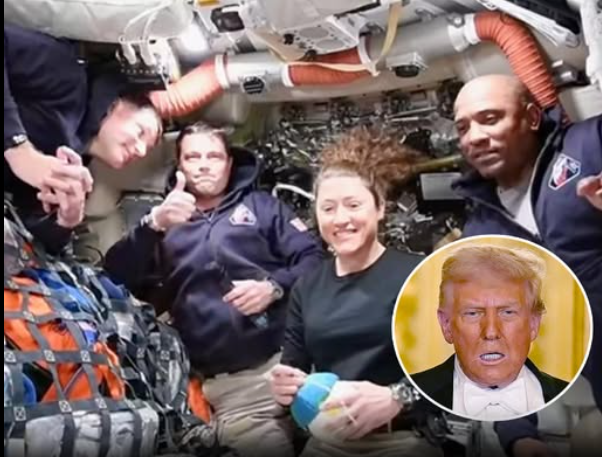
The vacuum of space is naturally silent, but on April 7, 2026, a different kind of quiet—dense with tension, confusion, and political undertones—settled inside the Orion spacecraft. As the four-person crew of Artemis II completed their historic loop around the far side of the Moon, marking humanity’s long-awaited return to deep space, they were scheduled for a ceremonial call with the Oval Office. What was meant to be a celebration of American ingenuity and a display of soft-power diplomacy instead collapsed into a surreal sixty-second silence that has since ignited social media and left political analysts searching for meaning. A moment intended to symbolize a “giant leap for mankind” instead stumbled into something unexpectedly fragile.
The setup was as high-stakes as it gets. Millions watched a live stream of Reid Wiseman, Victor Glover, Christina Koch, and Jeremy Hansen floating in microgravity, their faces lit by the soft glow of Orion’s instruments. Beneath them, the Moon’s barren surface drifted past—silent, immense, and indifferent. Then President Donald Trump’s voice crackled through the comms. He began with a sprawling tribute to the crew’s courage, comparing them to historic explorers before shifting into a long, winding analogy involving hockey legend Wayne Gretzky and “skating to where the puck is going to be.”
When the President finished, the conversation simply… stopped.
After Jeremy Hansen offered a brief, polite thank-you on behalf of the crew, silence took over. On Earth, it may have been only seconds, but in a live global broadcast from lunar orbit, each moment stretched unnaturally. The astronauts hovered in place, smiles carefully maintained, exchanging quick glances that said more than any transmission. No follow-up. No “over.” No closing exchange. Just four elite astronauts suspended in microgravity, waiting in a silence that refused to resolve.
Online, the reaction was immediate. Clips of the “frozen” exchange spread across X and TikTok within minutes. Interpretations fractured along familiar lines. Some called it a subtle political snub. Others insisted it was a communications glitch, a relay delay turning conversation into dead air. Whatever the cause, the optics were unmistakable: sixty seconds of silence in space felt like an eternity.
The tension finally broke when Mission Commander Reid Wiseman reached for the floating microphone. “Mr. President, are you still with us?” he asked calmly, his voice cutting through the static. A delayed response followed, prompting nervous laughter from the crew. Wiseman then lightened the moment with a joke about “roaming charges to the Moon,” easing the strain between Earth and orbit. The President eventually signed off, but the ceremony’s intended polish had already unraveled.
NASA and the White House later attributed the incident to a standard deep-space communication delay, compounded by relay timing issues. Such transmissions rely on the Deep Space Network—stations in California, Spain, and Australia—and brief delays are expected. A full minute of near-silence, however, remains unusual for a scheduled presidential exchange.
Unsurprisingly, the moment became a digital Rorschach test. Critics pointed to the crew’s restrained body language as evidence of discomfort or disapproval. Supporters blamed technical failures or bureaucratic mishandling. But for most viewers, interpretation mattered less than impact. What they saw was simple: even at a quarter-million miles from Earth, communication can still break down in profoundly human ways.
The episode has now secured its place in the strange catalogue of space history—somewhere between triumph and awkwardness. Artemis II remains a monumental success, a stepping stone toward humanity’s permanent presence on the Moon. Yet for many, the defining image of the mission may not be the lunar flyby or the capsule’s return, but those sixty seconds of suspended silence: four astronauts drifting above the Moon, waiting for a voice that didn’t arrive, while the entire Earth watched.
It was a reminder that in deep space, nothing is quite as loud as a silence everyone is trying to interpret.