The truth didn’t arrive with drama or thunder. It didn’t kick down the door or crash into my life in a way that demanded immediate attention. Instead, it crept in almost imperceptibly, gentle and quiet, as if it didn’t want to disturb the ordinary rhythms of a Tuesday afternoon. It arrived on the back of a DNA test, the kind you order online and almost forget about until the results show up out of the blue. It found its voice in a trembling confession, shared between two old friends over lukewarm coffee at a corner table in a cafe we’d visited countless times before. For years, everything had seemed so simple—my friendship with Sarah had weathered heartbreak, distance, and the slow changes of adulthood. We’d shared secrets, holidays, and endless cups of tea. But there are some truths that even the closest friends might be too afraid to say out loud.
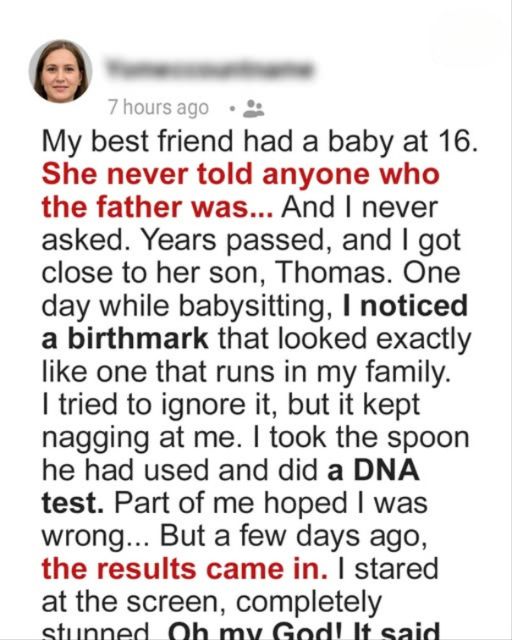
One small birthmark, shaped like a comma, resting on a toddler’s shoulder, managed to shift my entire world. I’d seen it as Thomas was playing on the living room rug, lining up his toy trucks with a focus that only little boys seem to possess. That birthmark was so familiar it stopped my breath for a moment, echoing one my brother and I both shared since childhood. I’d borrowed a spoon from Sarah’s kitchen, the kind of casual gesture that happens a thousand times between friends, and watched as Thomas giggled and ran to his mother, unaware of the tidal wave that was about to hit us both. That spoon, that afternoon, that moment—each became the first crack in a wall Sarah had built and protected for years, ever since she was sixteen and facing choices that would ripple through our lives.
When the DNA test results arrived, they didn’t just spell out a biological connection—they forced me to look at Sarah differently, to reconsider the friend I thought I knew inside and out. The facts were clear, but the story behind them was tangled and full of quiet pain. Instead of feeling betrayed, I found myself thinking about how heavy it must have been for Sarah to carry this secret alone, afraid of disrupting the fragile peace we’d built. I saw not a betrayer, but a young girl who had chosen silence out of necessity, out of hope to protect her child, and maybe, in some way, to protect me from a truth she didn’t know how to explain.
The confession itself was understated, more a whisper than a revelation. “Thomas’s father is your brother,” Sarah said, her hands wrapped tightly around a coffee cup, eyes searching mine for anger or understanding. The room seemed to hold its breath, as if the universe itself had paused to watch what we would do next. In that moment, everything hung in the balance—the history we shared, the family I thought I knew, and the child who had brought us both so much unexpected joy.
But anger never came. Instead, what filled the space between us was an overwhelming sense of tenderness, a recognition that the past can never be changed, only understood and accepted. We chose honesty, even though it was hard, and we chose compassion, even though it required letting go of old assumptions. We made a conscious decision that our future—mine, Sarah’s, and especially Thomas’s—would not be defined by shock or disappointment, but by love and the willingness to embrace a new kind of family.
Now, when Thomas runs into my arms, laughing and calling my name, I see him with new eyes. He is no longer just my best friend’s son; he is my nephew, a living, breathing extension of my family. He is proof that even the most unexpected revelations can strengthen the bonds we value most, transforming what could have been a moment of rupture into one of deeper connection. Every time I hold him, I am reminded that the truth, no matter how quietly it arrives, has the power to heal and to unite—and that sometimes, the family we discover is even richer than the one we thought we had.