December always made my mother’s kitchen feel smaller somehow, crowded not by people but by memory. The air carried the scent of roasted ham, cinnamon, butter, and exhaustion — the smell of a woman working beyond her limits because she believed love should still feel warm even when life was hard. Growing up, Christmas Eve in our apartment followed the same sacred rhythm every single year. Pots clattered against the stove. Silver spoons tapped against ceramic bowls. Steam fogged the windows while old music played softly from a worn radio balanced near the sink. My mother worked three jobs just to keep us afloat, yet somehow she always found enough money to create a feast that made our tiny apartment feel rich for one night.
But the most important plate she prepared never stayed on our table.
When I was little, I used to watch her wrap that plate carefully in thick foil as though she were packaging something fragile and precious. She always slid it into the same brown paper bag and tied the handles into a tight knot before putting on her coat. The first time I asked who the food was for, I couldn’t have been older than eight.
“Someone who needs it,” she answered gently.
At the time, that explanation satisfied me.
By fourteen, it irritated me.
We barely had enough ourselves most years. I didn’t understand why my mother insisted on giving away our best food when we struggled constantly to survive. Our town loved pretending it was a caring community, but poor people still moved through it half invisible, tolerated more than truly seen. I couldn’t understand why my mother chose to spend precious energy feeding someone she didn’t even know.
Every Christmas Eve, our destination remained exactly the same:
A run-down twenty-four-hour laundromat near the edge of town.
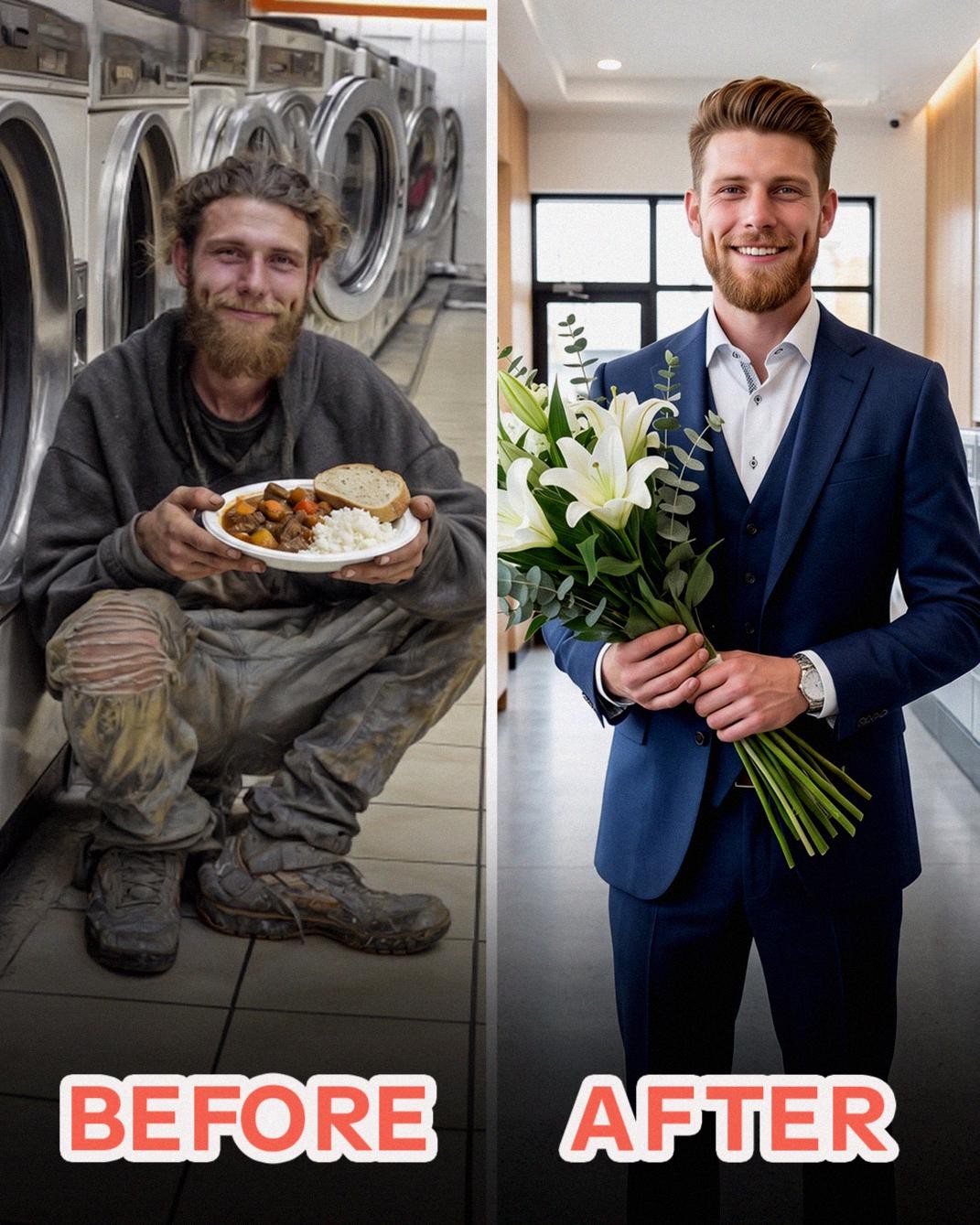
The place smelled permanently of chemical detergent, damp concrete, and overheated machines. Near the humming soda machine in the far corner always sat Eli. He looked less like a person and more like part of the building itself — someone trying desperately to fold himself into the shadows so nobody would notice he existed. His hoodie looked decades old, his shoes barely held together, and everything he owned fit inside one thin plastic bag resting beside his feet.
My mother never hesitated.
She walked directly toward him every single time.
And what I remember most now is that she never stood above him while offering the food. She always knelt beside him, eye level, like dignity mattered just as much as the meal itself. Eli would immediately start apologizing, insisting she didn’t have to keep doing this for him.
And my mother always answered exactly the same way:
“I know. But I want to.”
As a teenager, I thought she was reckless.
I remember whispering nervously in the car one year, “What if he hurts us?”
She didn’t even turn her head while driving.
“Danger comes from people being forgotten,” she said quietly. “Not from saying thank you.”
I didn’t understand that sentence then.
Honestly, I don’t think I truly understood my mother at all until cancer took her away from me.
The illness arrived slowly at first, sneaking into ordinary life so quietly we almost missed it. She became short of breath climbing stairs. Started coughing late at night. Then suddenly our apartment filled with medication bottles, hushed conversations, and medical equipment humming softly beside the couch. The woman who spent her life caring for everyone else disappeared piece by piece until there was almost nothing left for the disease to steal.
She died before winter fully arrived.
By Christmas Eve, I felt emotionally hollowed out.
Standing alone in her kitchen that year felt unbearable. The roasting pan sat exactly where she always left it, but the room no longer carried warmth. Only silence. I nearly abandoned the tradition completely. I almost convinced myself it no longer mattered now that she was gone.
Then I heard her voice in my head as clearly as if she were standing beside me:
“Someone still needs that plate.”
So I cooked.
Not beautifully like she did.
Just enough.
Chicken. Instant potatoes. Canned green beans. My tears blurred my vision half the time, but eventually the food was warm and packed carefully into the same kind of brown paper bag she always used. I drove toward the laundromat gripping the steering wheel so tightly my hands hurt. Part of me expected disappointment. Another part expected emptiness.
What I found instead changed my life completely.
The bells above the laundromat door jingled softly as I stepped inside.
And Eli was no longer sitting forgotten in the corner.
He stood near the soda machine wearing a perfectly tailored charcoal-gray suit. His hair was trimmed neatly. His face looked healthier, stronger, almost transformed into someone I wouldn’t have recognized if not for the eyes. In his hands he carried a bouquet of white lilies.
The moment he saw me, his composure broke instantly.
Not because he was surprised.
Because he had been waiting for me.
We sat together on the hard plastic laundromat chairs while dryers rumbled around us, and for the first time in my life Eli told me the truth my mother had quietly protected for nearly twenty years.
He asked if I remembered getting lost at the county fair when I was six.
The memory hit me immediately.
The panic.
The bright carnival lights.
The terrifying feeling of being swallowed by crowds much taller than me.
And a hand holding mine gently while leading me toward safety.
For my entire life, I believed a police officer rescued me that night.
It wasn’t a police officer.
It was Eli.
At the time, he was just a homeless teenager wandering the fairgrounds alone. But when he saw a frightened little girl crying in the middle of the crowd, he stopped without hesitation and helped me find security. He even remembered the glitter butterfly painted on my cheek — a detail impossible to invent.
My mother arrived moments later terrified beyond words.
And instead of seeing Eli as a threat, she saw him for what he truly was:
The person who protected her daughter when she couldn’t.
That was the night the Christmas tradition began.
But the truth ran even deeper than that.
Over the years, while I was busy growing up and building my own life, my mother had quietly stayed involved in Eli’s life too. She connected him with social workers. Helped him enroll in job training programs. Encouraged him every time he failed. Checked on him every Christmas without exception. And apparently, she talked about me constantly. He knew when I passed my driving test. When I graduated college. When I got my first apartment.
He had been watching our family from the shadows while my mother quietly pulled him back toward the world.
Then Eli handed me an old photograph.
It showed me as a child holding cotton candy beside my smiling mother at the county fair. And in the blurry background stood a skinny teenager in a hoodie watching us with visible relief written across his face.
Eli explained the suit too.
Years earlier, he promised my mother that if he ever managed to rebuild his life, he would come see her one day dressed like a man who finally belonged somewhere — proof her kindness had not been wasted.
Then came the part that shattered me completely.
Near the end of her illness, when the cancer became too aggressive for her to travel anymore, my mother made one final request to him:
Watch over my daughter after I’m gone.
Be the brother she doesn’t know she has.
That night, Eli and I drove together to the cemetery carrying the lilies and the paper bag of food I’d prepared. We sat beside my mother’s grave beneath the cold December moon sharing Christmas dinner quietly between us.
But for the first time since losing her, the silence didn’t feel empty anymore.
It felt shared.
Later that evening, sitting together on my couch watching old holiday movies, I finally understood something my younger self never could:
My mother had never been feeding a stranger.
She had been building a bridge.
A future safety net.
A family she knew I would someday need long before I realized it myself.
And suddenly every Christmas Eve made sense.
The extra plate was never charity.
It was love preparing a place at the table for someone who already belonged there long before either of us understood why.