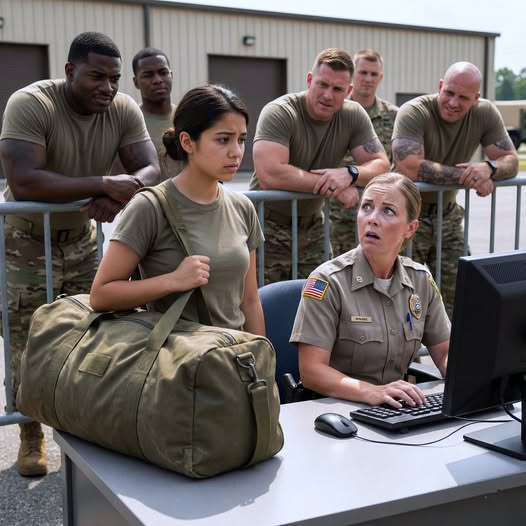
The mid-morning Kentucky sun scorched the pavement at the Fort Campbell transport depot, turning the tarmac into a glare-filled expanse that seemed almost hostile to the weary traveler. Sarah Martinez stepped off the Greyhound bus with the kind of quiet determination that masked a life lived in extremes. Her olive-drab duffel bag, frayed at the seams from years of combat deployments, seemed disproportionately heavy for her small frame. At twenty-eight, she possessed a deceptive vulnerability: soft, rounded features, a petite stature, and the kind of wide eyes that suggested innocence. Yet beneath that surface lay years of battle-hardened discipline, a mind forged in fire, and hands that had saved dozens of lives on foreign soil.
Nearby, a cluster of seasoned soldiers loitered, their imposing frames and confident stances a product of countless deployments. They exchanged glances, sizing her up in the same way a predator surveys prey. “Fresh recruit,” one murmured. “Look at her… she won’t last a week.” Sergeant Thompson, leaning casually against a railing, snorted under his breath, eyes flicking to Sarah as she stumbled slightly under her duffel. Sarah heard every word, but her face remained unreadable. In her world, being underestimated was a weapon, a tool she wielded silently and with precision.
At the intake desk, the processing officer’s eyes barely lifted from her clipboard. “Name?” she barked, her tone clipped and impatient.
“Sarah Martinez, ma’am,” Sarah replied, her voice clear and melodic, cutting through the noise of the terminal.
“Specialty?”
“Combat medic, ma’am,” she answered without hesitation.
The officer’s eyebrows shot up. Medics were expected to look the part—gritty, battle-worn, and authoritative. Sarah, by contrast, appeared almost fragile, more suited to paperwork than to triage in a warzone. “Previous deployments?”
Sarah paused, letting the weight of her answer hang. “Five tours, ma’am. Three in Afghanistan, two in Iraq.”
The clipboard nearly slipped from the officer’s grasp. Five tours by the age of twenty-eight was almost unheard of. Even among career Special Forces, such a record was exceptional. Rumors began to ripple through the depot, skepticism following her like a shadow. Staff Sergeant Rodriguez, a veteran with jagged scars down his forearm, spat onto the asphalt. “Command must be desperate,” he muttered, “if they’re sending us kids who lie about their service records.”
But not everyone was skeptical. In the base medical facility, Dr. Jennifer Walsh, chief medical officer, reviewed Sarah’s digital file. Her eyes widened as she scrolled through battlefield certifications: emergency thoracotomy, trauma response, amputations performed under fire—scores and certifications that dwarfed many of her colleagues’. She murmured under her breath, “There’s more to this one than meets the eye.”
That night, Sarah sat alone in the mess hall, picking at her food. Private Jackson, a young recruit who still had a trace of wide-eyed naivete, approached cautiously. “Ma’am… the guys,” he began, hesitating, “they think maybe you’re exaggerating. You don’t look… seasoned. Most vets have a certain look in their eyes. You don’t.”
Sarah set down her fork and studied him, her gaze piercing yet measured. For a fleeting moment, her armor slipped, revealing something ancient and weary behind her eyes—an exhaustion born from witnessing too much. “I’ve seen things too, Private,” she said softly. “I just choose not to wear them on my face.”
The next morning, Sarah’s reputation began to crystallize during a fifteen-mile march under the unforgiving sun. While the larger, bulkier men faltered and complained, she maintained a steady, unyielding rhythm, almost machine-like in her efficiency. When Private Johnson began to stagger, showing early signs of heat exhaustion, Sarah’s trained eye caught it instantly.
“Sergeant, medical situation!” she called out.
“He looks fine, Martinez,” Rodriguez replied dismissively.
“Sergeant, his pulse is 140, thready,” she countered sharply. “Early signs of altered mental status. He’ll collapse in ten minutes if untreated.”
Johnson’s knees gave way exactly as she predicted. Sarah moved with the efficiency of years under fire: administering electrolytes, cooling his core, and stabilizing him with the precision that only a veteran medic could achieve. Later that afternoon, at the rifle range, she stunned everyone by placing twenty consecutive rounds into the bullseye from five hundred yards—a nonchalant mention of sniper training at Camp Pendleton slipping from her lips as casually as weather talk.
Three weeks later, Sarah’s full measure was revealed. A catastrophic training accident at a mountain facility—mortars misfired, chaos erupted, multiple casualties—turned the calm depot into a battlefield. Among the wounded was Corporal Adams, suffering catastrophic abdominal trauma. The senior medic froze, unprepared for what lay before him.
“Permission to speak freely, ma’am?” Sarah asked Dr. Walsh.
Given clearance, she diagnosed Class III hypovolemic shock almost instantly. “He needs damage control surgery. Now.”
“Here? In the dirt?” the senior medic stammered.
Sarah didn’t pause. She laid out instruments, her hands steady and precise. She barked orders to her team, moving with practiced authority. “Pierce, better light! Wilson, two units blood, rapid transfusion!”
Under flickering floodlights, Sarah saved Adams’ life. Helicopter evacuation lifted him to safety, and Dr. Walsh turned, stunned. “Martinez… how many times have you done that in the field?”
“Forty-seven, ma’am,” she said quietly, her voice carrying a tremor that revealed the burden behind her calm exterior. “You adapt, or you don’t come home.”
Afterward, she met with Colonel Hayes, who reviewed her classified record: sixty-two confirmed saves under fire, three Silver Stars, five Purple Hearts.
“Why hide this?” he asked. “Why let them think you’re a fraud?”
“Each Purple Heart,” she whispered, “represents a life I couldn’t save. I remember the forty-three I lost. I don’t focus on the ones I saved.”
Hayes studied her—the five scars, the shrapnel in her shoulder, the blast injuries in her leg. A warrior, yes, but one who bore her pain silently, refusing battlefield promotions because she felt undeserving.
“Martinez,” he said finally, “over three hundred confirmed saves. These soldiers went home because of you. It’s time you start remembering that too.”
The secret was out. The depot that had once dismissed her now watched in awe as Sarah Martinez, the petite “rookie,” walked with quiet authority. No longer a girl, she was a legend—an embodiment of courage, precision, and the kind of experience that made the difference between life and death.