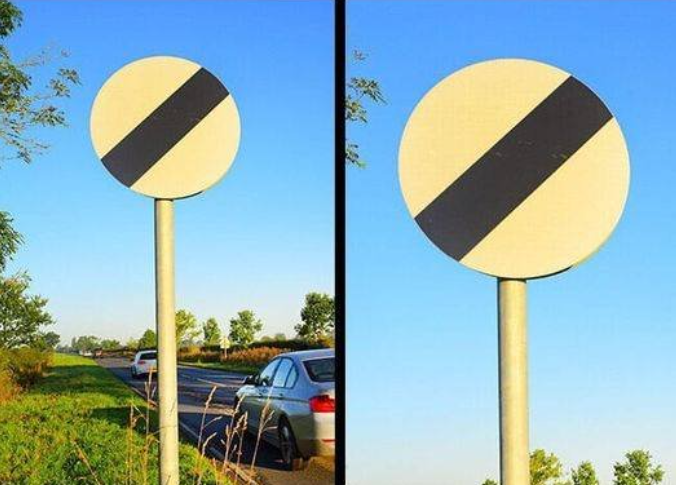
Most drivers believe they recognize every road sign—until they come across the one that reveals just how much they’ve forgotten. A plain white circle marked with a bold black diagonal stripe runs cleanly through the center, simple to the point of being easy to overlook. It appears constantly on UK roads and even on the theory test, yet when drivers encounter it in real life, many pause in confusion. That split second of hesitation is exactly what fueled a heated online debate after one motorist declared that “99% of drivers” misunderstand the sign completely. Judging by the flood of replies that followed, he wasn’t exaggerating.
The conversation highlighted something obvious yet rarely discussed: many people drive on autopilot. Instead of actively remembering the meaning of every sign, they rely on routine, habit, and familiar routes. So when that stark black stripe suddenly appears, they guess. They assume. They even joke. One Reddit commenter called it the “official national drifting zone,” while another insisted it meant “no speed limit—put your foot down.” Amusing, yes, but also proof of a bigger issue: a sign designed to make driving easier is being misread by a large portion of the population.
In truth, the sign simply indicates the start of the national speed limit. Nothing more. Its minimalist design serves a purpose—rather than repeatedly posting exact speed limits on rural or high-speed roads, the sign tells drivers that any special limit no longer applies. From that point on, the road defaults to the standard limit for that type of roadway. Clean, simple, consistent. But simplicity isn’t always intuitive, and the absence of numbers leaves room for confusion—especially when different vehicles follow different speed rules.
During the debate, the RAC stepped in to clarify. For cars, the national speed limit means:
• 60 mph on single-carriageway roads
• 70 mph on dual carriageways and motorways
But that applies only to standard cars. The moment someone steps into a van, a pickup, a towing vehicle, or anything heavier, the limits change. Vans must stick to 50 mph on single carriageways and 60 mph on dual carriageways. Vehicles towing caravans are restricted even further. Suddenly, that simple black stripe carries a surprising amount of complexity—especially for people who rarely drive anything other than a typical car. The confusion makes sense. The consequences don’t.
Road-safety experts emphasize that although the national speed limit sets a legal maximum, it doesn’t guarantee a safe speed at all times. On wet surfaces, sharp bends, foggy stretches, narrow lanes, or busy roads, the genuinely safe speed may be much lower. Yet many drivers see the black-stripe sign as an automatic signal to accelerate—sometimes aggressively—without considering visibility, road conditions, or surrounding traffic. This gap between assumption and reality is exactly why the debate resonated so widely.
Throughout the discussion, one point kept resurfacing: drivers forget. Not because they’re inherently reckless, but because most people never revisit the Highway Code after earning their license. Years pass. Habits solidify. Knowledge fades into the background. What they once memorized for the test becomes a vague recollection. People trust their instincts rather than the rules they once knew. And road signs—especially the subtle ones—take on meanings that drift over time.
The argument also opened up a broader truth: driver education shouldn’t end the day someone gets their license. Many countries require refresher courses or periodic written exams, but the UK does not. Some commenters argued that retesting would improve safety; others countered that people would simply cram again without truly learning. But nearly everyone agreed on this: renewed awareness could save lives.
A simple sign becomes dangerous when misinterpreted. The national speed limit sign doesn’t grant permission to speed—it removes the earlier limit and puts responsibility back on the driver. It expects them to understand the type of road they’re on, the vehicle they’re driving, and the conditions around them. It calls for thinking, not assuming. For awareness, not automatic reactions. A minimalistic sign demands a more attentive driver.
Eventually, the debate expanded beyond the sign itself and into the culture of driving. People shared stories of others speeding up instantly when the sign appeared—even while approaching blind bends or narrow bridges. Some confessed they’d believed the wrong speed limit for years without realizing they were unintentionally breaking the law. Others admitted they had to revisit the Highway Code mid-discussion just to refresh their memory. The sign had been part of their daily lives, yet its meaning had faded.
That fading becomes a problem when everyone on the road assumes they already know enough. Assumptions cause misunderstandings. They cause crashes. They create the “I thought you were slowing down,” “I didn’t realize this was a single carriageway,” or “I assumed the limit changed” situations drivers dread. And most of those situations are completely avoidable.
Safe driving isn’t just about following rules—it’s about remembering them long after the test is over. The national speed limit sign is a quiet reminder that responsibility doesn’t disappear simply because signs become familiar. And the online debate proved that many drivers could use that reminder more often than they’d like to admit.
Knowledge fades. Confidence doesn’t. That combination is dangerous.
In the end, the argument wasn’t really about a black stripe on a white circle. It was about how easily drivers forget the small details that keep them safe, and how even a brief refresher can make a difference. Everyone on the road benefits when people drive with clarity instead of assumption. A bit more humility behind the wheel, a bit less autopilot, and that simple sign becomes exactly what it was designed to be: a prompt to pay attention, not a signal to race ahead.
Sometimes the simplest signs are the ones that reveal how closely we’re really paying attention.