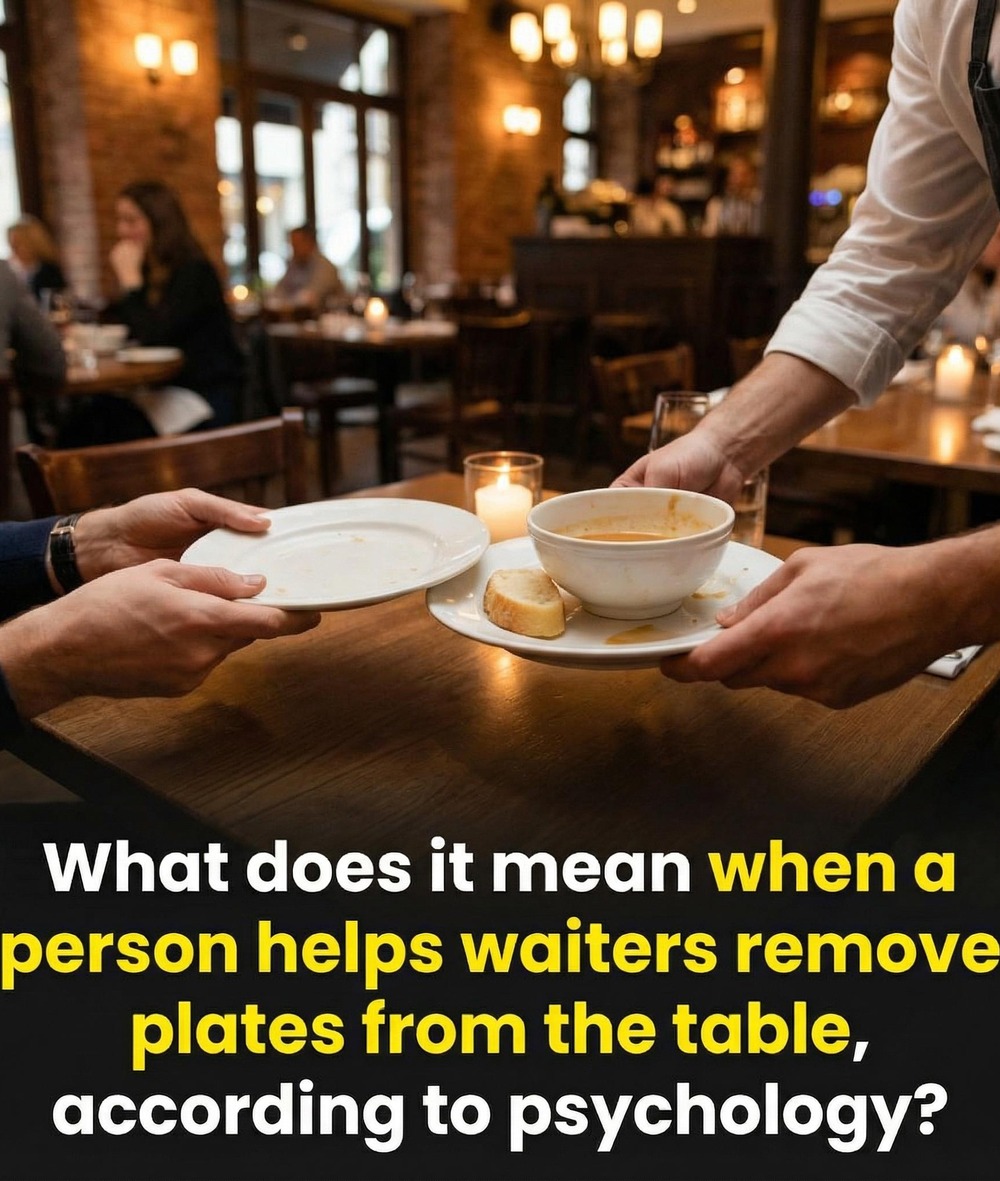
In a crowded restaurant, most moments fade into background noise. Dishes are set down, glasses touch, voices overlap, and servers move quickly through narrow aisles with trained precision. Occasionally, though, a small action stands out—a guest stacking plates, nudging an empty glass closer to the edge, or lifting a dish to make a server’s task easier. It’s a simple act, easy to miss, yet it often says more than expected.
Assisting a server is not about necessity. They are skilled at their work and rarely require help. What gives the action meaning is that it is freely chosen. In a setting where diners are conditioned to receive service passively, offering help reflects a mindset that extends beyond the exchange of food for payment. It shows awareness—that the person serving is not merely part of the setting, but a human being juggling time, effort, and pressure.
Psychologists refer to behaviors like this as micro-prosocial acts. They are brief, unprompted decisions that ease strain in shared environments. People who do this naturally tend to read the situation around them. They notice a server balancing too many plates, navigating a packed room, or racing against the pace of a busy shift. The impulse to help doesn’t come from obligation. It comes from empathy that surfaces quickly, without performance or calculation.
Here, empathy is practical rather than abstract. Many who help servers have worked in service roles themselves or have seen someone close to them do so. They remember long hours, physical exhaustion, and the emotional effort required to stay pleasant under constant demand. Even without direct experience, some people have a strong ability to imagine that strain. This capacity to mentally step into someone else’s workload is a key marker of social intelligence.
There is also humility in these gestures. Restaurants subtly reinforce hierarchy—one person is served, the other serves. When a guest helps, even briefly, that hierarchy softens. It sends a message that no task is beneath anyone and no role deserves dismissal. The assistance is light and respectful, offered in a way that supports rather than interferes.
Confidence plays a part as well. People who feel secure socially are more likely to act on instinct without worrying how they will be perceived. They don’t overanalyze whether helping looks awkward or unnecessary. Studies on self-esteem and emotional regulation suggest that individuals who feel grounded are more inclined toward spontaneous kindness because they are not focused on managing impressions. Their actions align with their values, not with a need for approval.
Notably, this kind of help is usually quiet. Those who offer it don’t draw attention to themselves or wait for acknowledgment. They don’t scan the table for reactions. In fact, praise can feel uncomfortable to them. The reward is internal—the knowledge that they eased someone else’s load, even briefly. This internal motivation signals authenticity rather than performative politeness.
Of course, not helping doesn’t automatically signal a lack of care. Cultural norms vary, and in some contexts assisting staff is discouraged or considered intrusive. Others may hesitate out of fear of interfering, or may be dealing with their own limitations or distractions. Public behavior is shaped by many unseen factors. What matters most is intention, not comparison.
When intention is thoughtful, the effect can be meaningful. Service work carries heavy emotional demands. Servers regularly absorb impatience, entitlement, and frustration. A small moment of cooperation—a hand steadying a plate, a table cleared without prompting—can interrupt that pattern. It reminds the worker that not every interaction requires emotional armor, a reminder that can carry them through a long shift.
These actions also influence the atmosphere of the space itself. Restaurants are shared environments, and emotional tone spreads easily. When one person acts with awareness, it subtly encourages others to follow. The room softens. Interactions become less transactional and more human. Research on group behavior shows that small cooperative acts often create ripple effects beyond the immediate moment.
There is a broader pattern behind this behavior. People who help in restaurants often act similarly elsewhere. They return shopping carts, hold doors without calculation, and offer directions without being asked. These are not grand gestures, but they reflect a consistent belief: shared spaces function better when individuals take small responsibility for the collective experience.
This outlook stands in contrast to entitlement, which depends on invisibility. Entitlement assumes service without recognition and effort without respect. Helping acknowledges labor. It recognizes that comfort is actively created by someone else. That recognition alone can change how people treat one another.
Psychologically, this reflects a balanced sense of responsibility—engaged but not overwhelmed. The person helps where they can, when it makes sense, without dramatizing their role. This balance is often linked to maturity: the understanding that care and autonomy can coexist.
Ultimately, these moments reveal how values surface when there is no pressure. No one is watching. No reward is offered. The cost is minimal. And yet, a choice is made. Repeated quietly over time, those choices form character—not the kind declared loudly, but the kind expressed when no one is keeping track.
In a culture shaped by speed, distraction, and self-focus, these gestures matter. They don’t solve systemic problems, but they restore dignity in everyday interactions. They remind us that kindness doesn’t need permission and respect doesn’t need volume.
Helping a waiter isn’t really about plates or glasses. It’s about recognizing shared humanity in a setting that often hides it. It’s a choice for awareness over autopilot, connection over detachment. And while the gesture itself may pass quickly, its effect lingers—shaping how people feel, work, and relate long after the table is cleared.