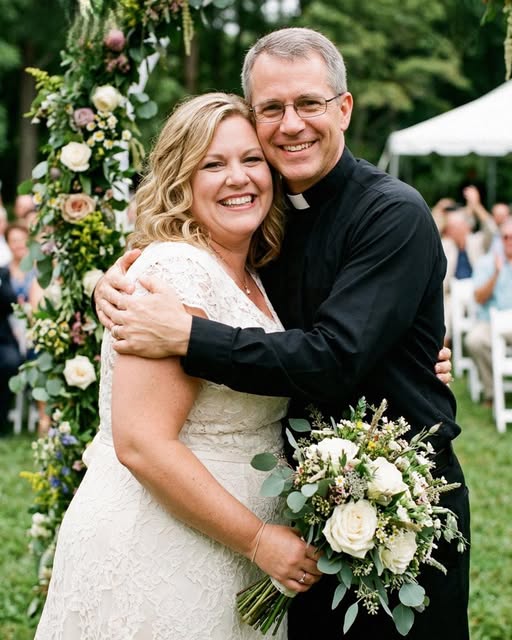
After the collapse of a failed marriage and a long series of relationships that felt more like temporary stops than real homes, I had settled into a quiet acceptance of solitude by the time I reached sixty. I had my routines, my church community, and a kind of peace that no longer depended on being shared. I assumed the part of my life reserved for romance had ended for good.
Then I met Nathan.
He didn’t arrive dramatically or demand attention. Instead, he came with a calm, steady presence that felt more like reassurance than excitement. As a pastor, he carried a quiet authority, but what drew me in most was his ability to listen without distraction or judgment. He, too, had known loss—two marriages already ended by death—and in that shared history, I believed I had found someone who understood both love and grief.
Our wedding was small, simple, and deeply meaningful. Standing before our community, I felt a sense of peace I hadn’t known in years, as if life had finally offered me something lasting. I thought, perhaps too easily, that we had both moved beyond the pain of our pasts.
That illusion ended the moment we walked into our home as husband and wife.
The warmth I expected was replaced by something unsettlingly cold. Nathan was no longer the man from the ceremony. He stood in the bedroom in his wedding suit, distant and rigid, as if something inside him had shifted entirely. Without explanation, he took a key, unlocked a drawer he had kept closed throughout our relationship, and removed a thick envelope with my name written across it.
Before I could understand what was happening, he told me I needed to know the truth.
What I read wasn’t a confession of wrongdoing. It was something far more disturbing: a letter written as though I were already gone.
Nathan wasn’t speaking to me as his wife in the present. He was speaking to me as a loss he had already begun to grieve.
As I read further, the meaning became clear. After losing two wives—one slowly through illness, the other suddenly—he had been left with a kind of emotional wound that never healed. In response, he had developed a habit of writing “farewell letters” to the people he loved while they were still alive, as if preparing in advance for their absence would protect him from being destroyed by it again.
To him, love had become inseparable from anticipation of loss.
To me, it felt like I had already been reduced to a memory.
I couldn’t stay in that moment. I left the house and ended up sitting alone in the empty church where we had just been married, holding a letter that described a future where I no longer existed.
When Nathan found me, he didn’t argue or defend himself. Instead, he took me somewhere else entirely—the cemetery, where his first two wives were buried.
There, the truth became fuller, heavier. His first marriage had ended slowly, marked by illness and exhaustion, during which fear had kept him emotionally distant. His second had ended abruptly, leaving him with words he never got to say. Both losses had shaped him into a man who believed that emotional preparation was a form of protection.
But what he called protection had become something else: a way of living as though every moment of love was already contaminated by its ending.
Standing there, I finally understood what I had walked into. I wasn’t being loved in the present—I was being pre-mourned.
And a life like that doesn’t leave room to exist in real time.
I told him plainly that I couldn’t be someone he had already lost. If he wanted a life with me, he had to stop treating it like a countdown to grief.
Something in him broke open at that moment—not dramatically, but quietly. For the first time, he seemed to see what his fear had done. In trying to protect himself from loss, he had been absent from every moment of love he still had.
We returned home changed.
The letters weren’t erased, but they were no longer allowed to define us. We put them away—not as something to be lived by, but as something to be understood and left in the past.
And slowly, deliberately, Nathan began to change. Not into someone without fear, but into someone who no longer let fear lead.
He stopped writing endings before they arrived.
And I stopped being treated like a goodbye.
What we built after that wasn’t perfect, and it wasn’t free of history—but it was finally lived in the present. And for two people who had spent so much time preparing for loss, that became its own kind of beginning.