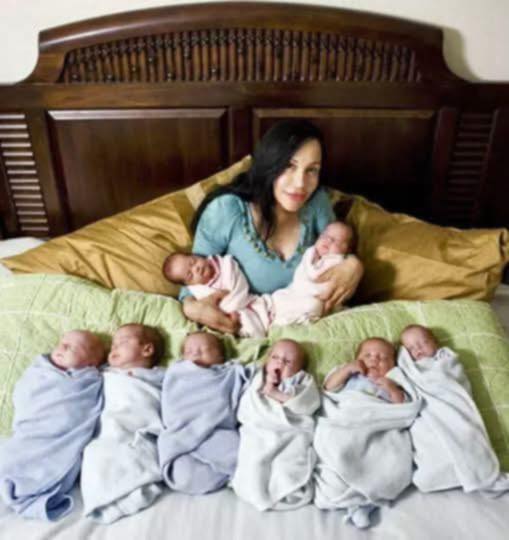
When Natalie Denise Suleman gave birth in January 2009, it instantly became a moment of medical history—and pop culture. The world quickly dubbed her “Octomom,” a nickname that would follow her relentlessly for years. She had just delivered the first known set of surviving octuplets, eight babies born alive in a single pregnancy. What made the event even more shocking was that Suleman was already the mother of six children. Overnight, her family expanded to fourteen, and her private life became the subject of public scrutiny.
The birth itself was extraordinary, but the fallout was even more significant. Media coverage was constant and often unforgiving, and the narrative surrounding Suleman quickly hardened into controversy. Yet behind the headlines was a far more nuanced story—one driven by personal conviction, medical ethics, financial struggles, and an unwavering commitment to her children.
Suleman was born on July 11, 1975, in Fullerton, California. She was raised as an only child by her mother, a schoolteacher, and her father, a restaurant owner. From an early age, she gravitated toward caregiving and child development. This passion guided her education and career. She attended Mt. San Antonio College, earned a degree in child development, and later worked as a psychiatric technician at a state mental hospital, caring for individuals with complex needs.
Her journey to motherhood began with in vitro fertilization (IVF). After several years of treatment, she successfully gave birth to six children: Elijah, Amerah, Joshua, Aidan, Calyssa, and Caleb. Suleman has consistently stated that her desire to have children was deeply personal and rooted in her values, not driven by fame or attention.
In 2008, Suleman made a decision that would forever change her life. She requested that all her remaining frozen embryos be implanted in a single IVF cycle, believing that discarding them was morally wrong. Her fertility doctor, Michael Kamrava, transferred twelve embryos—far exceeding standard medical guidelines. Eight of the embryos developed successfully, resulting in the octuplet pregnancy.
This decision sparked an international debate about reproductive ethics and medical responsibility. Critics accused Suleman of being reckless and questioned her ability to care for so many children. Supporters argued that reproductive autonomy should be respected, regardless of public opinion. The controversy led to a formal investigation, and in 2011, the California Medical Board revoked Kamrava’s medical license for gross negligence.
On January 26, 2009, Suleman delivered Noah, Isaiah, Jeremiah, Jonah, Josiah, Makai, Maliyah, and Nariyah at UC Irvine Medical Center. All eight survived—a rare and remarkable outcome. However, this achievement was quickly overshadowed by intense media scrutiny. Suleman found herself labeled irresponsible, unstable, and exploitative, with death threats following in the wake of her newfound fame.
Despite popular belief, the birth did not make her wealthy. There was no massive payout. Suleman was unemployed at the time and struggled to support her growing family. Faced with mounting expenses, she resorted to unconventional ways of earning money—choices that were widely criticized but driven by necessity. She appeared in adult entertainment projects, participated in celebrity boxing matches, and made paid media appearances. In 2012, she filed for bankruptcy, reporting nearly $1 million in debt.
Legal troubles followed soon after. In 2014, Suleman was charged with welfare fraud for failing to report about $26,000 in income while receiving public assistance. She pleaded no contest to a misdemeanor, completed community service, repaid the funds, and avoided jail time. This case only reinforced the negative perceptions of her, though she continued to raise her children mostly out of public view.
By 2013, Suleman had withdrawn from the spotlight almost entirely, choosing privacy over constant defense. For over a decade, she focused on raising her children away from tabloid culture, sharing only limited updates via social media.
In January 2025, the octuplets turned sixteen. Suleman marked the milestone with a rare public message, celebrating each child by name and emphasizing gratitude, faith, and love. Her tone was reflective, focusing more on family than the controversies of the past.
Today, Suleman speaks candidly about what she would do differently. She has expressed regret for not pursuing legal action against her fertility doctor and has acknowledged the long-term consequences of her decisions during that time. She has also been open about the challenges of raising a son with profound autism and the demanding care he requires.
Some of her children have begun sharing their own perspectives. In the Lifetime documentary Confessions of Octomom, her son Joshua described the shock and emotional weight of learning that his mother was expecting eight more children. His account provided a rare glimpse into what it was like growing up in a story that the world thought it already understood.
Suleman’s parenting style today is notably strict and deliberate. She limits social media use, discourages dating, and stresses discipline, routine, and service. She has said that she wants her children to be grounded, empathetic, and resistant to external validation—values shaped by her own experiences with fame and public judgment.
As the octuplets grow older, the narrative surrounding their family has shifted. The spectacle of the early days has faded, replaced by a more complex and nuanced understanding of their story. Suleman’s life remains controversial, but it is no longer defined solely by the event of 2009. It is a story of resilience under pressure, of mistakes acknowledged, and of a mother who endured public condemnation while keeping her family intact.
The octuplets are no longer symbols in an ethical debate or headlines in tabloids. They are teenagers with their own identities, shaped by an upbringing unlike any other. And their mother, once known only as “Octomom,” now stands as a reminder that no story—especially one told in the spotlight—is ever as simple as it may seem.