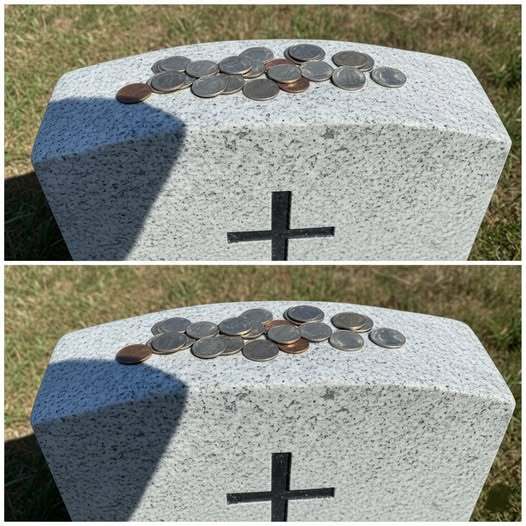
At first glance, the coins scattered across the cold, worn stone seem almost inconsequential—tiny discs of copper, nickel, and silver that might be mistaken for the random litter of a passerby. Yet when you pause, when you allow yourself to truly look, each coin becomes a quiet declaration, a whispered acknowledgment of lives lived, of sacrifices made, of bonds that death cannot sever. The graveyard, normally a place of hushed footsteps and solemn air, suddenly feels alive with invisible voices, a chorus made of memory, respect, and grief. Pennies, nickels, dimes, quarters: all of them transformed from mundane currency into a language of mourning, a lexicon of remembrance that speaks louder than any parade or public ceremony could ever hope to convey. Families stoop low, fingers trembling as they place coins atop headstones, tracing letters and dates with their hands, feeling the cold metal press against the engraved stone as if to say, I see you, I honor you, I remember.
This practice, which traces its origins back to the Vietnam era, has evolved over decades into a profound ritual whose significance extends far beyond its humble beginnings. For soldiers and veterans who once returned from war carrying memories too heavy to speak aloud, these coins have become a voice of their own. They speak of camaraderie in the face of chaos, of shared struggles in training fields and battlefields, of nights spent on watch and days filled with the monotony and terror of military life. A penny is not just a penny—it is a quiet nod to a moment of pause, a deliberate act to acknowledge a fallen comrade. A nickel reflects the enduring bonds forged through grueling drills and shared hardship, a subtle reminder that even in death, friendship and loyalty remain unbroken. A dime speaks of those who served side by side, who faced danger together and emerged with invisible scars that only those who stood shoulder to shoulder can truly understand. A quarter, often heavier and more commanding in presence, carries the most profound weight: the ultimate acknowledgment of being present at the moment of loss, a testament that the fallen were never forgotten, even in the midst of unspeakable tragedy.
For grieving families, these coins are far more than metal—they are proof that the story of their loved one did not end at burial. Each coin placed on a headstone tells them that someone, somewhere, still carries the memory of their family member, still honors their life, still acknowledges the sacrifice that cannot be measured in ordinary terms. In a world that often rushes past cemeteries, oblivious to the lives commemorated there, this simple ritual insists on stillness, reflection, and acknowledgment. No applause, no speeches, no headlines—just the quiet resonance of metal on stone, each clink a heartbeat of remembrance, a solemn promise repeated over and over: You are not forgotten. Your service mattered. Your sacrifice endures. And as veterans and family members alike bend over these markers, lingering in reverence, one realizes that the language of coins, though small and silent, carries a weight heavier than any medal or monument, bridging the gap between past and present, life and memory, loss and honor.