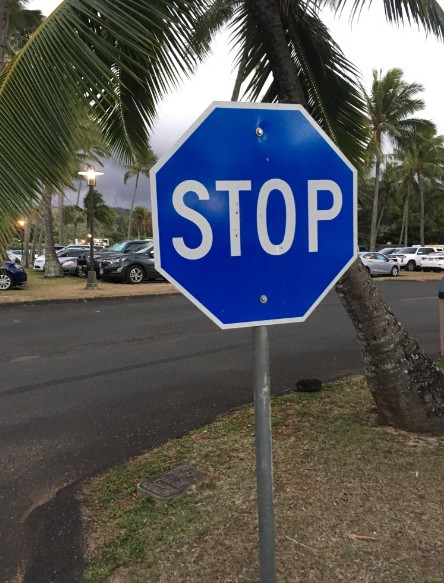
A blue stop sign feels instantly wrong the moment it enters your line of sight. There’s a jarring cognitive dissonance, a flicker of confusion in the mind: red is stop, green is go, yellow means caution—but blue? Your brain screams, “That’s not right—keep going.” And yet, the very urge to ignore it can be exactly what makes it dangerous. Unlike the bright red octagons drilled into the rules of the road, blue stop signs exist in a gray area. They hover on the edge of familiarity and anomaly, appearing in places where the official law doesn’t quite reach, leaving drivers and pedestrians to wrestle with instinct versus instruction. The question is immediate and unnerving: what happens if you follow your gut and roll through it—or worse, what if you disregard it and a collision occurs?
These unusual signs are not randomly placed. You’ll find them tucked away in private communities with winding streets, in corporate or university campuses, and in parking lots where every inch of asphalt counts. Their existence may seem quirky at first glance, almost decorative, like someone chose blue just to be different. But the intent behind these blue signs is serious: they are tactical, safety-driven interventions created by property owners to manage risks that conventional traffic law cannot fully address. They act as silent sentinels in spaces where vehicles, bicycles, and pedestrians interact in unpredictable ways, and where accidents can happen in a heartbeat.
Legally, in the United States, a stop sign is codified in federal and state regulations. The Manual on Uniform Traffic Control Devices (MUTCD) mandates a red octagon with white letters—no substitutions allowed. Any deviation from that standard, including a blue stop sign, lacks enforceable authority. If a law enforcement officer witnesses a driver ignoring a blue stop sign, they technically cannot issue a citation for failure to stop because the sign does not exist in the legal framework of public roads. In short, blue stop signs are unofficial—they carry no statutory power and are often limited to private property. That doesn’t mean they are harmless, however.
Blue stop signs are installed with a clear purpose. Businesses, school campuses, gated communities, industrial zones, and even hospital grounds use them to signal drivers where heightened awareness is needed. For instance, in a crowded university parking lot filled with pedestrians darting between cars, a blue stop sign at a tight intersection may prevent a serious injury. On a private industrial site, where forklifts and delivery trucks share narrow lanes with employees on foot, a blue stop sign can guide traffic in ways that standard law cannot regulate. In gated communities or apartment complexes, these signs may control speed and intersection behavior to protect children and pets without the formalities of municipal enforcement.
The consequences of ignoring a blue stop sign can be significant. If a collision occurs between vehicles, or if a pedestrian is struck in a crosswalk, the argument that “it wasn’t an official sign” offers no solace to those injured. Liability may still fall on the driver, because duty of care exists independently of government enforcement. Your legal risk may be minimal in terms of traffic tickets, but the human cost—accidents, injuries, or property damage—is very real. The blue stop sign is a quiet reminder that law and safety are not always one and the same; sometimes, compliance is about prudence and common sense, not legal obligation.
Psychologically, the presence of a blue stop sign tests human behavior and decision-making. Drivers are forced to reconcile instinct with learned rules. You’ve been trained since childhood: red equals stop, green equals go. When confronted with an unfamiliar color, the brain hesitates. Some may treat the blue stop sign as a novelty, a suggestion, or even an invitation to test boundaries. Others may instinctively obey, slowing to a cautious halt because the location of the sign signals potential danger. In this way, the blue stop sign functions as both a behavioral checkpoint and a practical tool for risk management. It measures not only attention but willingness to act responsibly in spaces without formal enforcement.
The safest approach is straightforward: when in doubt, stop. The color of the sign may dictate its legal authority, but your reaction determines real-world consequences. Blue may not carry the weight of law, but it carries the weight of judgment, caution, and responsibility. The next time you see that oddly colored octagon rising from a suburban intersection, a corporate driveway, or a campus courtyard, remember that compliance is not merely about obeying rules—it’s about valuing the safety of everyone in the immediate environment. The blue stop sign is a reminder that safety often exists outside legal codes, and that our choices in these gray areas define outcomes far more than any statute ever could.
Ultimately, the strange, unofficial blue stop sign is more than a design quirk; it is a microcosm of responsibility in private spaces, a small but significant challenge to the reflexes we rely on daily. It forces reflection: when the rules are unclear, what do you do? Do you follow habit, dismiss the anomaly, or act with prudence? In the silent spaces of private roads and parking lots, the color may be unconventional, the law may be silent, but your judgment—and your brakes—remain the ultimate authority.