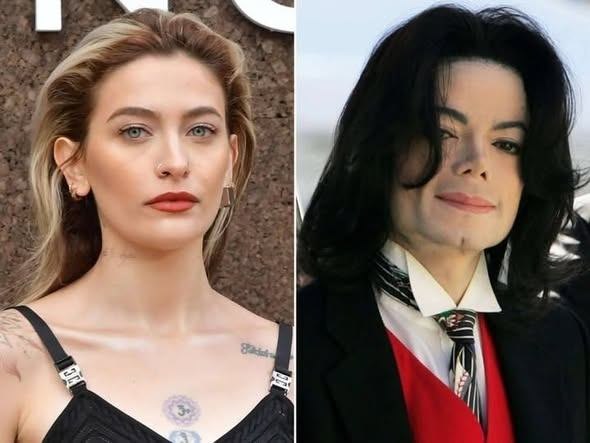
For years, Paris Jackson was known only as the hidden child trailing behind her father, a small figure veiled by surgical masks and towering security. She embodied Michael Jackson’s desperate attempt to shield innocence amid the relentless gaze of a global obsession. But those days of concealment are over. In a series of candid, unflinching revelations, Paris has stepped into a new kind of spotlight—one defined by radical honesty and a refusal to remain silent. She is no longer the grieving heiress; she is a survivor, exposing a life marked by addiction, self-harm, sexual assault, and a forensic conviction that her father’s death was no accident.
Paris’s passage from a protected childhood to a turbulent adulthood has been fraught and painful. She recounts her youth not as a climb to fame, but as a struggle to reclaim her humanity. Her skin once bore the scars of self-loathing, a visible testament to mental health battles that nearly ended her life. Today, those scars are overlaid with more than fifty tattoos—a living record of survival. Each mark is a reclamation of her body from the traumas that tried to dominate it. By speaking openly about teenage suicide attempts and the sexual assault she endured at fourteen by a stranger, she transforms private pain into public testimony, offering a voice for others confronting similar darkness.
Yet it is her perspective on her father’s legacy that has stirred the greatest debate. While Michael Jackson’s 2009 death was officially ruled as resulting from acute propofol intoxication under a physician’s care, Paris believes a far more sinister truth lies beneath. She insists her father was “set up” and murdered, framing this belief not as emotional speculation, but as a forensic conviction shared by those closest to him. She recalls him hinting that people were “out to get him,” living in fear and paranoia during his final months. To Paris, the official story is a convenient façade for a conspiracy she is determined to expose, no matter how entrenched the opposition.
Living as the daughter of the world’s most famous man, Paris likens her life to a chess match rather than an inherited privilege. Every move she makes is scrutinized, every word dissected for echoes of her father’s eccentricities. Still, she refuses to play the victim. Paris uses her platform to dismantle the myths surrounding her family, insisting on telling her own story. She remains devoted to her father’s memory, defending it with the same unflinching honesty she applies to her own struggles. For her, Michael Jackson was not the caricature tabloids created, but a deeply human, vulnerable man ultimately failed by the systems that profited from his genius.
Addiction has also shaped Paris’s journey. Growing up at Neverland and later under the scrutiny of the Jackson family estate, she sought refuge in substances to cope with the pressures of her reality. Her path to recovery has become central to her public identity, as she advocates for mental health awareness. She speaks of the “void” left by her father’s passing, a hole no wealth or fame could fill. By sharing her recovery and ongoing self-work, she has become a beacon for those navigating the silent struggles of self-harm and addiction.
Paris’s emergence as a voice of resilience marks a pivotal moment in the Jackson family story. From the tearful goodbye at her father’s memorial, she has transformed into a woman who knows true protection comes not from security guards, but from owning one’s story. She balances grief and suspicion, constructing a life defined by her own resilience rather than her father’s misfortunes. Her words cut through myth, revealing someone both hauntingly beautiful and painfully human.
As she continues to challenge the official account of her father’s death, Paris builds a career in music and modeling that reflects her inner world on her own terms. She embraces her identity as Michael Jackson’s daughter, but refuses to remain a secondary character in his tragedy. She is a survivor, navigating the fire with eyes wide open. Her belief in his murder is a heavy burden, yet one she bears out of duty to the man who tried to protect her from the world she now confronts.
The world may never provide the definitive answers Paris seeks, but her insistence on keeping the conversation alive is a tribute to their bond. She transforms the legacy of Neverland into a legacy of truth. By exposing her vulnerabilities—sexual assault, addiction, and self-harm—she has earned the authority to speak on the hardest topics. No longer the shielded child, she stands as a warrior, demanding the world see beyond the mask. Paris Jackson is not merely surviving fame; she is redefining it as a platform for justice and healing, proving that even the deepest scars can guide the way toward a more honest, meaningful future.