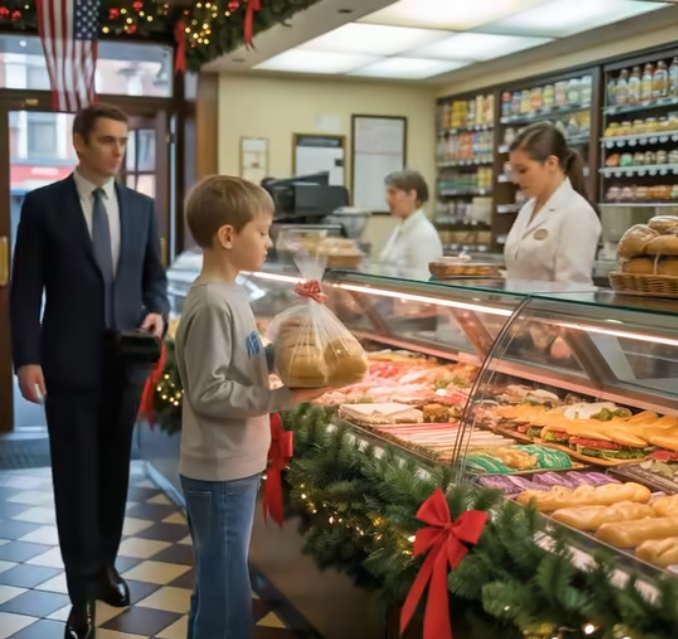
The snow had been falling steadily since morning, turning Manhattan into a quiet, softened version of itself. On Christmas Eve, Madison Avenue felt less like a bustling financial artery and more like a scene from a holiday postcard—streetlights glowing softly through the drifts, shop windows radiating warmth. Thomas Bennett moved briskly through the flurries, his four-year-old daughter Lily bundled tightly against his chest, her tiny hands tucked into the folds of his coat.
To the world, Thomas looked like the embodiment of success. A tailored overcoat, a sleek watch, a calm, measured posture—all hallmarks of a man who ran a global wealth management firm. But behind that exterior lay a more fragile truth. Eighteen months earlier, his wife Jennifer had passed suddenly, leaving Thomas to navigate the twin pressures of executive responsibility and single fatherhood. Money could solve many problems, but it could not fill the void left by love, or teach a man how to soothe a tear-streaked face or negotiate bedtime like a mother. Every day felt like a test he wasn’t prepared to pass.
By the time Thomas stepped off the curb after a last-minute year-end meeting, Lily’s patience had evaporated. Her stomach rumbled. Her small voice trembled near tears. He reached into his coat pockets—nothing. Another failure, another moment he feared he couldn’t fix.
Across the street, the warm glow of Golden Crust Bakery promised relief. Holiday wreaths, the smell of fresh bread and cinnamon—it was an oasis. Without hesitation, Thomas crossed the street.
Inside, the bakery was modest but immaculately kept, each detail reflecting care and pride rather than profit. Behind the counter stood a woman in her early thirties, her hair tied back, a professional smile stretched across a face weary from unrelenting work. Her name was Rachel.
“Welcome,” she said softly. “What can I get for you?”
Thomas ordered a croissant for Lily and coffee for himself. Behind Rachel, a small boy, maybe six or seven, peeked from behind the counter. His jacket was too small, shoes worn thin, yet his eyes were bright, alert, and calculating. He scanned Lily, then Thomas, then the pastries.
Finally, he spoke.
“Excuse me, sir,” he said, swallowing hard. “If you don’t eat everything… could we have it? Mommy hasn’t eaten today. Or if there’s bread that’s about to go stale. We don’t mind.”
The room went quiet. Rachel’s face drained, then flushed with shame. “Oliver,” she hissed. “Stop.”
But the boy stood firm. Not for himself—he was protecting his mother. Advocating for her.
Something broke in Thomas’s chest.
This was more than hunger. This was a child carrying adult responsibility on shoulders too small for it.
Thomas’s own childhood came rushing back—the quiet budgeting, parents skipping meals so kids wouldn’t notice. He had grown distant from that life, but the memory never faded.
“I think I ordered wrong,” Thomas said softly. “My daughter won’t finish this, and I’m not hungry anymore.”
He placed the pastries on the counter. Rachel’s eyes glistened. No objection. Dignity preserved.
Then Thomas looked around at the unsold bread, the full shelves. Closing time was near.
“What happens to the rest?” he asked.
“Sometimes shelters. Sometimes… we manage,” Rachel said quietly.
Thomas nodded. Decision made. Easy, simple, immediate.
“I’ll take everything,” he said.
“Everything?” Rachel asked, stunned.
“Yes. And you should close early. It’s Christmas Eve.”
She tried to refuse, but he insisted gently. Together, they packed the pastries. Stories emerged naturally—Rachel had lost her job when a nearby restaurant chain undercut prices. Opened the bakery with savings. Struggling to pay rent. Grocery bills. Hope running thin.
Thomas made a single call to his accountant. A transfer. Enough to stabilize the bakery—not a handout, but an investment in sustainability, community, and human dignity.
That evening, Lily and Oliver shared pastries at a small table, laughing freely, blissfully unaware of the world’s harshness.
Golden Crust not only survived—it thrived. Customers returned. Rachel hired locally, paid fairly, and even started a “pay it forward” fund for families facing hardship.
Thomas kept visiting—not as a savior, but as a regular. The bakery reminded him that real success isn’t measured in assets, but in lives strengthened, supported, and saved.
Years passed. Oliver grew up understanding courage, responsibility, and advocacy. Lily grew up watching wealth used wisely. Their friendship endured.
Golden Crust expanded. Scholarships were funded. Food security programs launched. Microloans supported small businesses. The bakery became a model of ethical leadership and social impact.
Thomas and Rachel’s friendship eventually blossomed into love, built slowly, on shared values rather than heroics. They married quietly, after hours, in the bakery.
On the wall hangs a simple, handwritten note:
“No one should be ashamed to ask for bread.”
Every Christmas Eve, Golden Crust opens its doors to anyone in need—no questions, no conditions.
Because one brave child’s voice reminded a powerful man what hunger feels like—and taught him that responsibility isn’t just numbers on a balance sheet, but lives changed for the better.