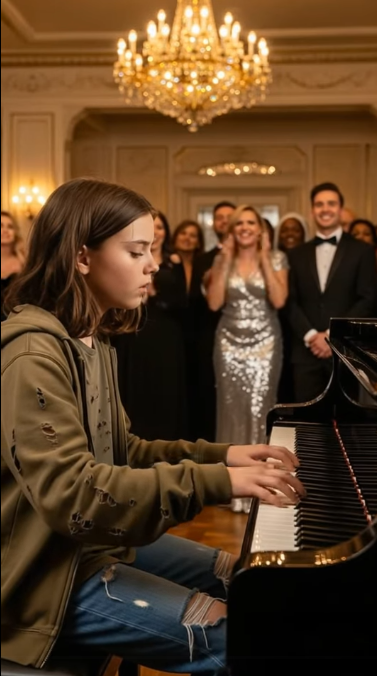
The air inside the Grand Ballroom of the Beverly Wilshire was curated to the last molecule, a vacuum meticulously scented with a thousand white lilies and filtered through vents whose mechanical heartbeats likely cost more than a high-end concert grand. To Lawrence Carter, a man celebrated worldwide as a musical genius yet deeply isolated in his own mind, the environment felt less like elegance and more like a slow-acting suffocation. I sat at the table of honor, swirling a glass of vintage champagne that carried only the taste of empty praise and societal expectation. To the donors, to the press, I was a guest of prestige; to myself, I was a man trapped inside a tuxedo that had begun to feel like a straitjacket of silk and obligation.
The evening was dedicated to the “Opportunities for Youth” foundation—a title that sounded inspiring on brochures but struck me as grotesque euphemism for a glittering parade of vanity and self-congratulation currently unfolding under the chandeliered ceiling. Around me, the ocean of tailored silk, polished leather, and cosmetic perfection rolled, punctuated by champagne flutes and the murmured praises of socialites. Our hostess, Eleanor Davenport, moved through it all with the imperious grace of a monarch inspecting her court. She was the undisputed Queen of Beverly Hills: philanthropist, social engineer, and a predator disguised in couture. Her smile was polished porcelain, and her eyes cut like shards of glacial ice.
She approached me, her gait deliberate, her gown a river of crimson silk trailing behind like a royal decree of power.
“Lawrence,” she purred, laying a manicured hand on my shoulder with the cold shock of a thermal plunge, “the donors are vibrating with anticipation. We must ensure the youth of this city have a beacon to look toward.”
I forced a smile, the muscles of my face aching. “Your gala is blinding, Eleanor. As always.”
She floated away, receiving tributes from senators and socialites, her laughter a high, metallic chime devoid of warmth. The orchestra, a polite assembly of hired hands, played a neutered, antiseptic Mozart—auditory wallpaper designed to compliment the clinking of silver and the whispering of million-dollar deals. Every movement in the room was choreography, every smile carefully constructed, every step rehearsed.
Then, the evening’s rhythm fractured like shattered crystal.
At the entrance, a sound sliced through the cultivated hum—a scream that rang with pure, uncompromising defiance. “Let me go!”
I turned to see a girl, no more than twelve, wrestling with two security guards. Her small frame seemed incongruous in the marble space; she was a dissonant note in the visual symphony of wealth. Her oversized grey sweatshirt was torn at the elbow, her trousers mottled with grime, and her sneakers were a patchwork of silver duct tape. Her hair was a nest of dark curls, her cheeks smudged with city dust. And yet, despite the ragged exterior, her eyes burned with a light that was more potent than fear.
Eleanor reached the scene first. Her smile, always a mask, hardened into something cruel and sharp.
“You don’t belong here,” she hissed, her voice low but cutting through the room with whip-crack precision. “This is a private event. You are trespassing.”
She flicked her wrist, dismissive as a queen removing a stain from her carpet, commanding the guards to remove the girl. The guests tittered cruelly. One woman in pearls pinched her nose as though poverty were contagious.
The girl planted her feet firmly, her duct-taped sneakers defying the plush carpet beneath. “I didn’t come for food! I came to play the piano. I’m going to play a song you’ll never forget!”
The absurdity of it struck everyone present—a street urchin challenging a nine-foot Steinway—but something deep inside me stirred. The girl’s posture, the defiance in her eyes, it was a memory surfacing from a decade ago. I didn’t think—I simply acted.
“Wait.” My voice, measured yet sharp, carried across the ballroom, halting the guards mid-step. I moved toward them, aware of the stares of the elite pressing down like weights. “Mrs. Davenport,” I said, my tone razor-edged, “the banner says ‘Opportunities for Youth.’ Perhaps we should practice what we preach. Imagine the optics, denying a child her moment in front of these people.”
The social blackmail was clear. Eleanor’s gaze flickered to the phones raised in silent witness. She forced a brittle smile. “Of course, Lawrence. How… charming. Surprise us, darling.”
The girl passed Eleanor without a glance, climbing the polished stairs to the bench. Her small feet barely reached the bronze pedals. She closed her eyes, inhaled deeply, and began.
The first chord was not a note—it was a storm. Complex, dark, and impossible for a child, it shattered the ballroom’s pristine veneer. I froze, my champagne glass slipping unnoticed from my hand.
The melody was a tapestry of sorrow, a lullaby fractured yet perfect. The left hand dragged a mournful pulse, the right hand fluttered like a trapped bird. It didn’t merely fill the room—it erased the glitter, the hypocrisy, the vanity. It screamed truth.
And then I recognized it. My breath caught. This was Elena’s Lullaby.
The memory hit with the force of a decade’s absence: the smell of rain on asphalt, cheap coffee on my tongue, Elena Ruiz laughing as she scribbled notes in a cramped New York apartment. My student, my equal, my first love, vanished when I departed for Europe, leaving only silence.
Eleanor’s face drained of color as her hand went to her throat. Her eyes, wide with terror, followed the girl. She knew this music too.
The final note trembled in accusation. I scrambled onto the stage. “Girl… where did you get that music? That was private!”
She turned, jaw set, eyes burning like Elena’s. She pointed at Eleanor.
“Mrs. Davenport! Recognize it? It’s the last song my mother, Elena Ruiz, ever wrote—the one you stole after firing her! You kicked us into the street and claimed her music as your own!”
The accusation landed like a hammer. Eleanor shrieked, her elegance dissolving. She called the child’s mother a delusional failure—but the music had already spoken. The room, once a temple of vanity, had become a courtroom. The Queen of Beverly Hills was dethroned.
I looked at the girl—my daughter—and for the first time in ten years, the stifling, curated silence of my life broke. I was awake. The world, at that moment, was raw and alive, and the truth was finally playing loud.