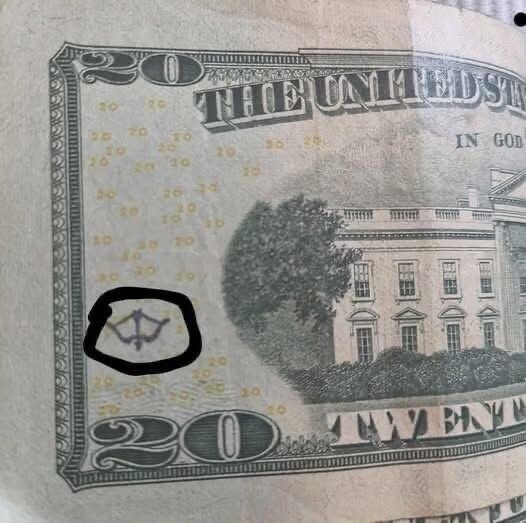
In the sterile and precise world of modern finance, most people handle money with casual indifference. We glance at the denominations, recognize the familiar portraits of historical figures, and slip the bills into our wallets without giving much thought to the physical history each banknote carries. Yet sometimes, a twenty- or hundred-dollar bill reveals something unusual: a small stamped emblem—perhaps a bow and arrow, a tiny star, or a cryptic geometric symbol tucked into the margin. To the untrained eye, it may look like graffiti or a random mark made by a bored teller, but these symbols are actually part of a centuries-old, covert system of currency verification known as “chop marking.”
These stamps are not signs of counterfeiting or damage; they are marks of global trade. They represent a decentralized system of trust that existed long before modern banks and continues to function quietly even in the digital age. Understanding the meaning of a bow-and-arrow symbol on a banknote connects us to a historical tradition that began in the ancient markets of China and spread across the world.
Chop marking originated more than a thousand years ago, when currency was valued by the weight of precious metals. In ancient Chinese markets, merchants traded primarily in silver and gold. To avoid fraud—which could lead to financial ruin—merchants and “shroffs,” expert money changers, carefully tested the weight and purity of the metal. Once they were satisfied, they stamped the coin or bar with a personal or company seal known as a “chop.”
This stamp functioned as a signature of authenticity. As a coin passed from trader to trader, it accumulated physical proof of its reliability. The more chop marks a coin carried, the more trustworthy it became, having survived repeated scrutiny by skeptical hands.
As economies transitioned from metal coins to paper currency, the tradition of chop marking did not disappear—it evolved. In the nineteenth and early twentieth centuries, as international trade expanded, the U.S. dollar began to emerge as the global “lingua franca” of commerce. However, in regions without centralized banking systems—such as parts of Southeast Asia, Africa, and Latin America—merchants still needed a fast and reliable way to verify foreign banknotes.
The solution was the ink chop. Merchants, currency exchangers, and even local casinos stamped small symbols onto the margins of U.S. bills. A bow-and-arrow emblem or stylized character served the same purpose as the ancient metal stamps: a visual signal that a professional had already inspected the bill’s paper quality, watermark, and security features. These marks formed an informal, decentralized verification network, allowing trade to move smoothly where official government guarantees were insufficient.
Even today, while institutions like the Federal Reserve and the U.S. Secret Service rely on advanced sensors and magnetic inks to detect counterfeits, chop marks remain a persistent low-tech reality. A bill bearing a bow-and-arrow stamp may have passed through international trade hubs such as Hong Kong, Singapore, or Bangkok. It could have been used in wholesale transactions or handled by currency exchangers in cash-based economies.
Legally, chop marks do not reduce a bill’s value. Under U.S. law, they are considered minor defacement, and banks accept such notes without hesitation. For numismatists, however, these marks are invaluable. Each stamp represents a hidden data point in the story of economic migration. A bill with multiple chop marks from different regions tells a global story—linking a bank in Ohio to a street vendor in Thailand or a trading house in Johannesburg.
Beyond their practical function, chop marks are cultural artifacts. They reveal a fundamental truth about money: it is not merely a medium of exchange, but a social contract built on trust. When formal institutions fail to provide that trust, people invent their own systems. The small bow-and-arrow symbol is a testament to human ingenuity in an era long before digital ledgers.
Those who know what to look for can usually spot these marks in the unused margins of a bill, away from official portraits and security features. They are often stamped in red, purple, or black ink and range from simple geometric shapes to intricate logos. While they may appear random, their placement is deliberate—visible at a glance to insiders without obscuring official printing.
Even in an age of cashless payments and digital stablecoins, chop marks persist as a fascinating anomaly. They represent the human side of trade—one that resists full automation. In some markets, a merchant’s physical stamp still carries more weight than a digital confirmation.
So the next time you receive a twenty-dollar bill, take a moment to examine its margins. If you spot a tiny symbol out of place, you are holding a piece of living history. That mark records a journey across borders and through skeptical hands—a badge of honor earned in the world’s most demanding marketplaces.