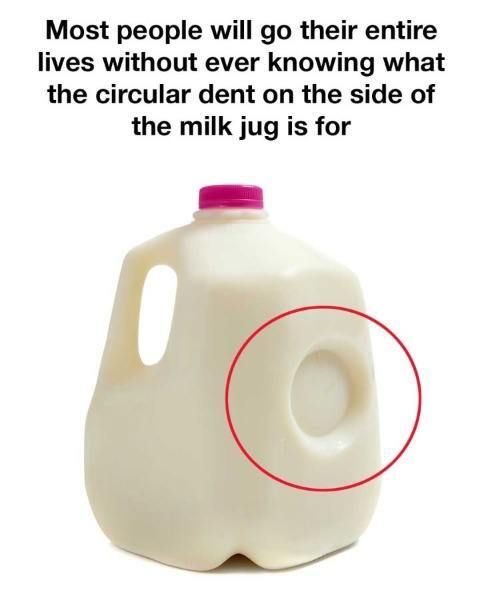
Most people go about their daily routines without ever giving a second thought to the packaging that surrounds the products they use. You might grab a jug of milk from the refrigerator, pour it into your cereal bowl, and place it back on the shelf without really noticing any details. But then, one day, perhaps when you’re putting groceries away or cleaning your kitchen, your eyes catch something odd: a peculiar, round dent on the side of your milk jug. At first, it seems like a manufacturing mistake—a flaw in an otherwise smooth surface. Yet, once you truly notice it, you can’t help but see it every time you reach for the jug. That small indentation quickly becomes more than just a curiosity. It’s not a defect, but an ingenious feature designed with purpose and precision. What looks like a simple dent is actually a multi-functional element—a silent guardian built into the jug. It’s a warning system, a protective shield, and a marvel of practical engineering all at once, cleverly integrated into the everyday objects we often overlook.
Understanding the true purpose of this curious shape reveals how much thought goes into something as mundane as a milk jug. The rounded indentation isn’t just for looks; it serves as a pressure valve, a shock absorber, and an innovative sustainability measure, all molded into a single, unobtrusive curve. As the milk inside the jug reacts to temperature changes—expanding when it warms and contracting as it cools—the “dent” flexes in response. This flexibility allows the jug to withstand these internal pressures without splitting open, leaking, or suddenly bulging outward. The next time you hear a faint pop when setting your milk jug down on the counter, know that it’s the plastic subtly adjusting itself, absorbing the stress from changes in air pressure or temperature so that your kitchen surfaces and your groceries stay safe and dry.
But the benefits don’t stop there. The indentation also serves as a built-in crumple zone, much like those found in modern cars. If you accidentally drop or bump the jug, this area is designed to deform, absorbing the impact and preventing the container from bursting or cracking open. This small design detail helps protect your milk from accidental spills, saving you from messy clean-ups and wasted groceries. Beyond its role in safety, the clever shape allows manufacturers to use less plastic without sacrificing the jug’s strength or durability. The dent creates structural support, reinforcing the container’s ability to hold its shape even when the walls are thinner. This not only reduces production costs—making milk more affordable for consumers—but also lessens the environmental impact by cutting down on plastic waste.
Even when the milk jug has reached the end of its useful life, the indentation continues to provide advantages. As the jug is compressed during recycling, the dent helps it collapse more efficiently, taking up less space and making the entire recycling process smoother and more effective. It’s a feature that benefits the environment long after the milk is gone. In a world where design is often celebrated for its flashiness or bold innovation, the small, unassuming dent in your milk jug stands as a testament to the power of subtle, thoughtful engineering. It’s a gentle reminder that the most brilliant solutions are sometimes the ones we barely notice, quietly improving our lives in ways we take for granted. So the next time you pour yourself a glass of milk, take a moment to appreciate the invisible genius at work on your kitchen shelf—a tiny curve that makes a world of difference.