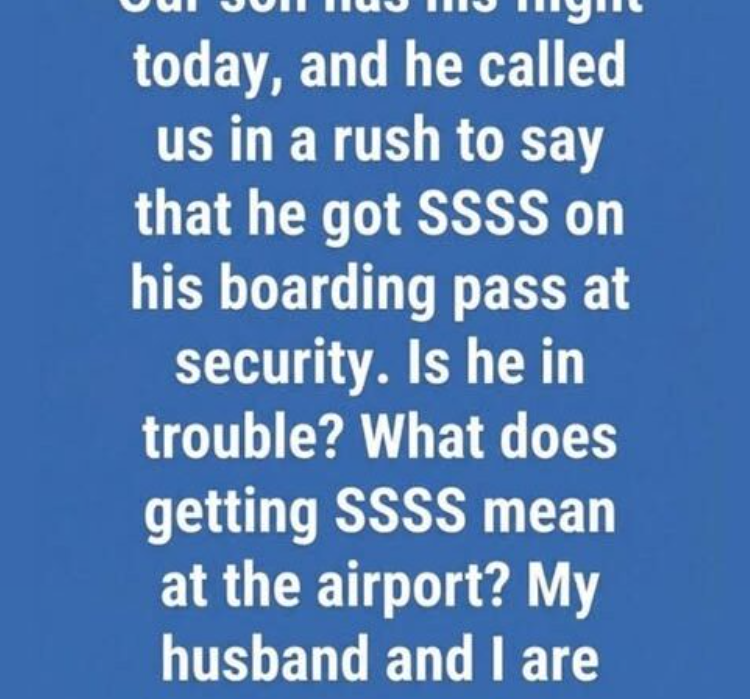
The modern airport experience is a carefully choreographed dance of logistics, coffee, and mild anxiety. You navigate the maze of check-in kiosks, place your luggage on the conveyor belt, and finally secure that rectangular strip of thermal paper: your boarding pass. Usually, you scan it for the essentials—gate number, boarding group, seat assignment. But sometimes, a traveler notices four bold letters printed near their name that seem to carry a quiet, bureaucratic threat: SSSS.
While most frequent fliers may go their entire lives without seeing this code, its appearance can trigger confusion or even panic. Is it a mistake? Are you being watched? Has a clerical error placed you on a government watchlist? The reality is rarely so dramatic, but the presence of SSSS is an important sign that your journey through the terminal is about to become significantly more complicated. To navigate it successfully, it’s crucial to understand the mechanics of the “Secondary Security Screening Selection.”
Decoding the Code: What Is SSSS?
SSSS stands for Secondary Security Screening Selection. It is used primarily by the TSA (Transportation Security Administration) in the United States, operating under the broader Department of Homeland Security (DHS). When these letters appear on your boarding pass, the automated “Secure Flight” system has flagged your profile for enhanced scrutiny that goes far beyond the standard metal detector or body scanner.
It is important to immediately clear up common myths. Being flagged with SSSS does not mean you are on the “No-Fly List.” If that were the case, you wouldn’t even receive a boarding pass. It also doesn’t necessarily mean you are a criminal suspect or that you’ve done something “wrong.” Rather, it means your travel profile for this specific flight has triggered a deeper, more invasive security check.
The Secondary Screening Process
If you see those four letters on your pass, the “normal” airport experience effectively ends at check-in. One early sign is that you cannot use mobile or home-printed boarding passes. Most SSSS travelers must check in at the airport desk, where an agent can verify their physical ID and travel documents.
At the security checkpoint, the process intensifies. While a standard passenger might take two minutes, an SSSS passenger should expect an additional 10 to 30 minutes of detailed inspection, typically involving:
Thorough Pat-Downs: A detailed manual search by a TSA officer of the same gender.
Explosive Trace Detection: Swabbing hands, clothing, and bag interiors for microscopic traces of explosives.
Full Luggage Inspection: Every item in carry-on luggage may be removed, opened, and inspected.
Electronic Verification: You may be asked to power on every electronic device—laptops, tablets, cameras, and even batteries—to prove they are functional devices, not disguised threats.
Why Me? The Algorithm’s Logic
The most frustrating part is the apparent randomness. TSA doesn’t publish exact “weights” for risk factors, but aviation experts note several common triggers:
Random Selection – To maintain unpredictability, a percentage of passengers is chosen randomly so no one feels entirely exempt.
Unusual Travel Patterns – Last-minute international flights, cash purchases, or travel to geopolitically unstable regions can flag the system.
Name Similarity and Watchlists – If your name matches someone on a government watchlist, the system may flag you repeatedly until identities are fully verified.
The Redress Process
For a one-time traveler, SSSS is a minor annoyance. For frequent travelers flagged due to name confusion, it’s a professional hurdle. The DHS Traveler Redress Inquiry Program (DHS TRIP) allows submission of extra identification documents to distinguish yourself from a person of interest. Successful applicants receive a Redress Control Number, which helps prevent future SSSS markings.
The Layered Security Philosophy
SSSS exists as an “unpredictable layer” in the aviation security system. No single layer is perfect, but layering multiple defenses ensures that weaknesses don’t align. It is designed to deter potential threats by adding the possibility of a more rigorous, unpredictable inspection.
Tips for Handling an SSSS Flag
Arrive early—at least an hour before your flight.
Stay cooperative and calm; officers are following protocol.
Keep electronics charged; devices that won’t power on may be confiscated.
Ultimately, SSSS is a temporary hurdle, not a permanent mark. It’s a reminder of the complex, invisible systems that safeguard modern travel. While it may delay your airport arrival, it is simply one chapter in the intricate story of global aviation security.