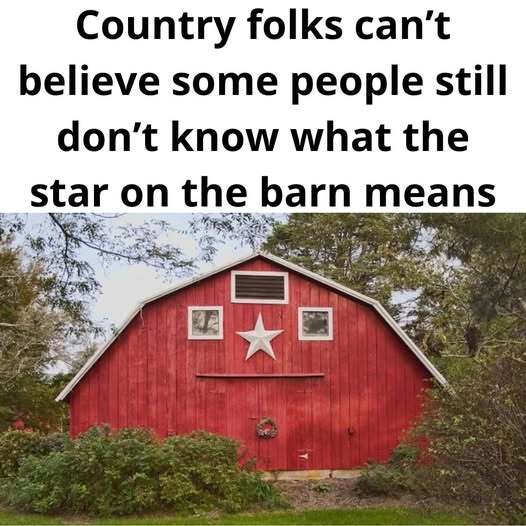
Long before barn stars became simple decorative pieces sold in home stores or casually displayed on suburban walls, they carried a much deeper meaning than most people realize. These stars were never chosen just for how they looked. They were part of a quiet, symbolic language created by Pennsylvania Dutch farmers—communities that brought their traditions from Europe and adapted them to a new and often unpredictable world.
For them, life was closely tied to the land. Weather could determine survival. Crops could fail without warning. Animals, illness, and forces they couldn’t fully understand all shaped daily life. In that environment, belief wasn’t something abstract—it was practical, woven directly into everyday routines.
Barn stars were born from that reality.
They weren’t random designs painted on wood or placed on buildings without thought. Each star had intention behind it. Its shape, its colors, even where it was positioned on a barn or home—all of it was carefully chosen. Together, these elements created a visual expression of hope, protection, and purpose.
At their core, barn stars were part of a broader tradition often referred to as “hex signs.” These designs combined geometric patterns with symbolic meaning, influenced by German folk traditions, Christian beliefs, and older forms of mysticism passed down through generations.
For the people who created them, these symbols weren’t just decorative.
They were believed to offer protection.
A star placed on a barn could represent a wish for a strong harvest, protection from storms, or the health of livestock. Colors carried meaning—red for strength, blue for peace, green for growth. Even the number of points on a star could reflect a specific intention.
Nothing was accidental.
Every detail mattered.
In many ways, barn stars acted like a form of visual prayer—something placed openly, not hidden, serving as a constant reminder of belief and intention. They were meant to be seen, both by those who lived there and, symbolically, by whatever unseen forces might influence their lives.
These designs were also connected to other forms of expression in the same communities. Quilt patterns, for example, often shared similar shapes and meanings. The repetition of stars, circles, and symmetrical designs created a sense of balance and order—reflecting both artistic taste and spiritual belief.
This combination of meaning and function is what made barn stars unique.
They weren’t purely art.
They weren’t purely ritual.
They existed somewhere in between.
As time passed, the world began to change. Scientific understanding replaced many of the fears that once shaped daily life. Weather could be predicted more accurately. Illness could be treated. The belief in unseen forces controlling outcomes slowly faded.
But the stars remained.
They didn’t disappear—they evolved.
What was once a symbol of protection became a symbol of tradition. Families continued to display barn stars, not because they expected them to influence events, but because they represented continuity.
A connection to the past.
A reminder of where they came from.
Over time, these symbols shifted from protective signs to meaningful heirlooms. They became part of the visual identity of rural life, especially in areas where Pennsylvania Dutch culture remained strong. Red barns with carefully placed stars became a familiar and recognizable part of the landscape.
Eventually, their meaning expanded even further.
Barn stars began appearing far beyond farms. They were recreated in metal, wood, and other materials, sold as decorations for homes with no direct connection to agriculture or the traditions that created them.
In this new context, their purpose changed again.
They became aesthetic.
A symbol of simplicity, rustic charm, and a connection to a lifestyle many people associate with authenticity and tradition.
Yet even in this modern form, a trace of their original meaning still remains.
Not in a literal sense—most people today don’t hang a barn star expecting protection or prosperity. But the act itself still carries a subtle link to the past.
It reflects a desire for something steady.
Something rooted.
In a fast-moving world that constantly changes, these symbols offer a sense of continuity. They remind us of a time when life was more connected to the land—when survival depended on patience, effort, and a quiet faith in things beyond control.
Every barn star, whether painted or crafted, carries that history with it.
It connects back to the farmers who stood in their fields, watching the sky and hoping for good weather. To families who believed that beauty and purpose could exist together—that a simple symbol could be both meaningful and visually powerful.
That belief is part of why these stars have endured.
Because beyond their original purpose, they represent something universal.
The human need to create meaning.
To mark spaces with symbols that reflect hopes, values, and identity.
To leave behind something that quietly says, “This mattered.”
Today, when a barn star is placed on a wall or displayed on a porch, it may no longer carry the same expectations it once did. But it still holds intention.
It still carries connection—however distant—to the people who first created it.
And in that way, it remains more than decoration.
It is a reminder.
Of where traditions begin.
Of how beliefs evolve but rarely disappear completely.
And of how even the simplest shapes—a few lines forming a star—can hold generations of meaning, quietly present wherever they are placed.