The bond between a single mother and her daughter is often forged in necessity, a shared resilience built through years of making do with very little. For twenty years, that was our reality. After my husband died when our daughter was only four, I became her entire world. There were no safety nets, no backup plans, and no experienced voices to guide me. It was just me, a paycheck I couldn’t afford to lose, and a little girl who deserved a life that didn’t feel like it was held together by thread. I thought I had succeeded in giving her that stability, but in April 2026, a single dinner invitation proved that the shadows I had buried decades ago were not as gone as I believed.
It started with surprise. My daughter, now twenty-four and recently returned from studying in Canada, called me with excitement in her voice. She was engaged. The news brought both joy and immediate, deep concern. She had been with a man named Dylan for a year—a thirty-five-year-old lawyer I had never met, and whose last name she had never even mentioned. The age gap worried me, but it was the secrecy that unsettled me most. I spent the next evening cleaning the house and rehearsing a polite welcome, unaware that the man about to walk through my door was not coming for approval, but for confrontation.
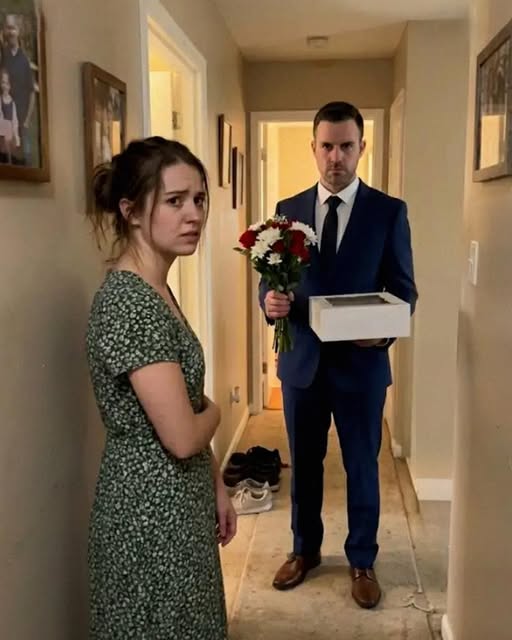
When the front door finally opened, I walked into the hallway with a dish towel still in my hand. There stood Dylan: polished, expensive-looking, and carrying himself with a controlled posture that felt strangely familiar. The moment our eyes met, the air in the room seemed to disappear. I didn’t recognize his face, but I recognized something in him—something cold and controlled in his eyes that I had spent twenty years trying to forget. Those eyes belonged to Daniel, the man I had been engaged to before I ever met my daughter’s father.
Before we even sat down for the meal I had prepared, the civility broke. “Before we sit down and pretend this is normal,” Dylan said, his voice cutting through the room, “I need your mother to tell the truth about my father.” The words shattered everything. Dylan was Daniel’s son. The man my daughter planned to marry was the son of the man who had nearly destroyed me.
I had to sit down because my legs wouldn’t hold me. Dylan stood over us, fueled by a lifetime of stories about a woman who had supposedly ruined his father’s life by disappearing without explanation. For years, Daniel had painted me as unstable and cruel, telling his son I had betrayed him. But the truth was far darker. When I was twenty-six, Daniel’s charm had turned into control. He didn’t just love me—he wanted to own me. He chose my clothes, corrected how I spoke, and made decisions for me under the excuse of “protection.” When I told him I was pregnant, the joy I expected was replaced with fear and possession.
I ran that same week. I left letters explaining everything and begging him not to follow me, but Daniel hid them and told his own version of the story instead. The most painful truth came next: a week after I fled, alone and terrified, I miscarried the child who would have been Dylan’s half-sibling. The silence that followed was heavy enough to crush the room. Dylan looked physically sick as the image he had of his father collapsed in front of him.
But the real shock was how deliberate everything had been. As the night went on, my daughter realized Dylan hadn’t brought her here for a family introduction. He had found his father’s hidden box of letters and photos a month earlier. He already knew who I was. He had spent weeks testing my daughter, setting up this confrontation to prove his father’s version of events. He had turned their engagement into a kind of experiment, controlling her choices just as his father once had controlled mine.
The breaking point came when Dylan issued an ultimatum. He told my daughter she had to choose: him or me. It was a familiar pattern of control, a reflection of the man I had once escaped. He wanted her loyalty to mean abandonment.
But my daughter didn’t choose either of us.
She chose herself.
She removed the engagement ring and handed it back to him. “I’m not choosing between you and my mother,” she said. “I’m choosing not to marry someone who thinks I can be forced into loyalty.” She chose truth over control.
After Dylan left, the house fell into silence. We sat at the kitchen table long after midnight, the tea going cold between us. For the first time, she didn’t look at me only as “Mom,” the strong provider. She looked at me as a woman who had survived things she never knew about. She told me, “You don’t get to decide alone what becomes part of my story.” It hurt, but she was right. By hiding my past, I had left her unprepared for how it might return.
A week later, Dylan sent a message. He had found the rest of the letters. He admitted the truth. He apologized. I didn’t reply. Some apologies are too small for the damage they follow.
My daughter and I are different now. The fragile thread I thought held our lives together has been replaced by something stronger: honesty. She still speaks to Dylan sometimes, not as a partner, but as someone trying to understand what remains of a broken relationship.
Most importantly, she speaks to me. She asks about the years before she was born, about who I was before I became a mother. We are no longer strangers living in the same story. We are two women, standing in the light, finally free from old shadows.
Last night, as she left my house, she looked back and said, “I think I need to know you as a person too.”
And I realized that although the truth shattered us for one night, it was the only thing that could ever truly hold us together.