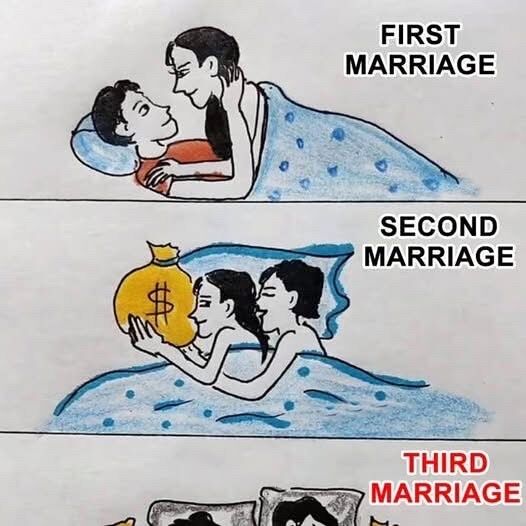
Marriage is not a static institution; it is a living, evolving reflection of who we are at any given moment in life. Each union acts as both a mirror and a microscope, revealing our strengths, weaknesses, fears, and desires in ways that few other experiences can. The first marriage, often imagined as a forever promise, tends to arrive wrapped in romantic idealism, high expectations, and a belief in destiny. It carries the intoxicating thrill of new love, a sense that two people have discovered a rare and perfect harmony. Yet, beneath that excitement often lies an untested foundation. As time passes, the pressures of life—financial strain, differing goals, everyday habits—begin to expose cracks that chemistry alone cannot mend. The “forever” we imagined sometimes shatters quietly, sometimes explosively, leaving heartbreak in its wake. But beyond sorrow, there is a profound lesson: the first marriage, for all its impermanence, offers a mirror that forces self-reflection. Patterns that once went unnoticed—the ways we avoid conflict, the hidden resentments we carry, the expectations we impose on others—become glaringly visible. That clarity, painful as it may be, is an essential guide for the journeys yet to come.
The second marriage arrives not with the naïveté of youth, but with a tempered heart, a collection of scars, and a mind sharpened by experience. It is approached with caution, curiosity, and sometimes a shadow of fear—fear that the mistakes of the past might repeat, fear that vulnerability could once again lead to betrayal or disappointment. Yet, unlike the first union, the second marriage is built with a conscious awareness of oneself. People enter it with a broader understanding of their emotional needs, boundaries, and limitations. They are aware of what they can compromise on and what is non-negotiable. Love in this stage is no longer purely about romance; it is about partnership, about negotiating life together with an acute awareness of the fragility of human connection. The second marriage is often more forgiving in some ways, because it is informed by realism, but also more discerning. There is less tolerance for illusions, more insistence on honesty, and a higher expectation that both partners are committed not just to each other but to personal growth and mutual respect. And yet, even this awareness carries its own quiet costs: lingering fears, unresolved grief from prior losses, and the shadow of what once was can color the present in subtle but significant ways.
By the third marriage, the stakes—and the perspective—have changed even further. By now, people have lived through the highs and lows of love, grief, and betrayal; they have learned what sustains them and what erodes them. Fairy tales are no longer pursued; instead, what is sought is something more delicate, nuanced, and deeply human. It is a desire for companionship rooted in reality, a longing for a partnership where both parties are fully aware of themselves and of each other. Third marriages are less about rescuing oneself from loneliness or fulfilling romantic fantasies and more about crafting a shared life that balances intimacy, independence, and wisdom. Decisions are measured, grounded, and intentional. The exhilaration may be subtler, but the emotional depth is profound. At this stage, love is intertwined with patience, empathy, and a steady commitment to seeing the other person clearly—and being seen clearly in return.
The evolution from first to third marriage is rarely linear, rarely tidy, and never predictable. It is a journey punctuated by mistakes, lessons, and moments of surprising grace. Early unions are often fueled by chemistry, passion, and an almost naïve conviction that love will overcome all obstacles. Conflicts are interpreted as failures, and unmet expectations feel like betrayal. When these unions dissolve, the resulting heartbreak is not just emotional pain but a form of education: a chance to recognize one’s own patterns, unresolved wounds, and blind spots. These experiences provide the raw material for personal growth and form the unspoken bridge to subsequent partnerships.
Later marriages are approached with a blend of hope and pragmatism. Partners enter with open eyes, understanding that love alone is not enough. Compatibility, shared values, emotional intelligence, and a commitment to navigating life’s complexities together are prioritized. Blended families, past traumas, and financial realities add layers of difficulty, but they also enrich the bond when both parties navigate them with care and respect. Mutual growth, communication, and self-awareness become the pillars that sustain the union. In essence, marriage evolves alongside the individuals within it; it is an ongoing collaboration between two selves who are themselves continually changing.
Ultimately, the trajectory from first to third marriage reflects not simply the evolution of romantic relationships but the evolution of self. Each union serves as a crucible, shaping our understanding of love, compromise, resilience, and emotional honesty. Partnership succeeds only when both people are willing to grow, adapt, and confront not just external challenges but the complexities within themselves. The cumulative lessons of multiple marriages—lessons about patience, self-respect, forgiveness, and emotional courage—create the foundation for a relationship that is not only enduring but profoundly real. Marriage, in all its stages, reveals the truth about human connection: it is fragile, demanding, beautiful, and transformative. And as we navigate each stage, we learn that the most enduring unions are those built on self-awareness, mutual respect, and the willingness to evolve together, again and again.