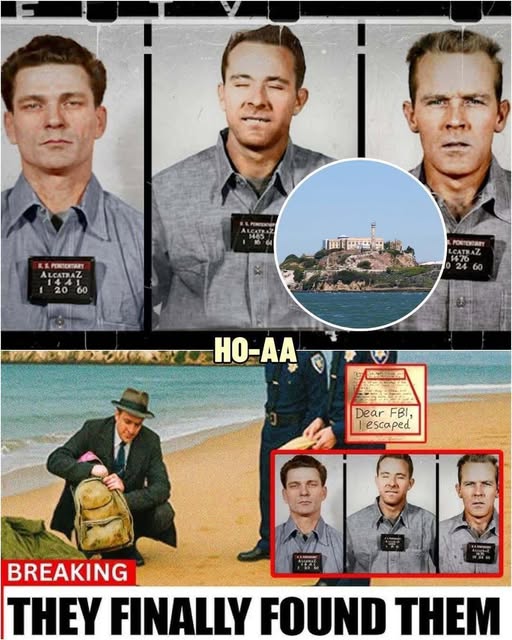
The night they disappeared, Alcatraz itself seemed to hold its breath. The fog rolled in thick and heavy, muffling the sound of the waves crashing against the rocky island, as if the sea itself were complicit in hiding what was about to happen. Inside the fortress of stone and steel, guards patrolled with the confidence of men certain that the system they protected could contain anyone. Cameras, bars, searchlights, and armed sentries made the island seem impenetrable. But that night, none of it mattered. Three men—Frank Morris and the Anglin brothers, John and Clarence—slipped past every precaution, evading every carefully laid trap, and vanished into the cold, dark waters of San Francisco Bay.
No alarms screamed. No witness accounts captured their final movements. The meticulous preparation, the hollowed-out ventilator shafts, the crude dummies left in their beds—all these details combined to make the escape almost cinematic in its precision. And then the world lost their trail. There were no bodies washed ashore, no footprints in the sand, no confessions, no sightings that could be confirmed. What remained were whispers in the corridors of law enforcement, cryptic letters arriving years later, and the enduring tension between the official story and the tantalizing possibility of life beyond the prison walls. One letter, discovered decades later, sent shivers through those who had spent their careers enforcing the island’s order: words written with care, evidence that maybe—just maybe—they had survived.
The Alcatraz escape endures because it speaks to something deep and almost elemental in the human psyche: the clash between absolute control and the stubborn, unyielding refusal of a person to be caged. The island represented perfection in containment—years of federal investment, the toughest guards in the nation, and a reputation as a place where escape was impossible. And yet, Morris and the Anglin brothers didn’t just break through physical barriers. They outwitted an entire system built on certainty, exploiting weaknesses, improvising when plans went awry, and relying on patience, ingenuity, and sheer nerve. Their disappearance continues to fascinate because it undermines the myth of total control. Every unanswered question, every blurred photograph that might show them in some distant town, every unverified letter, has only deepened the wound to official pride and enriched public imagination. It has made the escape not merely an event, but a legend, a story that refuses to be fully contained, even by history itself.
Speculation about their fate has grown more elaborate over the decades. Some say the men were claimed by the icy waters of the bay, their final moments a struggle against the relentless current, disappearing into the darkness as Alcatraz kept its terrible promise. Others believe they made it to freedom, carrying their secret across borders, settling in small towns, altering their names and faces, and blending into lives far removed from the notoriety they had earned. The idea of the men alive, anonymous, and free is almost intoxicating—a triumph of human cunning against an institution designed to suppress exactly that kind of triumph. Each theory carries with it its own tension: the quiet horror of drowning in isolation, or the thrilling thought of escaping and starting anew in a world that never knew your face.
Even today, nearly seven decades later, the story refuses to close. Historians, true-crime enthusiasts, and former law enforcement officials continue to pour over documents, letters, and every scrap of evidence left behind. They analyze water currents, weather patterns, boat traffic, and the very structure of the prison itself, attempting to uncover a truth that may never exist. Each small discovery reignites fascination, and yet confirms nothing. The mystery has become a mirror reflecting our own obsession with freedom, ingenuity, and the allure of the unknown. It asks us to consider the limits of power, the potential of ordinary men to outthink extraordinary systems, and the fragile line between life and legend.
If Morris and the Anglin brothers did survive, the myth of Alcatraz was forever altered. The island, once a symbol of ultimate authority and fear, became a reminder that human will can transcend even the most absolute structures. Their escape, and the tantalizing possibility of their continued existence, transformed Alcatraz from a prison into a story: a tale of suspense, brilliance, and audacious hope that resonates far beyond the gray walls and cold waters. On the other hand, if they perished, then their final moments were a silent testament to the terrifying might of the island and the ocean, a cruel but fitting end for a prison that promised nothing but confinement.
Either way, the escape became larger than the men themselves. It has grown into something timeless, a story suspended between triumph and tragedy, reality and myth, certainty and speculation. Each generation learns it anew, each historian, novelist, and filmmaker drawn to the island and its secretive, cold heart. The figures of Morris and the Anglins, whether alive or dead, remain unclaimed by history, leaving the world to wonder, to theorize, and to marvel at a human act of defiance so audacious that even the legendary “Rock” itself seems to pause, in recognition, of what was once accomplished within its walls.
The Alcatraz escape is more than a story of criminal ingenuity—it is a story about hope, human cunning, and the eternal longing to break free. It is a narrative that endures precisely because it resists resolution, because it flirts with possibility at every turn. The three men, their fates unknown, became immortal in a way few ever achieve: through the sheer force of daring, planning, and the refusal to accept boundaries imposed upon them. And that is why, no matter how many books are written or documentaries made, the story of the night they disappeared continues to hold the imagination of the world, quietly defying the finality that prisons and time so often demand.