Long before anyone understood what was unfolding, Washington, D.C. felt off. People walking the streets sensed it without knowing why—an unfamiliar weight in the air, a pressure that didn’t belong to an ordinary afternoon. Street vendors stopped mid-sentence. Commuters slowed for reasons they couldn’t explain. Even the pigeons swirling above Lafayette Square seemed uneasy, darting in short, jittery patterns. Something beneath the surface was winding tight, something the city felt before its residents did.
Earlier that morning, unmarked SUVs had moved through the downtown grid with an odd precision—looping the same streets, slipping through alleys usually ignored, pausing at intersections without stopping. Their windows were pitch-black, their routes too deliberate to dismiss. Two office workers later said they heard clipped radio chatter from one of the vehicles—sharp, urgent, controlled. They didn’t think much of it at the time. Looking back, it felt like the first fracture in the calm.
At 17th and I Street NW—a crossroads normally buzzing with tourists, government employees, and early lunch seekers—life continued as usual. Two National Guard members watched their post with relaxed vigilance, blending into the everyday backdrop. A few blocks away, the White House sat steady beneath the winter sun, familiar and still. No one knew that within minutes, that sense of normalcy would be violently torn away.
The first shot cut through the city’s noise with the suddenness of a snapped cable. People froze. A wave of starlings exploded from a rooftop. Before anyone could comprehend the sound, a second burst followed—closer, louder, unmistakable.
Chaos ignited instantly. A woman sprinted across the intersection and threw herself behind a concrete barrier. A man shoved two strangers toward a building lobby, dropping his coffee in the scramble. Cars stopped dead in the street. And at the center of it all, the two National Guard members collapsed almost in unison, their gear clattering sharply against the pavement.
For ten seconds, the world was nothing but confusion and panic. Then came the sirens.
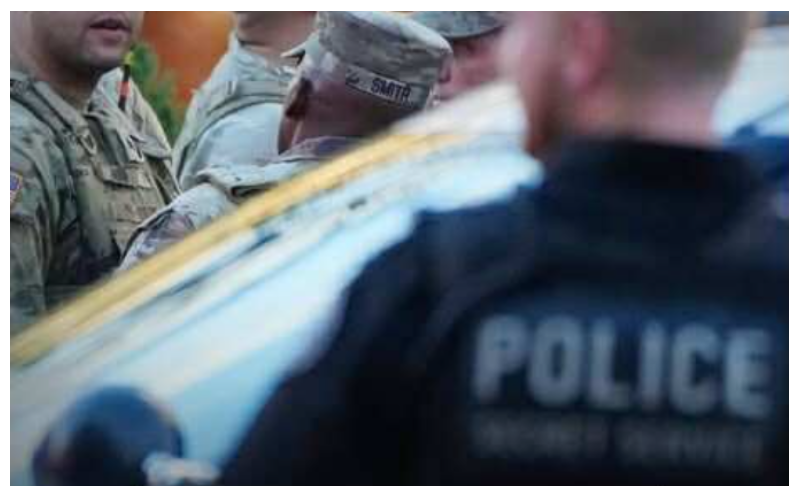
They didn’t build gradually—they arrived like a blow. Police cruisers ripped through the jammed streets. An armored vehicle whipped around a corner, tires screeching. A helicopter thundered overhead, blades slicing the air. Agents in tactical gear surged forward, shouting commands that drowned in the noise of fear.
Downtown shifted in seconds. Barricades slammed into place. Officers formed protective lines. Pedestrians were shoved back and redirected. Office buildings went into immediate lockdown. The blocks around the White House transformed from everyday bustle to a full emergency zone in minutes.
One witness—a federal employee with earbuds still in—later said, “It felt like the city suddenly realized it wasn’t invincible.”
Within the swirl of flashing lights, officers detained a single “person of interest.” The individual didn’t resist, speak, or show emotion. They were taken away quickly, consumed by the swarm of agents before anyone could see their face.
But answers were scarce, and the silence only fed the tension.
The injured Guardsmen were loaded into ambulances shielded by layers of personnel. No information was released—not their identities, not their conditions, not their units. Families probably saw the first reports on their phones before officials reached them. The vacuum of facts filled instantly with fear, speculation, and the harsh reminder that even the most guarded locations have weak points.
This wasn’t just an attack near a landmark—it was an assault on the sense of safety people assume surrounds the nation’s center of power. For decades, the area near the White House has embodied security, a place where danger feels distant. But gunfire echoing through those streets shattered that belief in a single afternoon.
Investigators moved fast. Evidence markers dotted the pavement like constellations. Surveillance footage was collected from every angle. Drones scanned rooftops and alleyways. Analysts worked inside mobile command units parked along the curb. Yet despite the rapid response, uncertainty lingered—an awareness that whatever happened had been set in motion long before the first shot.
The city held its breath.
People locked inside offices watched silent news broadcasts. Those stranded outside refreshed their phones nonstop. Parents texted their kids. Tourists whispered nervously in hotel lobbies. Even reporters at the scene spoke with an unfamiliar edge.
And beneath everything was the same unspoken question: Was this a lone act, or the beginning of something larger?
By evening, streets were still blocked. Investigators continued collecting fragments—debris, shell casings, witness accounts, digital evidence. Officials prepared careful statements designed to calm without revealing anything meaningful. Rumors spread faster than confirmed information.
But nothing could erase the image of two uniformed soldiers lying wounded only steps from one of the world’s most protected addresses.
The true impact wasn’t measured in sirens or barricades—it lived in the uneasy quiet that settled over the capital afterward. People glanced over their shoulders more often. Security doubled. Coffee shop conversations revolved around the same question: How could this happen here?
Until investigators reveal the full picture, that question hangs over the city like a shadow.
Washington has endured countless crises—political, social, symbolic—but this one struck close. Too close. And as the nation waits for answers, one truth remains: whatever ruptured on 17th Street wasn’t random. And the uncertainty it unleashed won’t fade until the city understands why.