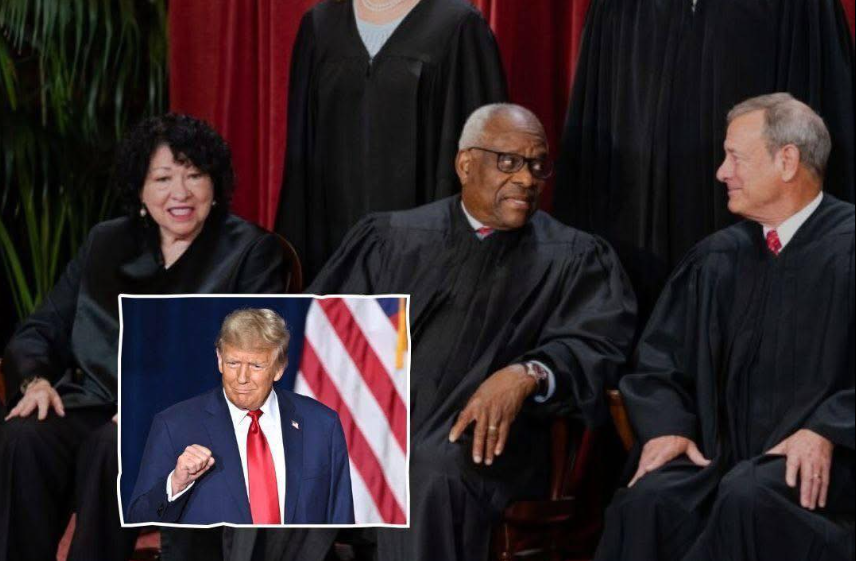
A legal earthquake didn’t just hit Washington—it split the ground open beneath it. In a stunning 8–1 decision, the Supreme Court delivered a sweeping immigration victory to Donald Trump, the kind of ruling that ricochets far beyond the marble columns of the judiciary. Analysts, lawmakers, and immigrant communities are still struggling to process what happened. Even traditionally liberal justices sided with the majority, a rare ideological convergence that sent shockwaves through the political landscape.
Overnight, roughly 300,000 Venezuelan migrants went from “protected” to potentially deportable. People who had lived for years under the belief that Temporary Protected Status offered stability—if not citizenship, at least breathing room—found themselves thrust into a new reality shaped by a single court order. Entire families, communities, and futures now hang suspended on what the majority opinion called a “statutory misinterpretation,” and what the sole dissenter warned could become “a humanitarian disaster cloaked in procedural language.”
The Supreme Court’s decision did far more than vindicate Trump’s legal strategy. It redrew the boundary between presidential authority and humanitarian refuge—lines that had already been fiercely contested in Congress, courts, and public debate. By overturning the lower court’s injunction, the justices effectively validated the administration’s argument that TPS is not a long-term humanitarian guarantee but an instrument of foreign policy. That legal distinction, abstract on paper, lands like a wrecking ball in real life for the Venezuelan families who built not just temporary shelter but entire lives during their years in the United States.
Inside those legal paragraphs lie human beings—crowded apartments shared by relatives and friends, corner food trucks run on shoestring budgets, construction crews that begin their days before sunrise, parents who juggle two jobs while raising U.S.-born children. Many have been here long enough that “temporary” feels like an insult to the sacrifices they’ve made. They have leases, mortgages, driver’s licenses, and tax records. They have neighbors. They have roots. They have hope that has been stretched thin by uncertainty but never quite snapped. Until now.
In internal DHS guidance, Kristi Noem framed continued TPS protection as “contrary to the national interest,” signaling a shift toward more aggressive removal efforts. Deportation numbers have already surged—over half a million removals recorded in recent cycles—and critics fear the ruling will open the door to even more sweeping enforcement actions. Immigration lawyers are reporting a flood of calls from families terrified they will be separated, losing not only stability but each other.
Supporters of the ruling argue that the executive branch must reclaim control of immigration policy from what they see as years of judicial overreach. They welcome the decision as a restoration of presidential power and a deterrent to future mass arrivals. To them, the Court’s opinion is a correction long overdue—a recalibration of the system’s balance.
But opponents see something very different: families dismantled by the quiet stroke of a pen. Mothers and fathers preparing suitcases not for travel, but for survival. Children asking why they have to leave the only home they’ve ever known. Business owners wondering if the workforce they rely on will vanish in a matter of weeks. Advocates warn of entire communities destabilized, not by crime or crisis, but by a legal technicality interpreted with cold precision.
For weeks, buses and flights are expected to begin moving people who once believed they had finally escaped fear. Shelters brace for increased demand. Community groups scramble to provide legal aid. Social media fills with messages of both outrage and applause, mirroring the country’s raw divide on immigration.
And now the nation faces a much larger, far more uncomfortable question—one the ruling forces into the forefront:
What do America’s promises to migrants actually mean?
Are they lifelines?
Are they temporary conveniences?
Or are they fragile illusions—easily rewritten by courts, memos, and political tides?
As the dust settles around this seismic ruling, one truth becomes clearer than ever: immigration isn’t just a policy debate. It is a battle over identity, morality, and the future of millions whose lives hinge on decisions made by people who will never meet them.