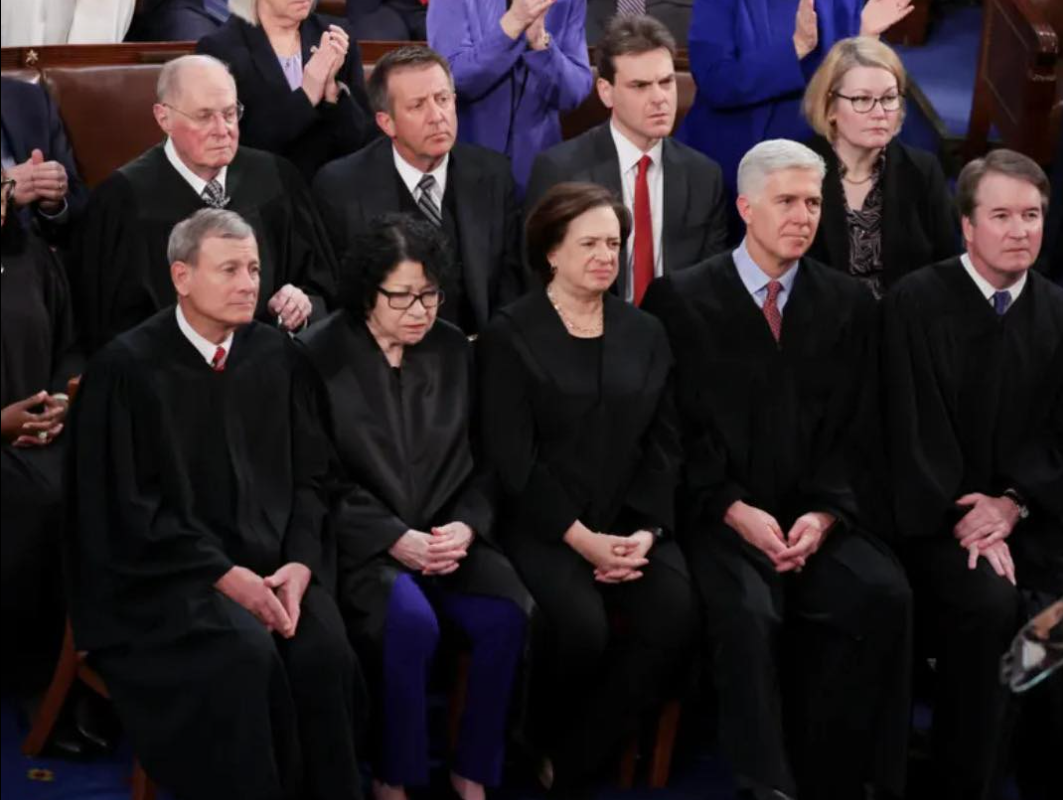
The warning shot didn’t just echo; it shattered every assumption about what a Senate race could mean. One obscure, low-profile race, one candidate almost dismissed as a footnote, and suddenly the very legitimacy of the Supreme Court itself became the central issue on ballots across the state. Graham Platner, a former Marine who turned to oyster farming after leaving active duty, wasn’t making promises about local infrastructure, healthcare, or even the economy. Instead, he laid out a vision that national Democrats only whisper about behind closed doors: a wholesale remake of the Supreme Court, punishing sitting justices for decisions he deemed illegitimate, and redrawing the balance of power in Washington in ways that many considered audacious—or reckless. Allies praised it as courage, a principled stand against entrenched judicial overreach. Critics called it political arson, a reckless gamble with the nation’s democratic norms. And for ordinary voters, the message was impossible to ignore: democracy itself, Platner implied, was at stake.
Platner’s rise transformed a sleepy, routine Senate race into a referendum on the fragility of the American political system. This wasn’t about incremental change, polite compromise, or the careful checks and balances that political operatives have spent decades polishing. Platner didn’t couch his agenda in euphemisms like “rebalancing” or “judicial reform.” Instead, he spoke in the language of confrontation: subpoenas, term limits for justices, stripping the Supreme Court of jurisdiction over contentious issues like abortion and voting rights. Onstage, he named justices explicitly, painting their rulings not as legal reasoning but as “attacks” on democracy, personal affronts to the electorate, and violations of the public trust. For a state historically grounded in cautious understatement, where politics is often conducted in careful, genteel increments, Platner’s rhetoric felt like a moral siren, a political earthquake, and a cultural provocation all at once—depending entirely on the perspective of the listener.
Meanwhile, the entrenched political establishment scrambled to respond. Senators like Susan Collins leaned on the old bargain of stability, decorum, and incremental nudges—softly guiding change without rocking the boat too violently. Their strategy was clear: calm, steady governance, where disputes were managed behind closed doors, and institutional integrity remained a guiding principle. Platner, by contrast, positioned himself as a disruptor, a figure promising rupture, not reform. His victory, if it happened, would be interpreted as tacit permission for national Democrats to abandon the pretense of neutrality entirely, to wield raw power in direct response to perceived judicial overreach. It would signal that the bounds of acceptable political action had shifted dramatically, and that checks on partisan ambition could no longer be assumed.
If Platner lost, however, the outcome would carry a different kind of warning. Party leaders would interpret it as confirmation that Americans were still willing to tolerate incremental, restrained governance over bold, confrontational action. Voters’ reticence would serve as proof that the electorate feared the cure more than the disease, unwilling to gamble with institutional norms even when they seemed precariously stretched. Yet even a loss wouldn’t erase the tremors his campaign unleashed. The conversation had shifted, and the seismic possibilities he introduced—judicial accountability, the politicization of Supreme Court decisions, and the overt challenge to longstanding conventions—would continue to reverberate through both state and national politics for years to come.
Local communities, political analysts, and national observers alike were left grappling with the implications. Town halls overflowed with debate, editorials splashed warnings and praise across the media, and social media became a battleground for outrage and support alike. The issues Platner raised—once abstract concepts debated in law journals or whispered in political strategy sessions—now carried urgent, tangible consequences for every voter: questions of constitutional limits, the stability of legal precedents, and the very definition of democratic accountability.
In the end, what Platner’s candidacy revealed wasn’t simply a thirst for attention or a quest for personal power. It was a reflection of a deeper, more unsettling truth: the American political system was far more malleable—and vulnerable—than most citizens allowed themselves to imagine. One Marine-turned-oyster-farmer had managed to turn a routine Senate race into a moral and constitutional litmus test, forcing the nation to confront questions about legitimacy, authority, and the price of ideological audacity. Allies would frame him as a prophet, enemies as a pyromaniac, but history would judge the broader consequence: a quiet but undeniable shift in the perception of what democracy could withstand before its institutions themselves were tested.
And as election day loomed, every discussion, every op-ed, every campaign ad carried the same undercurrent: the balance of power in Washington had never felt so fragile, and the stakes for ordinary voters had never been higher. A single race, a single candidate, a single audacious plan—it was no longer just a campaign. It was a warning shot fired across the bow of the American political landscape, echoing far beyond one state, one election, or one ballot. The Supreme Court itself, Platner suggested, was no longer untouchable, and neither was the nation’s sense of democratic stability.